🛠 Varnish Coverage Calculator
Estimate how much varnish you need by area, varnish type, coats, and thinning options.
📏Unit System
📌Quick Presets
📐Area Input
⚙️Varnish Settings
✅ Your Varnish Estimate
📊Varnish Type Comparison
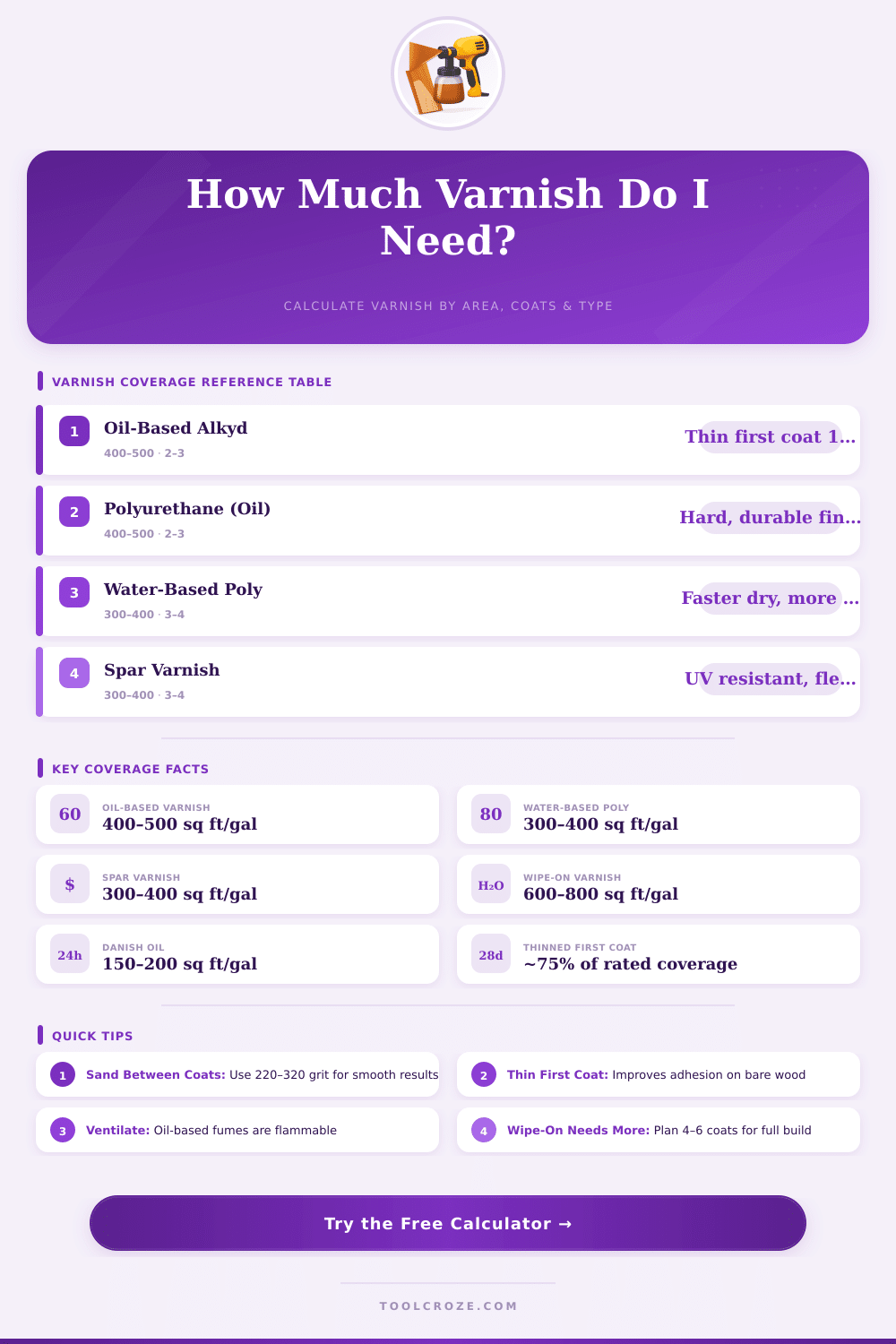
| Varnish Type | Sq Ft/Gal | Coats Needed | Dry Time | Best Use | Int/Ext |
|---|---|---|---|---|---|
| Oil-Based Alkyd | 400–500 | 2–3 | 6–8 hr recoat | Furniture, floors | Both |
| Polyurethane (Oil) | 400–500 | 2–3 | 8 hr recoat | High-traffic floors | Both |
| Water-Based Poly | 300–400 | 3–4 | 2–4 hr recoat | Light wood, cabinets | Interior |
| Spar Varnish | 300–400 | 3–4 | 6–24 hr recoat | Marine/exterior | Exterior |
| Wipe-On Varnish | 600–800 | 4–6 | 2–4 hr recoat | Detail work, trim | Both |
| Danish Oil | 150–200 | 2–3 | 6–8 hr recoat | Furniture, penetrating | Interior |
| Tung Oil | 125–175 | 3–4 | 12–24 hr recoat | Workbench, tools | Both |
🌲Wood Condition Reference
| Condition | Prep Required | Thinning Needed | Expected Absorption |
|---|---|---|---|
| New / Bare Wood | Sand 150–220 grit, clean dust | Yes, 10–15% thinner | Higher — more varnish absorbed |
| Previously Finished | Scuff-sand 220 grit, clean | Rarely needed | Normal coverage rate |
| Sanded / Stripped | Remove all old finish, 150 grit | Yes for first coat | Higher — treat like bare wood |
🖌️Application Method Reference
| Method | Coverage Note | Finish Quality | Best For |
|---|---|---|---|
| Natural Bristle Brush | Full rate, may leave brush marks | Excellent with flow-out | Flat panels, floors |
| Foam Brush/Roller | Slightly lower — some absorption | Smooth, minimal brush marks | Flat surfaces, quick work |
| Wipe-On Cloth | Very low per pass, very thin coats | Very smooth, no brush marks | Trim, detail, turnings |
⏱️Drying and Cure Time Reference
| Varnish Type | Touch Dry | Recoat Time | Full Cure | Sanding Grit |
|---|---|---|---|---|
| Oil-Based Alkyd | 2–4 hr | 6–8 hr | 7–30 days | 220–320 |
| Polyurethane (Oil) | 2–4 hr | 8 hr | 7–30 days | 220–320 |
| Water-Based Poly | 30–60 min | 2–4 hr | 3–7 days | 220–320 |
| Spar Varnish | 4–6 hr | 6–24 hr | 14–30 days | 220 |
| Wipe-On Varnish | 1–2 hr | 2–4 hr | 7–14 days | 320–400 |
| Danish Oil | 2–4 hr | 6–8 hr | 3–7 days | 400 |
| Tung Oil | 4–8 hr | 12–24 hr | 7–30 days | 400 |
💡Tips
The cover of varnish depends much on the kind of wood that one covers. How porous the wood is seriously affects how long one tin of varnish will last. Also the amount of base varnish, base and final coats matter, and one must count the cost carefully.
A bottle with 4 ounces of varnish is enough for 80 square feet on painted or smooth wooden surfaces. In rough hardwood the same amount covers around 50 square feet. For rough lumber or plywood the cover is much less only around 12 square feet.
How Much Varnish Covers and How to Apply It
Applying by brush and by spray give very different results. By brush one covers around 400 to 500 square feet per gallon. By spray the cover is twice as big, around 800 to 1000 square feet per gallon.
Spray tins allow you to cover big area quickly, which makes the work more efifcient. Some folks thin the varnish and use a big soft brush, if they do not have a spray can, and that works well also.
varnish itself is a clear protective coat, that is not the same as wood stain. It commonly has a bit yellow look because of the making process and used materials, but one can color it, if needed. For outside wood best use good bright coats of varnish with high resistance against UV rays, but one must sand and re-varnish every too years.
Some wood types do not respond well to varnish because of their oil content or rough texture, so preparing the surface well is truly important.
Getting the right thickness is a hard task. Between too thick application of varnish and thin cover exists a gentle balance. Too thick a coat can cause cracks, like shrinking and lines, when the outer layer loosens while drying.
Often it is better that the cover be a bit too thin than too heavy. One applies varnish in thin coats by cross motion, with around five minutes between every step. Extra coats can need 24 hours or more to dry, depending onthe surface.
Two to three coats usually are enough for full cover and protection. Varnish is also useful for paintings. For oil paintings one must finish with varnish, to protect the color against fading.
With acrylic paints the varnish has a different role, because acrylics do not truly need sealing. Without an isolating coat on acrylic paint, the varnish soaks into the porous surface. For artworks from paint the options include applying varnish by soft brush, using spray varnish for smooth cover or coating with an acrylic protective layer.
Online calculators help to estimate how much varnish you need for a project.