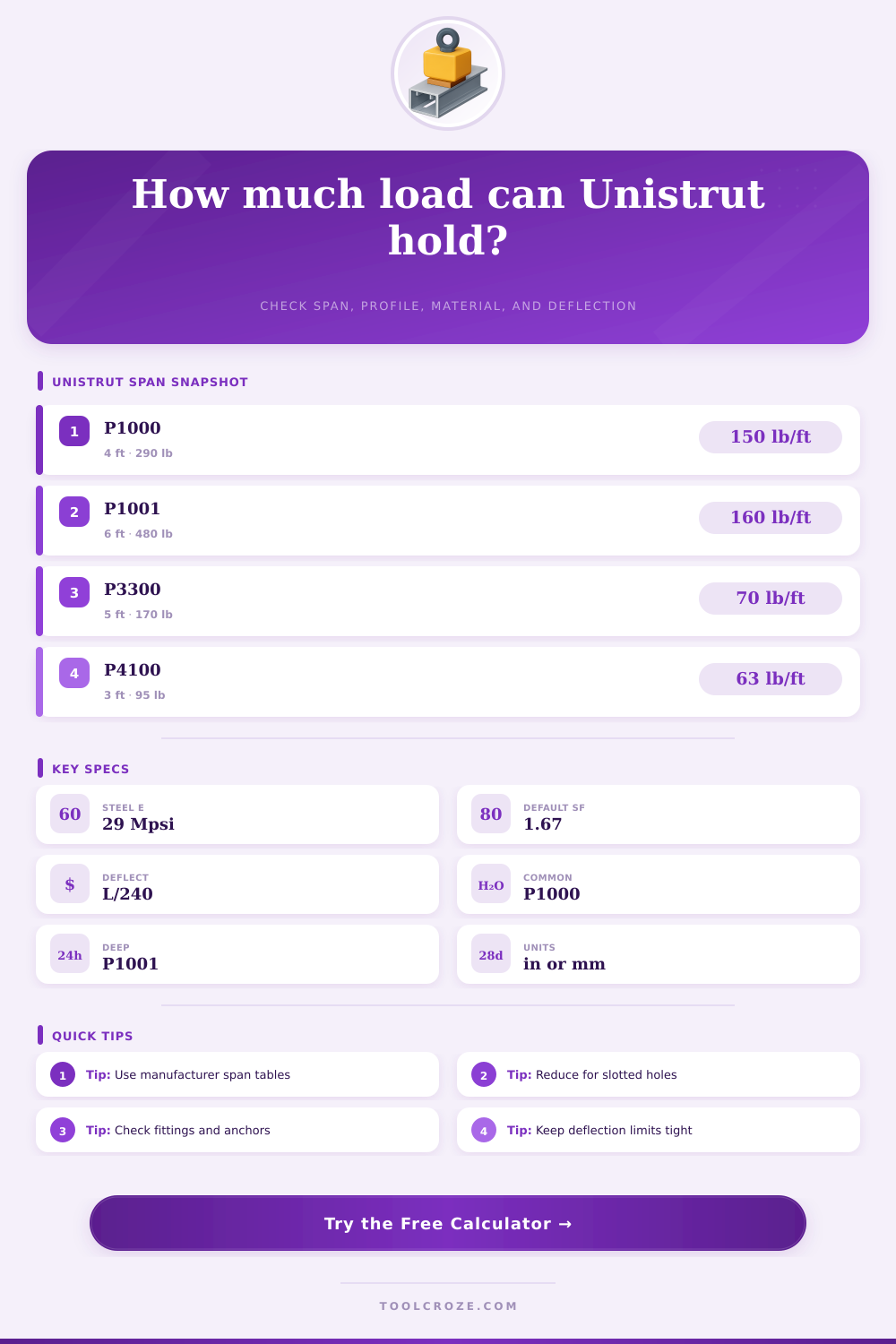
Unistrut Load Capacity Calculator
Estimate service load, deflection, bending stress, end reactions, and standalone span capacity for common strut channel profiles and support conditions.
⚙Real Unistrut Presets
📏Load Setup
🧱Selected Material / Spec Grid
📋Unistrut Channel Reference
| Profile | Approx size | Gauge | Ix strong axis | Section modulus | Weight |
|---|---|---|---|---|---|
| P1000 | 1-5/8 x 1-5/8 in | 12 ga | 0.187 in⁴ | 0.230 in³ | 1.90 lb/ft |
| P1100 | 1-5/8 x 1-5/8 in | 14 ga | 0.138 in⁴ | 0.170 in³ | 1.43 lb/ft |
| P3000 | 1-5/8 x 1-3/8 in | 12 ga | 0.151 in⁴ | 0.207 in³ | 1.71 lb/ft |
| P3300 | 1-5/8 x 7/8 in | 12 ga | 0.071 in⁴ | 0.162 in³ | 1.30 lb/ft |
| P4100 | 13/16 x 1-5/8 in | 14 ga | 0.030 in⁴ | 0.074 in³ | 0.85 lb/ft |
| P5500 | 1-5/8 x 2-7/16 in | 12 ga | 0.435 in⁴ | 0.357 in³ | 2.46 lb/ft |
| P1001 | Back-to-back P1000 | 12 ga | 1.020 in⁴ | 0.627 in³ | 3.80 lb/ft |
| P5000 | 1-5/8 x 3-1/4 in | 12 ga | 1.300 in⁴ | 0.800 in³ | 3.10 lb/ft |
⚒Material And Service Reference
| Material basis | Yield used | Modulus E | Best use | Adjustment note |
|---|---|---|---|---|
| Pre-galvanized steel | 33 ksi | 29 Mpsi | General indoor supports | Baseline capacity |
| Hot-dip galvanized steel | 33 ksi | 29 Mpsi | Exterior pipe racks | Check hole fit-up |
| Plain carbon steel | 36 ksi | 29 Mpsi | Painted frames | Higher stress basis |
| 304 stainless steel | 30 ksi | 28 Mpsi | Washdown and food areas | Slightly more deflection |
| 316 stainless steel | 30 ksi | 28 Mpsi | Corrosive environments | Verify alloy rating |
| 6061-T6 aluminum | 35 ksi | 10 Mpsi | Light instrument rails | Deflection often controls |
📐Span And Deflection Guide
| Condition | Moment formula | Deflection formula | Typical limit | Watch item |
|---|---|---|---|---|
| Simple center point | M = PL/4 | Δ = PL³/48EI | L/240 | Midspan sag |
| Simple uniform load | M = wL²/8 | Δ = 5wL⁴/384EI | L/240 to L/360 | Total load wL |
| Fixed end span | M = PL/8 or wL²/12 | Approx 20-40% simple | L/360 | End restraint quality |
| Cantilever point | M = PL | Δ = PL³/3EI | L/180 | Wall bracket and anchors |
| Cantilever uniform | M = wL²/2 | Δ = wL⁴/8EI | L/180 | End connection moment |
🔧Common Support Scenarios
| Scenario | Common profile | Load pattern | Good starting limit | Extra check |
|---|---|---|---|---|
| Pipe trapeze | P1000 or P1001 | Point plus pipe weight | L/240 | Rod and clamp ratings |
| HVAC duct support | P1000 twin rail | Uniform distributed | L/240 | Hanger spacing |
| Cable tray cross member | P3300 or P1000 | Uniform tray load | L/360 | Tray side rail load |
| Solar rack rail | P1000 stainless | Uniform plus wind | L/240 | Uplift and corrosion |
| Wall-mounted bracket | P5500 or P1001 | Cantilever point | L/180 | Anchor pullout |
💡Calculation Tips
Unistrut. If you haven’t encountered Unistrut yet, well, look around. That’s the gray metal channel screwed to ceilings and walls. You mount your light aluminum ductwork or heavier copper pipes on it.
Unistrut IS the skeleton of today’s building, but most folks believe it to be indestructible steel. Nope. The actual channel may be thin gauge metal that can bends if loaded incorrectly. Before long, you will hang a trapeze from a sagging pipe. That pipe could flood an office because you didn’t know its real capacity.
How Unistrut Works
So what does all this mean? Basically it’s an estimate to determine your profile’s load carrying capacity over some distance. And it figures the deflection limits for you. You don’t have to worry if L/240 is too floppy. You won’t have to look up the section moduli either. But there are no guarantees that any number on a computer screen equates to reality in the field.
The true limiting factor isn’t always structural failure of the channel. More often it’s the anchor pullout in concrete or slipping at the connection. A stiff strut with nuts hanging by a thread is still nothing but a loose piece of hardware.
The first mistake is typically selecting the incorrect profile. For simple light pipe runs, P1000 is the go-to workhorse. But it’s not designed to handle large HVAC units all by itself. You can step up to a deeper profile like P5000 (or double them in back-to-back) if you want some extra meatiness. A quick glance at reference table on the page tells you how that depth jump translates to resistance to rotation. And that added depth purchases stiffness. Stiffness keeps things level under load.
The result also depends on material selection. Galvanized steel is strong but heavy. Aluminum are lightweight but deflects more since its stiffness is so low. Even though aluminum doesn’t break, it may bend out of position and that’s bad if you’re trying to support sensitive equipment that requires exact alignment. So again don’t just look at deflection strength but rather deflection limit. A channel that holds weight but sags noticeable is a failure.
The limit to deflection depends on what it is sitting on. Plumbing is good with L/240. Glass partitions or sensitive equipment are OK up to L/360 or smaller. Use the calculator to modify that. For applications where there is pump vibration or wind uplift on solar racks, you would of want to be more strict in your requirements. Dynamic loads fatigue connectors more quickly then static loads ever will. People don’t realize that.
With cantilevers, it’s trickier: There are huge bending moments applied where the strut meets the anchor point, on a bracket extending from a wall. These calculators accounts for that situation, too, but you have to rely even more heavily on your anchor than the strut. Even with most ideal-looking channel, brittle masonry can pull right through your concrete wedge anchors. Always verify the pullout rating independently.
A 1.67 is the default factor for normal service conditions. Increase it when you’re unsure about load, or if there’s corrosion that will erode the material over decades. Better safe now than trying to explain why it collapsed later on.
In the end, then, this all comes back to balancing: you have cost, weight, stiffness, and strength to juggle. And the tool helps you get to the sweet spot between a costly and a safe design. But never forget that there is no substitute for judgment when using any spreadsheet. Go walk the building. Look where the supports are realy put in place. Observe if something sags that didn’t before. Rely just as much on your own eyes than your calculations. Understanding how things stay up will make you stop being afraid of the structure, and instead begin to respect it.
Those gray channels overhead aren’t some magic. They’re physics made real. Respect ‘em accordingly.