
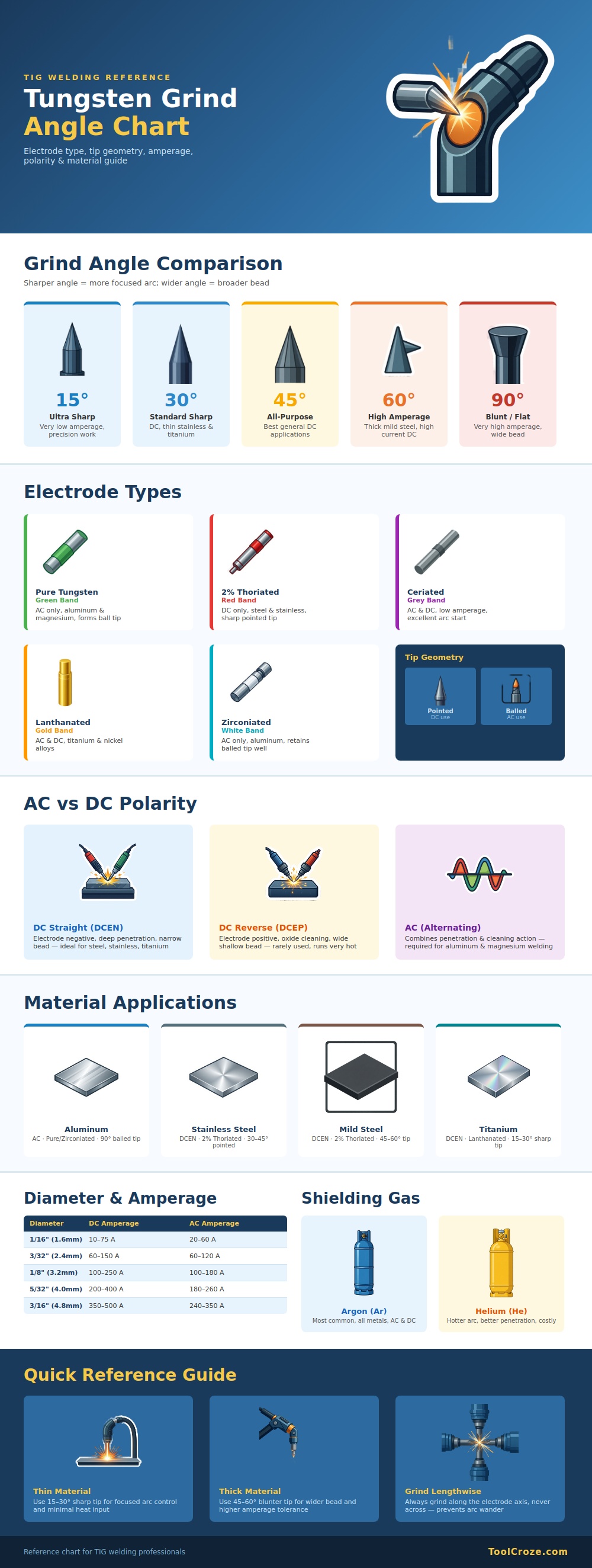
The angle of your tungsten tip is what causes the arc to wander from its target. For most welders, grinding is a chore but it’s also about geometry. That point controls how much heat energy will concentrate. It also determines how it works whether you are laying down puddle or performing delicate surgery.
Depending on your goal, this angle varies between sharp and blunt which you can see in visual chart. A fifteen-degree angle is like a laser pointer. It is precise. Starts well on low amps so good for things like corners or thin sheet metal. But the sharp point are a weakness because it melts at high current. Push a lot of juice in a tiny tip and it will ball up and fall apart.
## How to Grind Your Tungsten Tip Correctly
For heavy stuff, wider angles is advised to let off some heat. Sixty degree angle produces a fatter surface area that lets you run higher amps without melting down electrode into a molten glob. Trade-off is reduced precision as you get more stable. But this isn’t a matter of preference; it’s a function of what you’re welding.
AC power breaks down the oxide coating on aluminum, and alternating current allow the tip to build a little ball as it goes through the cycle. The arc then stabilizes. You can’t hold a sharp point on aluminum. You will let it ball up. Tungsten that is pure or zirconiated are good for this application due to its ability to retain its shape under thermal stress.
Stainless or steel electrodes will be DC negative current, which keeps the heat concentrated in the workpiece rather than the electrode. The electrode stay sharper longer this way. Thoriated tips can takes a lot of current while retaining their shape. Standard stainless is good at about a thirty- or forty-five degree angle where it penetrates well but doesn’t erode instantly. Make it wider (sixty degrees) on thick mild steel and get deeper fusing power from the higher amperage needed.
Grinding in the wrong direction are a mistake that will ruin an otherwise good grind. Grind lengthwise along electrode with the grooves running parallel to the axis. Grinding across will create tiny ridges which is like rails for the arc. It’ll jump from ridge to ridge causing erratic and unstable behavior. Grind lengthwise and you have a smooth surface and a centered beam. Getting the angle correct take longer but saves you frustration later on.
Another factor is what gas you use. For aluminum it’s normaly argon as that will give you a good cleaning action and a stable arc. If you want to add some heat to penetrate thicker material even with a duller tip, you would of use helium. However, helium require higher flow rates and is more costly. Most folks just stay with argon unless they need a solution for a thermal issue.
TIG welding is all about controlling your heat input, and the one way we have most control over it is the grind on our tungsten. A blunt tip will spread out the heat while a sharp tip will concentrate it. Match the shape of your electrode with current you plan to run and thickness of material. Doing so eliminates wandering arcs. The weld stays in place and follows exactly where you want to lay the bead.
