Tree Board Foot Calculator
Estimate standing timber board feet from DBH, merchantable height, taper, bark, and form class. Compare log rules and net recovery.
🌳Preset tree scenarios
🔧Tree inputs
📊Results
Full breakdown
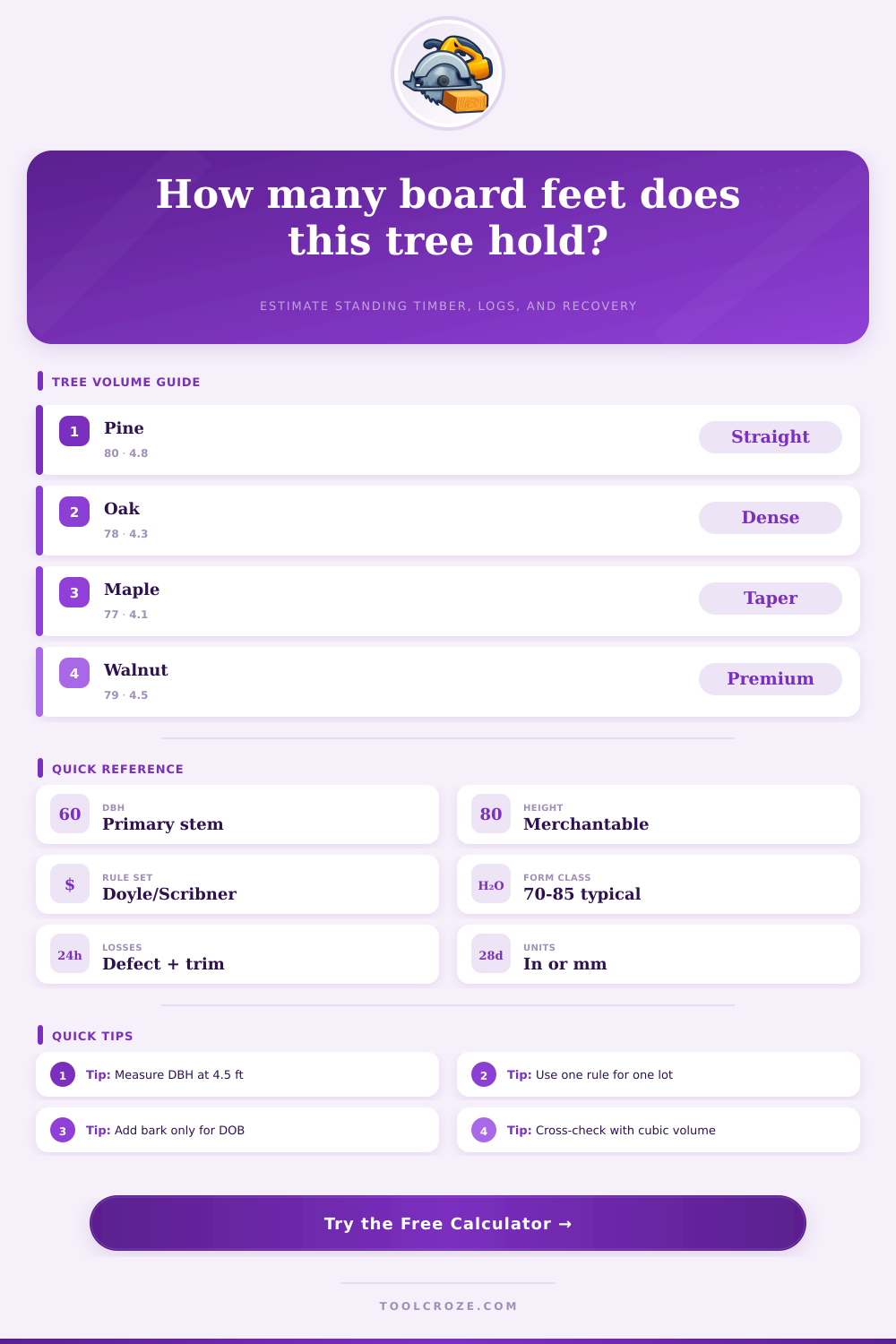
🌳Species recovery guide
📈Rule comparison
| Rule | Formula shape | Bias | Best fit |
|---|---|---|---|
| Doyle | ((D - 4)^2 x L) / 16 | Low on small stems | Rough checks |
| Scribner | (0.79D^2 - 2D - 4) x L / 16 | Middle ground | Common mill use |
| Intl 1/4 | (0.22D^2 - 0.71D - 1) x L / 8 | Closer on small logs | Fine-grain estimate |
| Cubic cross-check | Area x length x factor | Volume-first | Sanity check |
📈Form class guide
| Form class | Shape | Use | Hint |
|---|---|---|---|
| 70 | Heavy taper | Conservative | Short bole |
| 75 | Average taper | Mixed stands | Common default |
| 80 | Good form | Sawtimber | Most presets |
| 85 | Very straight | High yield | Clear stems |
📈Common tree examples
| Tree | DBH | Height | Typical output |
|---|---|---|---|
| Young pine | 12 in | 40 ft | About 80 BF |
| Yard oak | 18 in | 50 ft | About 180 BF |
| Backyard maple | 16 in | 45 ft | About 140 BF |
| Large walnut | 24 in | 60 ft | About 350 BF |
💡Tips and safety
Board foot is unit for the volume of cut wood in United States and Canada. It served as main measure for logs and trees used to veneer or lumber. In various construction works you use every kind of such volume.
They range of structures until furniture. Also sawtimber you estimate and will sell by means of board feet.
What Is a Board Foot and How to Measure It
One board foot matches to solid wood in 1 inch thickness, 12 inches wide and 12 inches long. That same to one square foot of wood thick in one inch. The American definition estimates it in 144 cubic inches wood.
Every piece of wood with so much content you consider one board foot. More easily you imagine it as 12-inch square thick in one inch. At 4/4 stock piece in 12 inches wide, 12 inches long and 1 inch thickness is one board foot.
For instance, 2 linear feet of 1-inch stock wide in 6 inches also form one board foot.
For estimate board feet in standing tree you measure first their usable heights and diameters. The volume of log or tree shows how many board feet lumber you can from it cut. Like this you measure the amount of usable wood from logs.
You count that by means of multiply of the length and diameter by means of scaling factor. Many tables help to give the board foot volume of tree. It depends of the tree size.
For board feet in cut board you multiplies thickness, wide and long in inches, later divide by means of 144. For instance for 2 of 6 of 96 inches: (2 × 6 × 96) ÷ 144 match 8 board feet. If length is in feet, divide by means of 12 instead of 144.
A Tree Board Foot Calculator helps to estimate how many board feet wood you can receive from tree trunk or logs. It bases on rules as formulas. Between them are the Doyle rule, Scribner rule and International 1/4-inch rule.
A board foot rule calculator estimates yield from logs by means of Scribner or Doyle. It also estimates standing trees by means of adaptations of Doyle, Scribner and International 1/4-inch rule. Some even takes in account 1/8-inch kerf.