Treated Lumber Weight Calculator
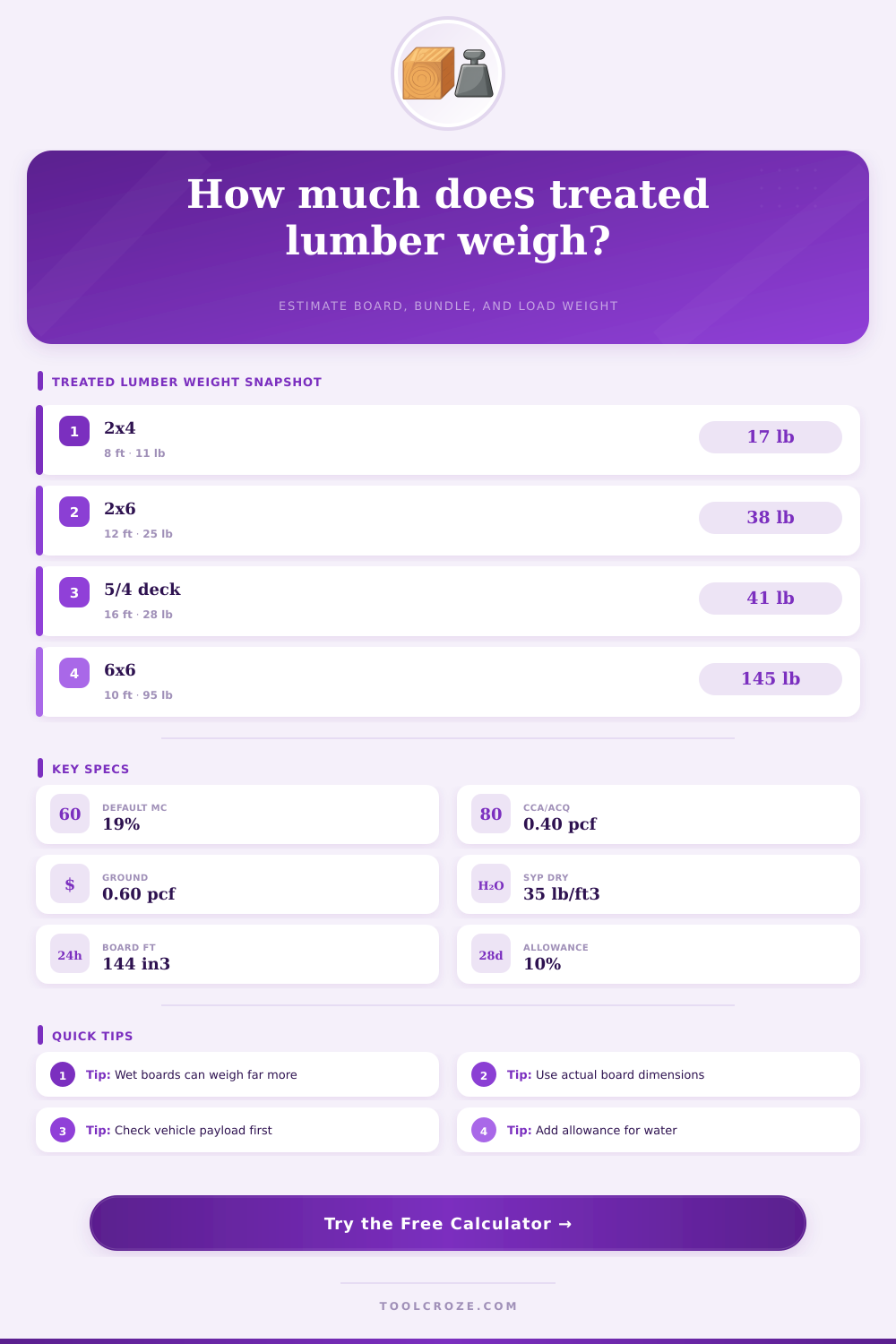
Estimate pressure treated board weight, bundle weight, board feet, and handling load from actual size, length, species density, treatment retention, moisture content, and quantity.
⚙Real Treated Lumber Presets
📏Lumber Size, Treatment, and Moisture
Treated Lumber Weight Results
🪵Current Material Summary
📊Common Treated Lumber Size Reference
| Nominal size | Actual size | Volume per 8 ft | Typical treated use |
|---|---|---|---|
| 2x4 | 1.5 x 3.5 in | 0.292 ft³ | Deck blocking, fence rails, framing |
| 2x6 | 1.5 x 5.5 in | 0.458 ft³ | Deck joists, stair stringer stock, rails |
| 2x8 | 1.5 x 7.25 in | 0.604 ft³ | Ground contact joists and beams |
| 5/4x6 | 1.0 x 5.5 in | 0.306 ft³ | Decking boards and stair treads |
| 4x4 | 3.5 x 3.5 in | 0.681 ft³ | Fence posts, deck posts, rail posts |
| 6x6 | 5.5 x 5.5 in | 1.681 ft³ | Retaining walls, heavy posts, timbers |
🌳Species Density and Moisture Reference
| Species group | Base density at 12% MC | Typical treated stock | Weight behavior |
|---|---|---|---|
| Southern yellow pine | 35 lb/ft³ | Decking, posts, structural framing | Dense, often heaviest softwood option |
| Douglas fir-larch | 32 lb/ft³ | Framing, beams, utility lumber | Moderate weight with strong grain |
| Hem-fir | 30 lb/ft³ | Posts, rails, framing in some regions | Slightly lighter than Douglas fir |
| SPF | 28 lb/ft³ | General pressure treated framing | Light to moderate dry weight |
| Western red cedar | 23 lb/ft³ | Rails, outdoor trim, specialty boards | Light, but water can still add load |
| White oak | 47 lb/ft³ | Specialty exterior timbers | Very heavy before treatment water |
🔬Treatment Retention and Service Category
| Treatment category | Retention used | Common exposure | Calculator effect |
|---|---|---|---|
| Above ground UC3B | 0.25 pcf | Deck boards, rails, trim | Adds light preservative mass |
| Ground contact UC4A | 0.40 pcf | Posts, joists, landscape contact | Default treated lumber allowance |
| Heavy duty UC4B | 0.60 pcf | Fresh water, severe decay zones | Higher preservative loading |
| Marine splash UC5A | 2.50 pcf | Docks, brackish splash zones | Large treatment weight addition |
| Fire-retardant treated | 1.50 pcf | Code-specific exterior assemblies | High chemical retention estimate |
🚚Typical Project Loads
| Project bundle | Example pieces | Likely weight range | Handling note |
|---|---|---|---|
| Small stair repair | 6 pcs 2x6x8 | 85 to 135 lb | Usually manageable by hand |
| Fence post run | 12 pcs 4x4x8 | 300 to 510 lb | Check trailer tongue load |
| Deck board order | 40 pcs 5/4x6x16 | 1100 to 1650 lb | May exceed light pickup payload |
| Retaining timber set | 10 pcs 6x6x10 | 950 to 1450 lb | Use mechanical help for unloading |
💡Weight Calculation Tips
There’s a particular point in deck construction where it stops being about linear footage of lumber and starts getting into your gross vehicle weight. There you stand in the driveway looking at a pile of timber six-by-sixes pressure treated and think yeah I can lift these by hand…they’re not too heavy. But they’re basically concrete blocks filled with water. Species density and moisture content make the difference between a broken axle and a day well spent. And there lies the rub. People fail to account for this. You purchase wood and see what it weighs in textbook. You assume that is how much it weighs, and then you ask why your pickup truck won’t go over a speed hump.
That’s what this page’s calculator does: close that distance between eyeballing it and the reality. No, it doesn’t provide a single board dimension. Instead, it adds everything up, including the moisture content in the pile, the wood species, chemical retention required by your building code, and the exact board dimensions, and then gives you actual number. You pick your “nominal” dimension from the drop-down list, and the tool assumes the real-world dressed sizes (because planed lumber is much less different than indicated on its sticker). Those few inches missing from a two-by-four’s cross section multiplies quickly when you’re carrying twenty of them at once.
Why You Need This Wood Weight Calculator
This is the reality: most homeowners don’t know how important species are when it comes to deck boards. For example, dense southern yellow pine can weighs as much as thirty-five pounds per cubic foot before we add chemicals. By contrast, western red cedar has a density more like balsa wood at about twenty-three pounds per cubic foot. That’s a huge difference if you change species while maintaining same number of boards. The tool knows the base wood densities and factors them in. Then it tacks on extra weight of preservatives needed because ground-contact lumber must be more heavily treated than framing lumber used above ground. All those chemicals are heavy salts in liquid form that replace air within the wood fibers, where they will remain. That’s why treated wood might weigh more then an equal volume of untreated green wood, the treatment itself contributes weight.
The wild card is moisture. Wood straight off the production line are soaked wet. Some will have moisture levels over thirty percent. Your boards come on the truck carrying excess water. This water is not from chemical or from the wood itself, but just plain old H2O. You’re picking up and paying for a bunch of free water if you take it right out of yard. That water evaporates as time passes (and the pile dries off in the yard), shrinking the boards a little and reducing their mass quite a lot. The calculator allows you to change moisture number so you can model both wood that was just hauled out of the yard and wood that has been drying in the sun for a while. A tiny change in the input box alters results by dozens of pounds per entire bundle.
Another useful tool is handling allowance. Driving on a nice even road and loading the truck perfectly never happen. Having an additional 10-15% over your estimated weight will keep you within your vehicle’s maximum safe payload capacity. That cushion includes things like tarp weight, strap weight, random pieces of wood that you might leave in the back of the truck. That way when you get on the scale, you’re not sitting exactly at your maximum while risking maxing out your suspension.
The thing with DIY projects: Most don’t fail because of bad design, they fail because of ignored logistics. Can’t get those timbers to where you want them? Then you can’t build that retaining wall. Knowing the true weight before you head out will save your vehicle and some time.
The reference tables are meant to put things into context (i.e., show you how much a given size weigh at various lengths and uses). They’re a way to double-check your estimating. If in doubt, go heavier and wetter. It’s a bit more up front planning but could of save having a very heavy lift further along.