
Ever get frustrated when a screwdriver turns into a round bit and rounds out the fastener it’s trying to turn? It happens with haste, you’re in a hurry or you’ve got the wrong tool for the job, or maybe the right tool just doesn’t fit your need. That’s where Torx screws come in.
Instead of four-point contact of traditional Phillips screwheads, Torx screws has six points of contact. This distributes the torque more evenly, which keeps the driver firmly engaged even when turning under heavy pressure. Because it works great in delicate internal components of smartphones and on pickup truck suspension bolts, you’re seeing these screws all over the place now.
Everything You Need to Know About Torx Screws
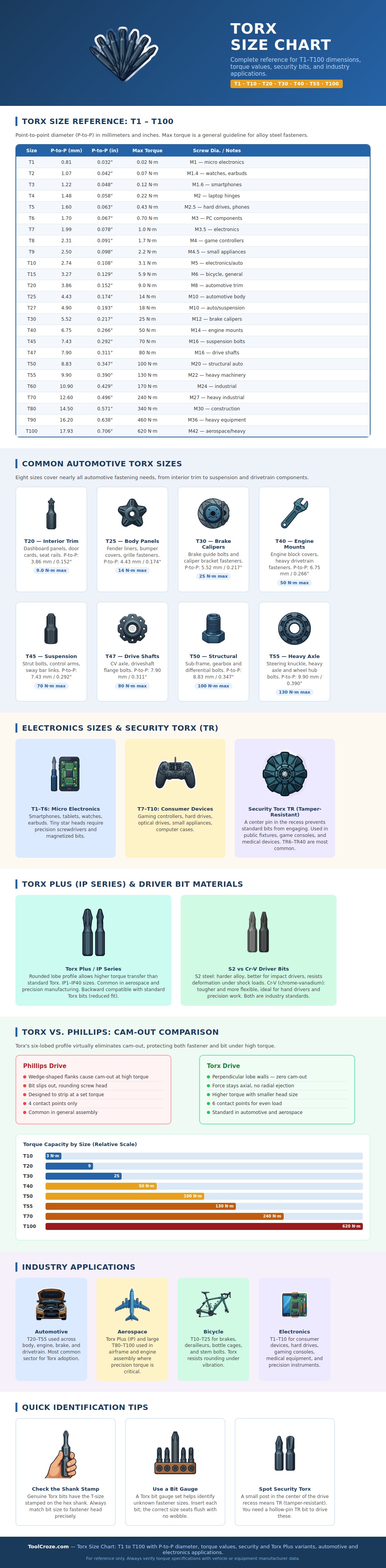
As you can see in the chart above, they range from tiny T1 bits for medical device screws to huge T100 driver bits for space craft assembly. At first glance it may be overwhelming, but after a moment looking at the sizes you’ll notice the pattern; the size matches the size of the star itself as measured between points. So the larger the number is the larger the star, which usually equates to a beefier fastener shaft and greater ability to carry torque.
For auto work, you’ll only really need about half of what’s here. T20 to T45 are the most common sizes for just about all car work. A T20 bit is probably the one you’re using to take off your door panels or other interior trim, soft tasks where you don’t need to apply a ton of force. When it comes to oil pan bolts or calipers on brakes in engine bay, those tend to be T30 or T40 bit sizes. They require precision because over-tightening warps things, but they still need to grip enough to hold up over time despite highway vibration.
The graphic also shows where certain sizes group toward particular uses which makes an easy mental shortcut for creating a kit of your own. And then there’s the other pace: electronics repair. Those T1-T6 sizes is so small they’re more showy than useful, more star than tool. They’re what holds your hearing aid or laptop or gaming controller together. The danger isn’t over-torqueing a screw, it’s cracking the tiny bit off inside its hole after forcing the slightly incorrect-sized screw in place. In this world, precision trumps brute force.
And you’ll see a variant of these Torxes (labeled R or TR for security) sporting a little pin through their centers, keeping regular bits from grabbing on. They are used by manufacturers who want to stop curious fingers and thus require a special hollow-pin driver should you wish to pop open some public fixture or game console.
The material matters more than most hobbyists know: A normal steel (chrome-vanadium) is soft enough to bend when used as a hand tool but stiff enough not to be a problem. Bits made of this will dent under a shock load like an impact driver applies. For that reason, power tool bits are now standard in a harder, tougher S2 steel. When repeatedly hit with hammer, this keeps the star point nice and sharp, ensuring good engagement. There’s no faster way to kill your fastener and bit than by using a cheap one on an expensive impact wrench.
Torq Plus (or IP) series is also available, and this version has rounder lobes than the standard Torx screws that have sharper points. By rounding out the lobe the higher level of torque can be transferred without tearing up the screw head so it’s taken off in applications like high performance bicycles as well as aircraft. The bits are backward compatible though they fit slightly looser on regular screws. This is a tiny bit of engineering that makes a huge difference when you’re screwing down critical parts of structure.
Respecting the physics of the joint means matching the bit to the screw. No matter how carefully you apply pressure, a worn-out driver will always destroy a new screw. You should of checked the fit first. Make sure your bits are sharp and clean, check the size beforehand, and let the geometry do the work for you. Trust that six-pointed star; it was designed to stay put, so use the right tool every time.
