
There’s always a point where you think the task is complete; that point when your gut tells you it isn’t. Typicaly this occurs after several hours tinkering with engine parts of a car. After cranking down every bolt as hard as possible, you’re feeling sure of yourself and confident everything is tight and secure. Yet there remains a vibration in the wheels at cruising speed or oil seeping out from the head gasket.
Rarely is issue one of insufficient labor. Rather, it’s a matter of unseen forces, those of friction and those of clamp load. For many, the torque wrench is merely a yard stick: turn it till it reads so-’n-so and you are golden. It couldn’t be more incorrect. Tension is not torque. Much of your force are lost to friction before it even reaches the threads.
Why Torque Specs Matter for Safe Repairs
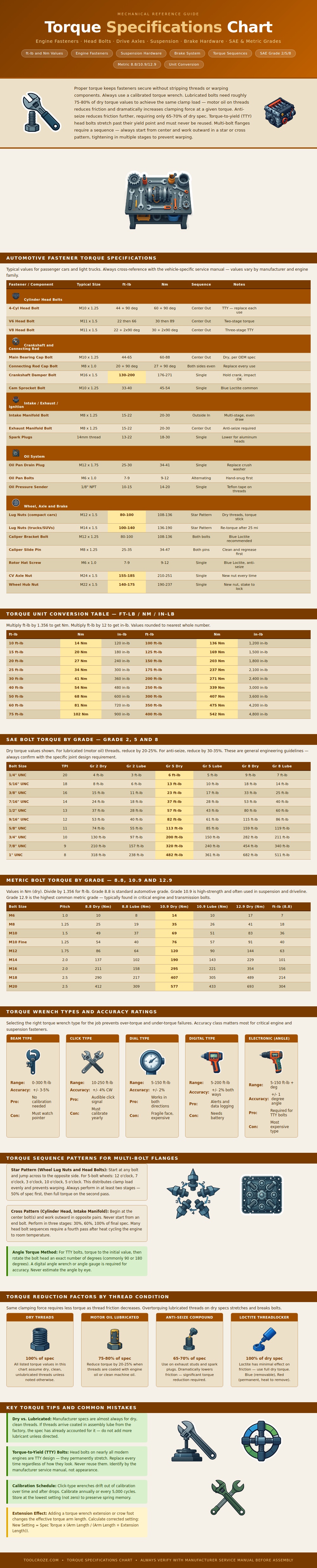
This doesn’t even cover every possible automotive fastener out there (see the breakdown above), but that’s not what this is about. Knowing the number is one thing, but understanding what it means is another. Why did they come up with 80 ft-lbs for tightening an oil pan, or 65ft-lb for a cylinder head bolt on a V6 engine? The answer is often a two-step operation in which you tighten to some modest foot-pound amount first and then turn the bolt a certain angle. This stretch the bolt beyond its yield point. You then use springiness of the metal to keep the clamping force instead of relying on friction of the threads. It is a very fine balance between material science and engineering precision.
The whole equation changes with lubrication. The torque reference guide focuses on modifying numbers based off the use of lubricants like oil or anti-seize. Use dry torque specs on a greasy bolt and you’re gonna break it off. Why? Because there’s less drag, so more of your turning effort get put toward pulling that bolt apart as opposed to pushing through resistance. Before you hit the number on your wrench, you could of end up breaking off a key fastener. And that’s where folks miss the boat. When they see that lube, they think, “It’ll make this task easier.” But in the world of torque mechanics, easy is bad unless you compensate by altering your settings. When bolts has oil on their threads, always back off 20-25% on your goal.
Next comes issue of order. A star-pattern is necessary for things like a wheel lug nut or a flange bolted on tight, beginning with the inside, working your way out. Going around in a circle causes warping, leading to spaces where nothing can be tightened down enough. The diagram spells this out nicely (and it’s not just a multiple bolt situation. It asks that we use a crisscross rhythm to spread the load evenly). So instead of one spot having to take the full blow until all others are fastened, it avoids distorting the piece.
Just as important as the spec is the proper tool for the job. Old school, reliable, springless beam wrenches never goes out of calibration. Popular and efficient click-type wrenches need service annualy to stay accurate. For torque-to-yield bolts that stretch permanently when installed, a digital angle wrench is not negotiable. Eyeballing your way to an accurate 90-degrees isn’t good enough to avoid failure.
So, to wrap it all up: Torque specs aren’t just recommendations. They’re a manufacturer’s statement of the exact amount of force they believe the part can take without failure. Calibrate your tool. Follow the torque sequence. Take lubrication into account. Respect the number. You’ll be able to walk away from a repair knowing that the assembly will hold when it needs to. And you won’t have to rely on muscle memory to know why; you’ll know the inner workings of what makes that wrench turn. With proper torque, your fastener stays where it belongs without stripping threads or deforming parts. You go from gambling to being more certain than before.
