🔧 Torque Ratchet Extension Calculator
Calculate the correct torque wrench setting when using an extension or crowfoot attachment
| Extension (in) | Correction Factor | Set Wrench To (for 100 ft·lb target) | Set Wrench To (for 100 N·m target) |
|---|---|---|---|
| 2 | 0.900 | 90.0 ft·lb | 90.0 N·m |
| 3 | 0.857 | 85.7 ft·lb | 85.7 N·m |
| 4 | 0.818 | 81.8 ft·lb | 81.8 N·m |
| 6 | 0.750 | 75.0 ft·lb | 75.0 N·m |
| 8 | 0.692 | 69.2 ft·lb | 69.2 N·m |
| 10 | 0.643 | 64.3 ft·lb | 64.3 N·m |
| 12 | 0.600 | 60.0 ft·lb | 60.0 N·m |
| 18 | 0.500 | 50.0 ft·lb | 50.0 N·m |
| Application | Target Torque (ft·lb) | Target Torque (N·m) | Typical Extension |
|---|---|---|---|
| Lug Nuts (passenger car) | 80 – 120 | 108 – 163 | 6 in |
| Lug Nuts (truck/SUV) | 120 – 165 | 163 – 224 | 6 in |
| Spark Plugs (aluminum head) | 13 – 20 | 18 – 27 | 3 – 6 in |
| Oil Drain Plug | 20 – 30 | 27 – 41 | 0 – 3 in |
| Cylinder Head Bolts | 65 – 95 | 88 – 129 | 6 – 10 in |
| Brake Caliper Bolts | 35 – 55 | 47 – 75 | 4 – 6 in |
| Axle/Hub Nut | 130 – 200 | 176 – 271 | 6 – 10 in |
| Harmonic Balancer Bolt | 180 – 220 | 244 – 298 | 6 – 12 in |
| Transmission Pan Bolts | 10 – 15 | 14 – 20 | 4 – 8 in |
| Control Arm Bolts | 110 – 150 | 149 – 203 | 6 – 10 in |
| ft·lb | N·m | ft·lb | N·m |
|---|---|---|---|
| 10 | 13.6 | 100 | 135.6 |
| 20 | 27.1 | 120 | 162.7 |
| 30 | 40.7 | 150 | 203.4 |
| 40 | 54.2 | 175 | 237.3 |
| 50 | 67.8 | 200 | 271.2 |
| 75 | 101.7 | 250 | 339.0 |
When you use a torque wrench with an extension, the extension change the amount of torque that is applied to the fastener. The extension increases the length of the torque wrench. An increased length of the torque wrench increase the amount of leverages that is applied to the fastener.
The increased leverage caused by the extension mean that the torque wrench will apply more force to the fastener than the setting on the torque wrench. Failure to adjust the torque wrench setting for the extension may lead to over-torquing of the fastener. Over-torquing of a fastener can strip the thread of the fastener and components like rotors or aluminum heads can warp or crack as a result.
How to Adjust a Torque Wrench with an Extension
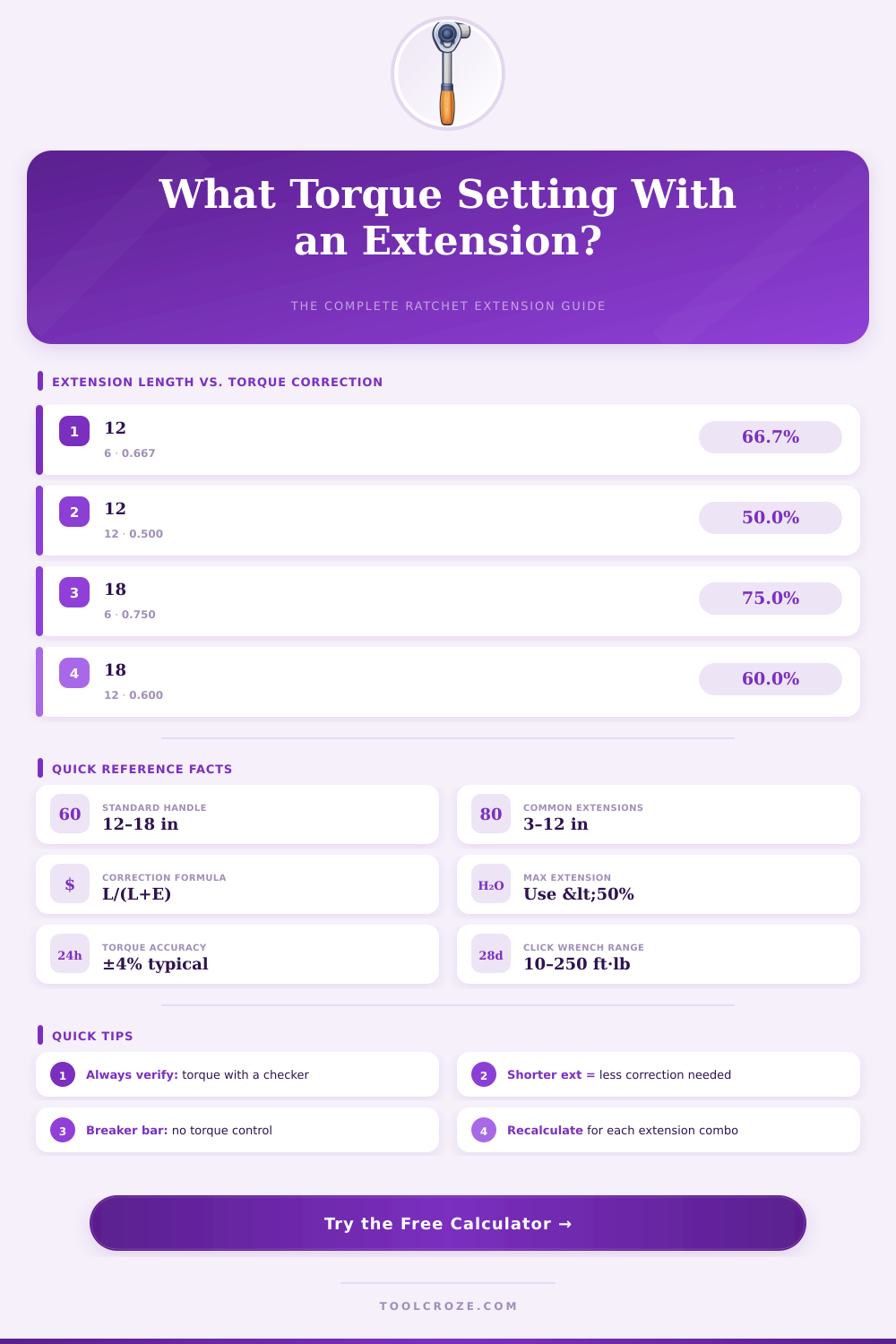
In order to calculate the correct setting for the torque wrench with an extension attach, it is first necesary to understand the relationship between the length of the torque wrench handle and the length of the extension. The length of the handle of the torque wrench and the length of the extension create a new total length of the tool that will be applied to the fastener. You can divide the length of the handle of the torque wrench by the total length created by the extension and the handle to determine the adjustment factor for the torque wrench.
For instance, if the torque wrench handle is 12 inches in length and the extension is 6 inches in length, the total length of the tool is 18 inches. 12 inches can be divided by 18 inches to determine the adjustment factor. Multiplying the target torque for the fastener by this factor will reveal the correctly setting for the torque wrench.
If the target torque is 100 foot-pounds, the extension will require the torque wrench to be set to 67 foot-pounds (100 divided by 1.36) to compensate for the extension. Most types of torque wrenches require the same mathematical adjustments to account for the extension attached to the tool. The click torque wrench, the beam wrench and the digital torque wrench will all apply more force to the fastener when an extension is attached to the tool.
However, you should take care in the use of crowfoot wrench. Crowfoot wrenches apply the force to the fastener at a different angle then the fastener. A crowfoot wrench set to a 90 degree angle will have different mathematical calculations applied to the torque wrench than a straight extension attached to the wrench.
Care should also be taken to ensure that the proper units of measurement are used when using a torque wrench. Some fasteners require the application of a certain amount of torque in foot-pounds while other fasteners require a certain amount of torque in newton-meters. Using the incorrect units of measurement will result in the application of the incorrect amount of torque to the fastener.
One foot-pound is equal to 1.36 newton-meters. Avoid using a breaker bar to apply torque to the fastener. Breaker bars are not designed to apply torque to the fastener and dont have a torque setting to allow for the measurement of the force applied to that fastener.
Accuracy of the torque wrench is important, espesially when working on critical components of the vehicle. The margin for error of a torque wrench can lead to significant problems in the vehicle if the fastener is over-torqued or under-torqued. Cheap extension for torque wrenches can introduce additional error into the measurement of the torque being applied.
It is best to use an extension shorter than half the length of the torque wrench handle. The longer extension should not apply significant force to the fastener as the extension may bend under that much force. When an extension is used, the setting of the torque wrench should of been recalculated.
Any change in the extension changes the total length of the tool. To ensure that the fastener receives the correct amount of torque, the setting on the torque wrench must be changed when changing the extension of the tool.