Torque Multiplier Calculator
Calculate torque wrench setting, delivered output torque, reaction arm load, bolt preload estimate, drive utilization, and adapter losses for multiplier bolting work.
Final torque wanted at the socket after multiplier losses.
Used to predict delivered torque if you already know the setting.
Planetary gear losses commonly place real efficiency near 82% to 94%.
Torque Multiplier Results
| Multiplier class | Typical ratio | Practical output range | Common work |
|---|---|---|---|
| Compact wheel service | 3:1 to 4:1 | 300 to 900 lb-ft | Wheel nuts, axle nuts, field service |
| Flange bolting | 4:1 to 7:1 | 600 to 1800 lb-ft | Pipe flanges, vessel covers, pump bases |
| Heavy industrial | 7:1 to 12:1 | 1200 to 3500 lb-ft | Mining, track pads, large gearboxes |
| High-output anchor | 12:1 to 25:1 | 2500 to 10000 lb-ft | Tower anchors, press frames, crusher liners |
| Output torque | 6 in arm | 12 in arm | 18 in arm |
|---|---|---|---|
| 500 lb-ft | 1000 lb | 500 lb | 333 lb |
| 1000 lb-ft | 2000 lb | 1000 lb | 667 lb |
| 2500 lb-ft | 5000 lb | 2500 lb | 1667 lb |
| 5000 lb-ft | 10000 lb | 5000 lb | 3333 lb |
| Output drive | Typical hand-tool rating | Metric equivalent | Use note |
|---|---|---|---|
| 3/8 in | 150 lb-ft | 203 N-m | Light service only |
| 1/2 in | 400 lb-ft | 542 N-m | Automotive and shop work |
| 3/4 in | 1200 lb-ft | 1627 N-m | Truck and flange work |
| 1 in | 2500 lb-ft | 3389 N-m | Heavy equipment work |
| 1-1/2 in | 7000 lb-ft | 9491 N-m | Large industrial bolting |
| 2-1/2 in | 18000 lb-ft | 24405 N-m | Very high torque tools |
| Fastener / thread state | Typical K factor | Preload formula | Best calculator use |
|---|---|---|---|
| Waxed or controlled lubricant | 0.10 to 0.12 | F = T / Kd | Critical calibrated bolting |
| Moly or heavy oil | 0.12 to 0.15 | F = T / Kd | Flanges, studs, pressure joints |
| Light oil or plated | 0.15 to 0.18 | F = T / Kd | General machine assembly |
| Dry clean steel | 0.18 to 0.20 | F = T / Kd | Structural and field bolts |
| Rough dry threads | 0.20 to 0.22 | F = T / Kd | Inspection estimate only |
| Scenario | Target torque | Ratio and efficiency | Check closely |
|---|---|---|---|
| Heavy bus wheel nuts | 450 to 500 lb-ft | 3:1 at 92% | Socket seating and wheel spec |
| Pickup axle nut | 250 to 350 lb-ft | 3:1 at 90% | Bearing preload method |
| M24 lubricated flange | 600 to 750 lb-ft | 5:1 at 88% | Cross pattern sequence |
| Track pad bolts | 900 to 1200 lb-ft | 7:1 at 86% | Reaction surface strength |
| Large anchor studs | 2500 to 5000 lb-ft | 12:1 to 18:1 | Thread condition and elongation |
There you are: You’ve got a heavy-duty wrench in one hand and a torque multiplier in the other. In front of you is this flange bolt that looks like it’s been around the block. According to the service manual, you need to apply eight hundred pound-feet of output, but what setting do you dial on your input tool? Crank it too high and you’ll strip out the threads or snap off the stud. Turn the input down too far and your joint will leak when pressurized.
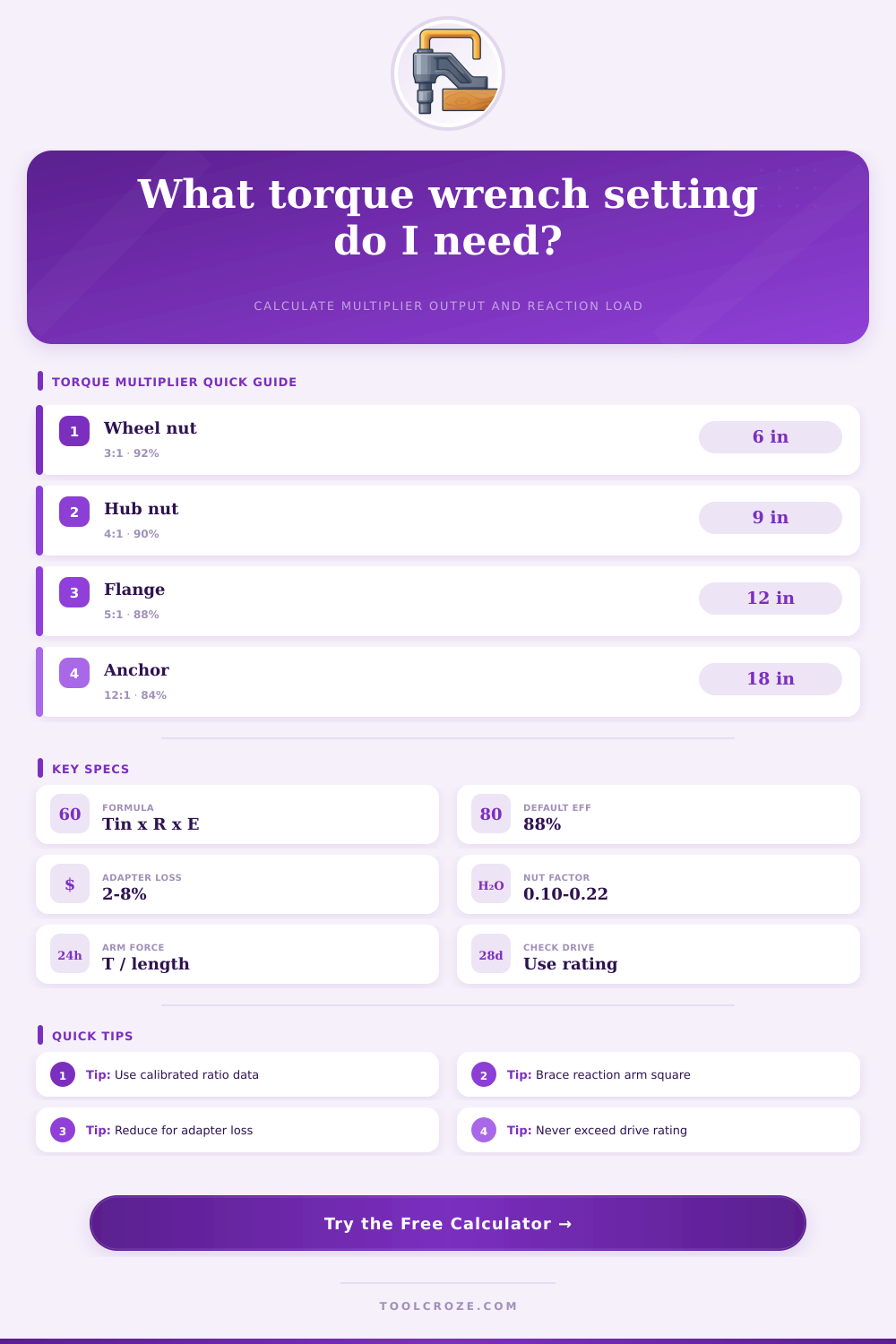
Suddenly, it’s not just an exercise in math. Now there is a safety component. This is what the calculator above turns that desired torque into. It’s based off the planetary gear ratio, which increases your applied force, and then drops because of efficiency loss within the tool. Multipliers generaly have about an 88% efficiency, so they loses twelve percent of your force to heat and friction within the gears. Not accounting for that means you’ll always under-torque your fastener. Once you input your personal ratio, the tool compensate for that.
Why You Need to Use the Calculator
What really trips people up though is load on reaction arm. You are trying to put torque into something via a multiplier. This means there is an equal and opposite force attempting to turn the whole thing around. And it does that with great force pushing back on your reaction point. A short reaction arm cause huge loads on the pivot point, where brackets can bend and equipment gets damaged. The calculator will tell you exactly how hard that brace is being pushed down on so you know for sure it will take it. Because it’s not just about screwing that bolt in, but keeping rest of the machine intact while doing so.
The nut factor or K-factor (which is also called friction) are greater than you realize. If you have a rusted nut on a dry thread, its K-factor could be as high as zero-point-twenty-two. That’s nearly eighty percent of your energy consumed fighting rust instead of locking down the joint. With lubrication, it will reduce to around zero-point-ten or even less so you can put more of your energy into stretching the bolt. So match the K-factor value in the calculator with the real-world condition of your fastener(s). A wrong guess could of get you in trouble when calculating preload.
The other important test is drive use. There’s a limit on how far any drive will go before its splines shear off. Does your desired output take you right up against the rated capacity of the adapter or socket? You’d rather have an idea that you’re running at 90% capacity before you get started rather than discovering it by dropping tool on the floor. And while eye protection is part of safety, so is understanding the mechanical constraints of all components in the chain.
What doesn’t appear on paper is all the stuff field conditions can add to the mix. For example, breakaway torque exceed install torque as cold metal contracts. Threads rusted or otherwise bind unevenly. Flanges are misaligned, adding side loads that throw off your readings. Your eyes and experience need to account for real world; use the calculator for an ideal physics-based starting point but go slightly under the calculated setting and creep upward if it won’t seat. Knowing those inputs makes it a controlled process rather than a brute force operation.
It’s not guesswork anymore; it’s an engineering process of hooking up. The same goes for a guy changing a truck’s suspension hubs as much as one tightening an anchor bolt on a wind tower. Control the input, respect the reaction and let the math explain what your eyes can’t see. That’s when it stops being routine maintenance and becomes a luxurius repair bill.