🚙 Torque Converter Stall Speed Calculator
Estimate corrected flash stall, launch wheel torque, heat load, and near-coupling RPM using converter rating, engine torque, gearing, tire size, traction, and altitude.
🏁 Real Vehicle Presets
⚙ Converter Inputs
📈 Calculated Outputs
🔧 Converter Family Comparison
📊 Reference Tables
| Family | Typical Stall | Torque Mult. | Coupling Factor |
|---|---|---|---|
| Towing / heavy haul | 1600–2200 rpm | 1.85 | 0.84 |
| Street performance | 2200–3000 rpm | 2.00 | 0.87 |
| Autocross / road course | 2600–3400 rpm | 2.05 | 0.89 |
| Drag radial / bracket | 3200–5000 rpm | 2.25 | 0.91 |
| Diameter | Stall Tendency | Common Use | Heat Trend |
|---|---|---|---|
| 13 in | -12% | Heavy tow / RV | Low |
| 12 in | Baseline | OE truck / muscle street | Moderate |
| 10 in | +10% | Street-strip | Higher |
| 8–9 in | +18 to +24% | Purpose-built drag | Highest |
| Vehicle Weight | Load Factor | Typical Response | Launch Note |
|---|---|---|---|
| 2400–2800 lb | 0.97 | Quicker coupling | Less stall rise |
| 3000–3600 lb | 1.00 | Baseline | Balanced flash |
| 3800–4400 lb | 1.04 | Higher flash | More converter work |
| 4500+ lb | 1.08 | Strong stall rise | Watch fluid heat |
| Preset Build | Converter | Rear Gear | Use Case |
|---|---|---|---|
| 5.3 LS Street | 11 in / 2600 | 3.73 | Daily + spirited roll-on |
| 468 BBC Bracket | 9 in / 4200 | 4.56 | High-torque footbrake pass |
| 5.9 Cummins Tow | 13 in / 1900 | 3.73 | Controlled trailer launch |
| Turbo 350Z | 10 in / 3600 | 3.54 | Spool before release |
💡 Setup Notes
This torque converter stall speed calculator estimates flash RPM, launch torque, heat load, and coupling behavior from engine torque, converter size, gearing, tire diameter, traction, and altitude corrections.
A torque converter is an component of a vehicle’s transmission system that help to transfer the power from the engine to the vehicle’s wheels. The stall speed of a torque converter is the engine RPM at which the impeller of the torque converter will spin free enough to provide a multiplication of torque to the vehicle during launch. If the stall speed of the torque converter are too low, the engine will bog down when it reaches the stall speed and will not reach its peak power.
If, however, the stall speed of a torque converter is set to be too high, the torque converter will create excessive heat that can damage the transmission fluid in the transmission system. The actual stall speed of a torque converter can vary depending on the specific make and model of the vehicle in which the torque converter are installed. For instance, a torque converter that stalls at 2600 RPM on a dynamometer may stall at a higher rate when installed in a heavy street truck that have sticky tires and a steep gear ratio.
What Affects the Stall Speed of a Torque Converter
The heavy truck will cause the turbine portion of the torque converter to fight against inertia. Other factors that can impact the stall speed of a torque converter include the torque of the engine, the weight of the vehicle, the size of the tire, and the altitude at which the vehicle is being driven. The heavier the vehicle, the more slip is required from the torque converter to allow for the multiplication of torque.
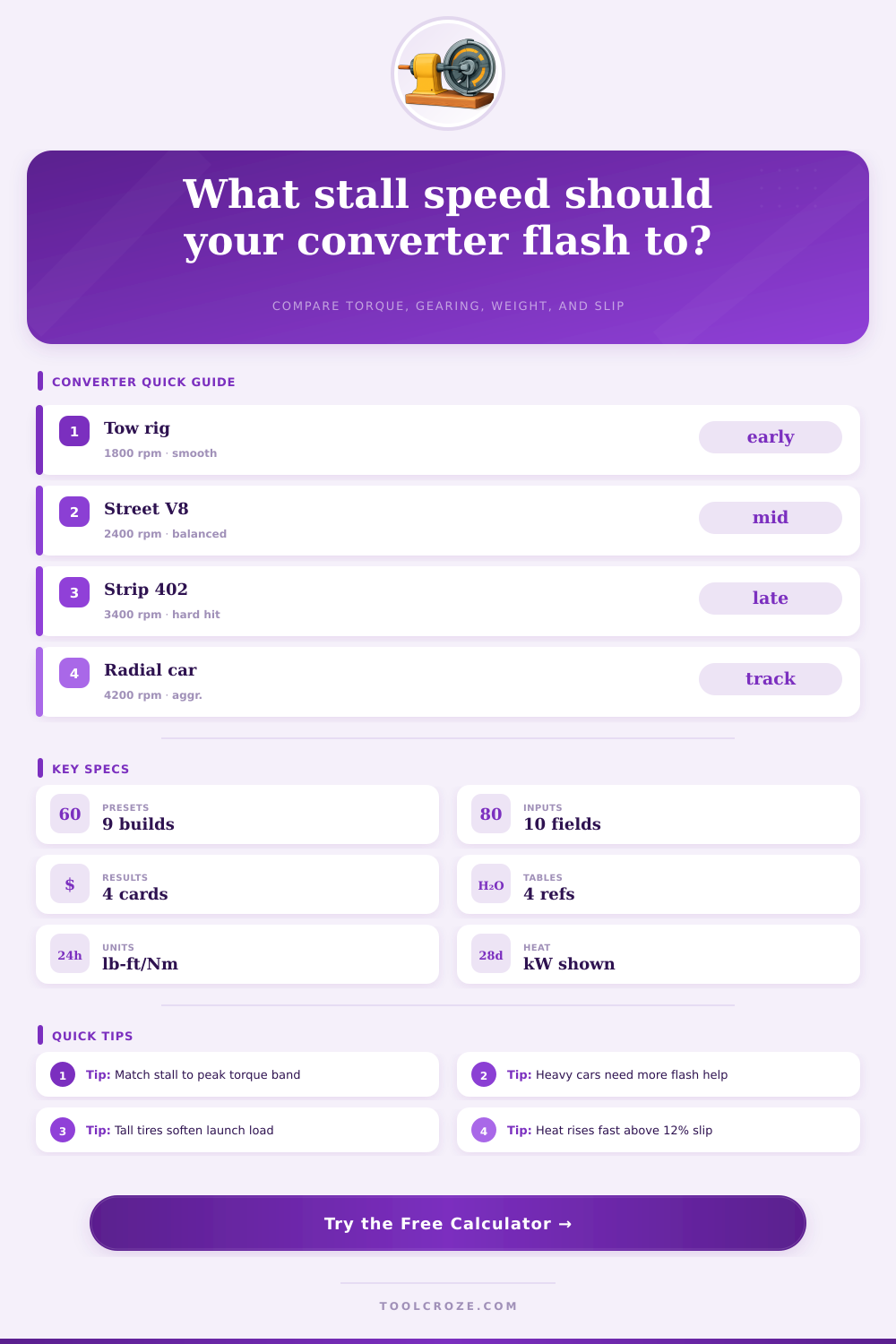
Taller tires will reduce the stall speed, thin air at high altitudes will reduce the engine output of the vehicle, and reduced engine output will impact the performance of the torque converter. There are different families of torque converters that is manufactured for different types of vehicles and the different purposes for which those vehicles may be utilized. For instance, heavy duty trucks that are often used to tow large rigs will utilize a large 12 inch torque converter that stalls at a relatively early RPM between 1800 and 2200.
The relatively early stall of these torque converters allows for the smooth coupling of the engine and transmission systems. These towing torque converters create a multiplication of only about 1.85 times the torque output of the engine. Street vehicles that utilize high performance V8 engines will often use torque converters that flash at around 2400 RPM.
This high performance vehicle will use a 2:1 ratio in its torque converter so that the vehicle will exhibit responsiveness when driven, but will not experience surges of power on the highway. In contrast, drag racing vehicles will utilize torque converters with higher stall speeds than street and towing vehicle. For instance, torque converters for drag racing vehicle will stall at 3400 RPM or higher.
These high stall speeds create a multiplication of 2.25 times the engine torque. Additionally, smaller torque converters, such as 9-inch torque converters, will increase the stall speed of the torque converter by 18 percent when use for drag racing applications. However, smaller torque converters will create more heat within the transmission system due to the 18 percent increase in slip between the torque converter and transmission system.
Finally, to ensure that the vehicle launches properly from the starting point, the stall speed of the torque converter should be selected to match the peak torque of the engine. The stall speed of the torque converter should be 200 to 400 RPM lower than the peak torque of the engine. The load of the vehicle and the gear selection will affect the performance of the torque converter.
If a person increases the weight of the vehicle from 3600 pounds to 4500 pounds, then the stall speed of the torque converter will increase as well. If the gear ratios of the vehicle are affected, then the stall speed will also change; steep gear ratios will increase the flash speed of the torque converter. Additionally, the size of the tires will also impact the performance of the torque converter; short tire sizes, such as 26-inch tires, will increase the force create by the torque converter, but larger tires, such as 31-inch tires, will allow for a lower stall speed for the torque converter.
The final output of the vehicle can be measured by the launch wheel torque. The launch wheel torque can be calculated by multiplying the engine output with the torque converter ratio, the first gear ratio, the rear gear ratio, and the mechanical efficiency of the drive train. If the stall speed of the torque converter is high, then the horsepower will be lost as heat.
Additionally, the slip of the torque converter should be kept under 12 percent after the launch of the vehicle; if the slip of the torque converter reaches 12 percent or above, quickly the transmission fluid will become too hot for the transmission. It is not a necessity for a person to have a torque converter with a high stall speed; if a person’s engine produces 430 lb-ft of torque, but the torque converter is only rated for 400 lb-ft of torque, then the stall speed will be 4 percent more high than the torque converter is rated for. Due to the differences in the needs of the various vehicles, different stall speeds are required for certain vehicle types.
For instance, a street car will require a balanced stall speed, a heavy tow rig will require an early coupling of the transmission, and a race car will require a high stall speed to provide high multiplication of torque to the wheels. Additionally, a person must also consider the altitude at which the vehicle will be driven; at 5000 feet above sea level, the air is thinner and the engine will lose 6 percent of its torque. Safety is another consideration with the purchase of a torque converter.
Every torque converter have limits to the number of rpm that it can produce; this is limited to the strength of the flexplate and the transmission. Additionally, the temperatures of the automatic transmission fluid (ATF) should be constantly monitored; if the temperature rises to 220°F, the ATF may produce varnish that will damage the transmission. Finally, a person can use the brake stall test to determine the stall speed of the torque converter; however, the tests should be limited to avoid heating the transmission fluids to high temperatures too quick.
Actually, its important to remember that you should of checked the manual. This moddern tech can be tricky, and sometimes the parts isnt quite what you expect to recieve. Dont let teh slip get too high or youve wasted alot of money on luxurios parts.