🚙 Torque Converter Slippage Calculator
Measure converter slip under launch, towing, cruise, or lockup checks using engine RPM, turbine RPM, gearing, tire size, torque, and fluid temperature.
📌 Presets
⚙ Slip Inputs
🎯 Results
🗂 Converter Family Grid
📊 Reference Tables
| Driving state | Typical slip | RPM loss trend | What to watch |
|---|---|---|---|
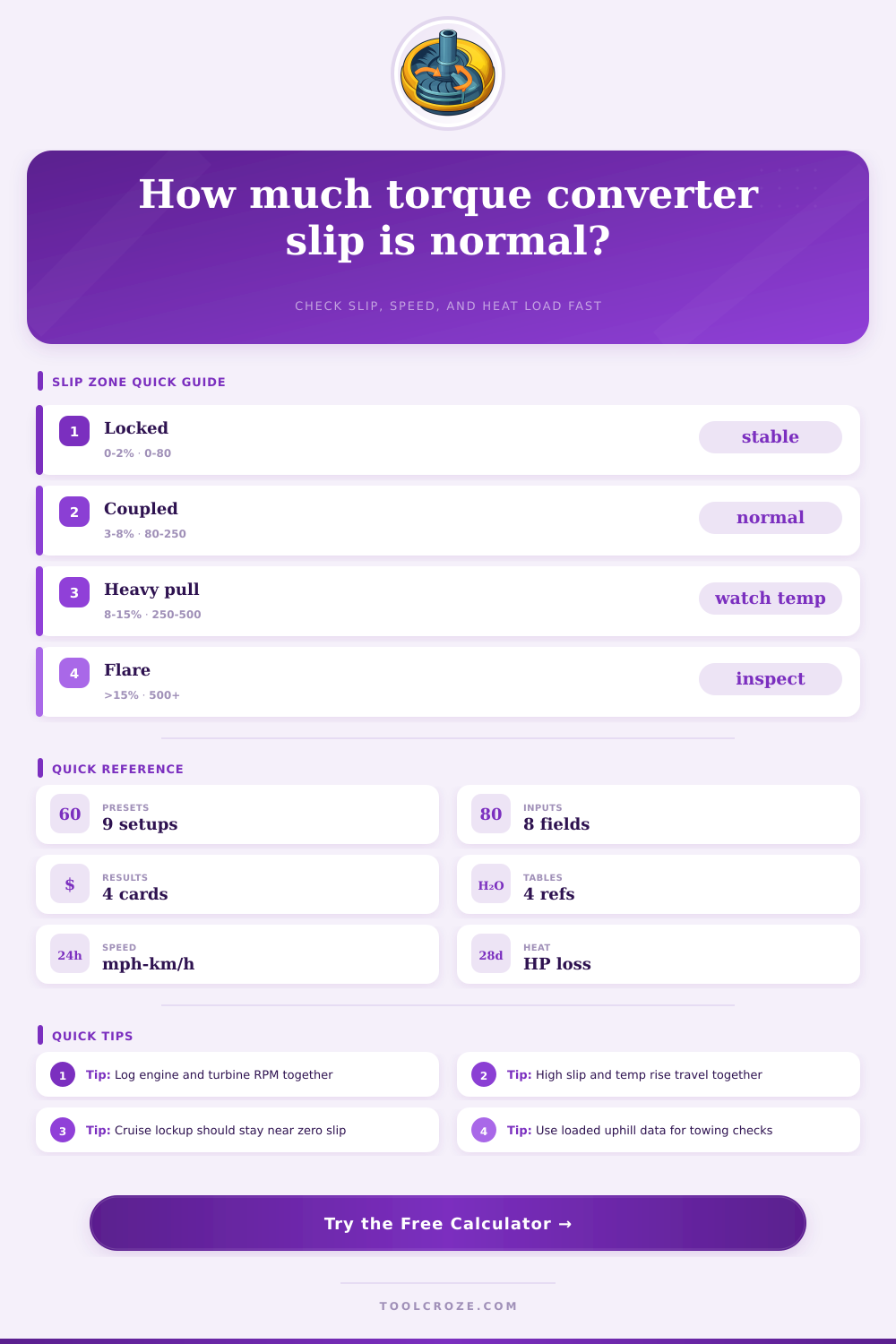
| Lockup clutch applied | 0–2% | 0–80 RPM | Higher values can indicate clutch wear or PWM instability. |
| Steady highway cruise | 2–5% | 50–180 RPM | Normal for open converter cruise, especially in overdrive. |
| Towing on a grade | 6–12% | 180–450 RPM | Monitor ATF temperature and unlock frequency. |
| Stall flash / hard launch | 12–25% | 400+ RPM | Short bursts are normal; prolonged slip means heat. |
| ATF temp | Condition | Slip concern | Action threshold |
|---|---|---|---|
| 160–180°F | Healthy | Normal converter coupling window | Good baseline for repeated logging |
| 180–200°F | Warm | Acceptable during hills or short pulls | Watch if slip stays above target |
| 200–220°F | Hot | High slip will accelerate fluid stress | Back off load or improve cooling |
| 220°F+ | Severe | Converter heat can rise quickly | Inspect tune, lockup, and cooler flow |
| Transmission gear | Common ratio | Use case | Slip effect |
|---|---|---|---|
| 1st gear | 2.40–4.70 | Launch and stall flash | Largest turbine lag and highest multiplication. |
| 2nd / 3rd gear | 1.40–2.10 | Street pull and roll race | Useful for comparing recovery after the hit. |
| Direct 1:1 | 1.00 | Dyno pull or trap analysis | Easy place to compare converter efficiency. |
| Overdrive | 0.62–0.85 | Highway cruise | Best zone for lockup clutch slip checks. |
| Converter family | Typical stall | Coupling target | Common application |
|---|---|---|---|
| OE lockup | 1600–2200 | 95–99% | Sedan, SUV, daily truck |
| Street 2400 | 2200–2600 | 92–97% | Mild cam street builds |
| Street 3200 | 3000–3400 | 88–95% | Street-strip V8 cars |
| Drag 4500 | 4200–5000 | 82–92% | Bracket and radial cars |
💡 Tips
A torque converter is a component that act as a fluid clutch between the engine and the transmission. The torque converter allow the engine to spin independently of the transmission. The torque converter use fluid to transfer power from the engine to the transmission.
The engine spin an impeller inside the torque converter, which move fluid to a turbine. The fluid slip between the impeller and the turbine, causing some amount of slip within the torque converter. The difference between the engine RPM and the turbine RPM is the slip within the transmission.
What Is Torque Converter Slip and How to Check It
A person can measure the slip of a torque converter by measuring the engine RPM and the turbine RPM at the same time. If the RPMs is similar, the slip of the torque converter is small. If the difference in RPM is large, the slip of the torque converter is high.
Excessive slip in a torque converter will create heat within the transmission. The slip of the torque converter will increase the temperature of the automatic transmission fluid. High temperatures of the automatic transmission fluid can damage the fluid over time.
The automatic transmission fluid can break down into a substance call varnish. The varnish can damage the internal component of the transmission. Therefore, a person must monitor the slip of the torque converter to ensure that the transmission fluid does not breakdown.
For instance, when a truck is towing a load on a hill, the engine may be spinning at 2400 RPM while the transmission fluid turbine is moving at 2200 RPM. The 8% slip rate between the engine and the transmission fluid will heat the automatic transmission fluid. As the fluid heats, the slip will continue creating heat in the transmission fluid components.
The amount of slip that the person is performing with the car considers normal within a torque converter depend on the type of driving. For instance, during the launch of a car, the slip of the torque converter should be high to allow the car to gain high acceleration power. During a launch, the slip of a torque converter should be between 15% and 20%.
During acceleration, the slip should slowly decrease as the car gain speed. During highway driving, the slip should be minimized. For instance, in the overdrive gear of the car, the slip should be between 3% and 5%.
If the vehicle is using a lockup clutch, the slip should be close to 0%. For towing application, the slip should be between 8% and 12% of the engine RPM. A person should monitor the automatic transmission fluid temperature while in these towing applications to ensure the torque converter isnt overheating.
The theoretical speed of a transmission can be calculated using the gear ratio and the axle ratio of the vehicle. These two ratio will allow a person to calculate the speed at which the turbine of the torque converter should be spinning based on the speed of the vehicle. Another factor that affects the theoretical speed of the transmission is the diameter of the tires of the vehicle.
The diameter of the tires determine the circumference of the tire and, therefore, the true ground speed of the vehicle. Using an incorrect tire diameter will lead to an inaccurate reading of the slip rate of the torque converter. Additionally, different type of torque converters have different targets for slip of the fluid within the transmission.
A stock torque converter will have a target slip efficiency for high rates of slip while cruising. A performance torque converter will have a higher stall speed to allow for high slip during the launch of the car. Additionally, higher stall speed for a performance torque converter will allow for high rates of slip when cruising at high speeds.
The heat load of the engine and transmission can be calculated by determining the percentage of slip of the torque converter, the engine torque, and the engine RPM. For instance, if the torque converter has 10% slip and the engine has 300 lb-ft of torque at 2000 RPM, the torque converter is losing approximately 10 to 15 horsepower of power as heat. This lost power is heat that heats the automatic transmission fluid.
If the automatic transmission fluid becomes too hot, it will slip more easily. This cycle of high heat and high slip will create high level of heat and slip within the torque converter. A person should inspect the transmission fluid for slip to ensure that the slip is returning to 0% as much as possible.
If the slip is above 15%, someone should inspect the torque converter. Additionally, excessive slip of the torque converter waste fuel for the engine. Additionally, excessive slip will cause the bands and clutches within the transmission to wear down over time.
A person must use the appropriate context for the slip of the torque converter. High rate of slip are acceptable for short bursts of time. High slips for long periods of time are not.
During those periods, the transmission fluid overheat. A person can monitor the temperature of the automatic transmission fluid to determine if the transmission need to be repaired. If the fluid is between 160 and 180 degrees, the fluid is at a healthy temperature.
However, if the fluid is over 200 degrees with high slip of the torque converter, the person must upgrade the cooling system for the transmission or the torque converter may need to be rebuilt. By monitoring the slip of the torque converter and the temperature of the automatic transmission fluid, a person can ensure that the transmission remain healthy for the driver and the engine of the car. You should of checked the fluids regularily.
It is alot of work but its worth it to avoid a broken transmission. The cars size and weight matter more then people think.