⚙ Torque Converter Efficiency Calculator
Measure converter slip, torque multiplication, power transfer, and heat rejection using real RPM and torque data from launch, towing, cruising, or lockup tests.
📌 Preset Test Setups
⚙ Converter Input Data
🎯 Efficiency Results
📊 Fluid Spec Comparison Grid
Best under 210°F
Stable clutch apply
Fast fill response
Sharper apply feel
📖 Reference Tables
| Operating phase | Typical slip | Expected efficiency | What it means |
|---|---|---|---|
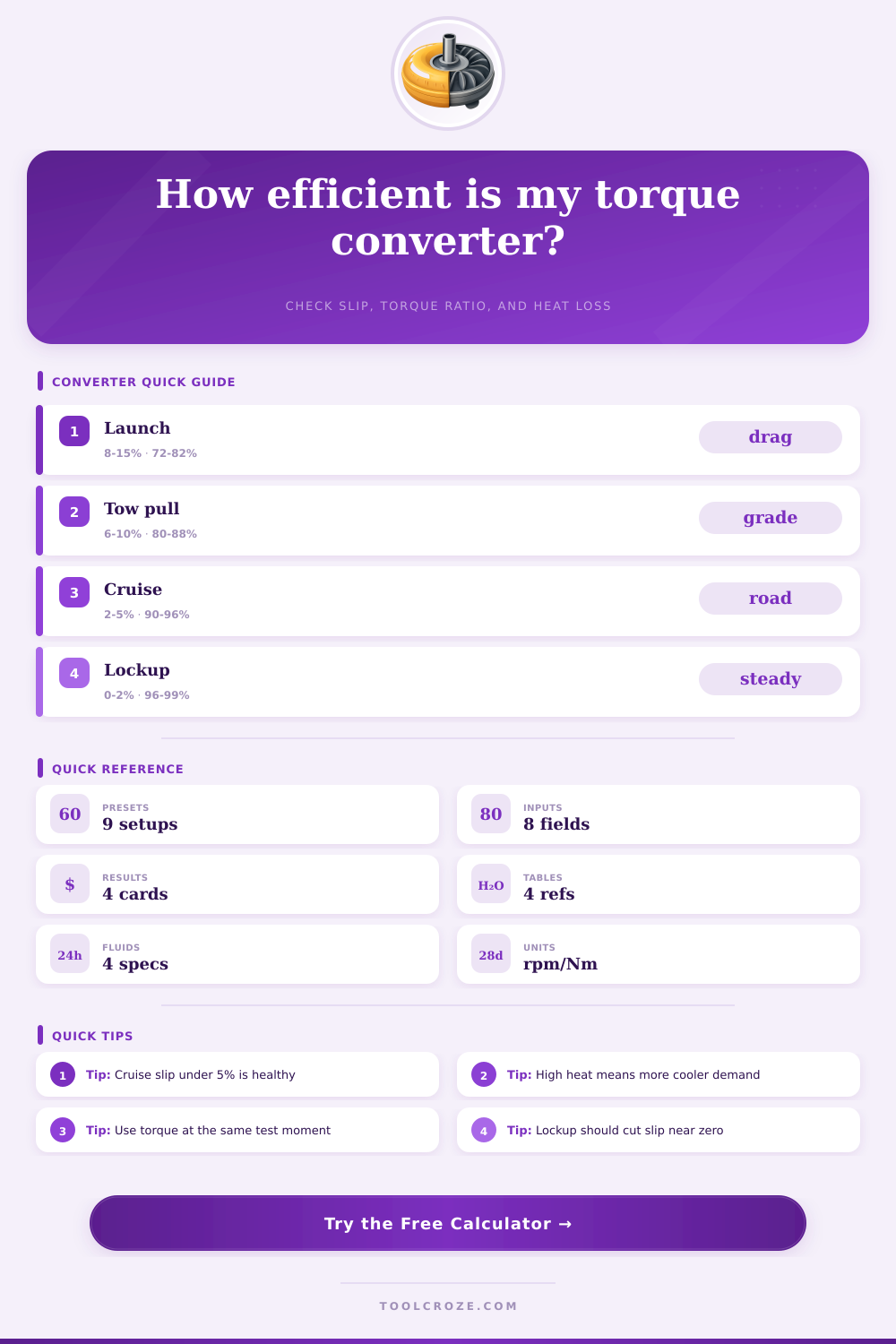
| Launch / flash stall | 8% to 15% | 72% to 82% | Converter is multiplying torque and making the most heat. |
| Part-throttle acceleration | 5% to 9% | 82% to 89% | Normal street acceleration zone before full coupling. |
| Towing / grade pull | 6% to 10% | 80% to 88% | Watch cooler capacity because sustained load grows quickly. |
| Cruise / coupling | 2% to 5% | 90% to 96% | Healthy non-lockup road behavior with low heat production. |
| Lockup clutch applied | 0% to 2% | 96% to 99% | Very little converter loss if the clutch holds cleanly. |
| Converter family | Diameter | Common stall range | Target use |
|---|---|---|---|
| Street lockup | 10 to 12 in | 1800 to 2800 rpm | Low slip cruise with occasional load. |
| Heavy tow billet | 10 to 11 in | 1600 to 2400 rpm | Stronger coupling under grade pull and heat. |
| Drag race | 8 to 9.5 in | 3800 to 6200 rpm | Fast flash stall with high launch multiplication. |
| Circle track | 9 to 10 in | 3000 to 5000 rpm | Restart bite with stable mid-corner recovery. |
| Off-road low speed | 10.5 to 12 in | 2200 to 3600 rpm | Controlled crawl with durable heat handling. |
| ATF temp | Viscosity effect | Converter behavior | Action |
|---|---|---|---|
| 140–160°F | Thicker fluid | Stable coupling but slower clutch fill. | Good warm-up band before hard pulls. |
| 170–190°F | Normal viscosity | Best balance of response and cooler margin. | Ideal data-logging window for most tests. |
| 200–220°F | Thinner fluid | Slip tends to rise under sustained torque. | Add cooler airflow or shorten the pull. |
| 230°F+ | Rapid thinning | Heat load accelerates and clutch life drops. | Back out and inspect the cooling system. |
| Use case | Speed ratio target | Torque ratio target | Cooling note |
|---|---|---|---|
| Daily cruise | 0.95 to 0.98 | 0.95 to 1.05 | Minimal heat once coupled. |
| Street pull | 0.90 to 0.95 | 1.00 to 1.15 | Short bursts are usually manageable. |
| Heavy towing | 0.90 to 0.94 | 1.05 to 1.18 | Large cooler and low restriction lines help. |
| Drag launch | 0.84 to 0.92 | 1.15 to 1.45 | Expect large heat spikes during the hit. |
| Off-road crawl | 0.80 to 0.90 | 1.20 to 1.60 | Sustained low-speed work needs airflow or fan assist. |
💡 Tuning Tips
This calculator turns logged RPM and torque into converter efficiency, slip, torque ratio, and heat loss so you can compare launch, towing, cruise, and lockup behavior with one repeatable workflow.
A torque converter are a component of an automatic transmission that is responsible for converting the power of the engine into movement that the vehicle can use. A torque converter utilize automatic transmission fluid to transfer energy from an impeller to a turbine. The impeller is connected to the engine, so the impeller and the engine is spinning at the same rate.
The turbine is connected to the transmission input shaft, and a sensor built into the transmission can measure the speed of the turbine. A torque converter also incorporate a stator, which redirects the fluid from the impeller to a turbine to allow for the multiplication of the torque. The concept of slip occur within the torque converter if the impeller and the turbine are spinning at different rates.
How a Torque Converter Works and Why Slip Matters
If the impeller and the turbine is spinning at the same rate, there is no slip. However, a torque converter must experience some slip to appropriately perform it’s main function of multiplying the torque that the engine produces. Slip is beneficial in that less slip mean that the transmission will be more efficient and the fluid will experience less heat.
High slip, however, create high amount of heat within the transmission fluid. Because heat reduce the viscosity of the fluid, high slip causes the transmission fluid to thin, which enable even more slip to occur within the torque converter. The efficiency of a torque converter can be measured by calculating the slip percentage of the torque converter and the ratio of the torque that the torque converter multiplies.
The slip percentage and the torque multiplier can be calculated by recording the RPM of the impeller and the turbine, as well as the amount of torque that the vehicle is producing. For example, if the impeller is spinning at 2,800 RPM while the turbine is spinning at 2,580 RPM, the slip percentage can be calculate. A torque converter used for street driving should exhibit a high amount of slip when the vehicle is cruising at high speeds, as this will increase the fuel economy of the vehicle.
However, the slip percentage of a torque converter while cruising at highway speeds should be between 2 and 5 percent to maintain high fuel economy and high efficiency of the torque converter. Towing a vehicle with a high amount of weight require a different type of torque converter than that used for driving a vehicle on the street. The torque converter that is used for towing is often constructed with a larger diameter.
The larger diameter of the torque converter allow the torque converter to better handle the heat that is produced while towing a heavy load. When towing a heavy load, the slip of the torque converter may be between 6 and 10 percent. However, since heat is also created while towing a heavy load, it is important to monitor the fluid temperature of the torque converter.
High fluid temperatures will reduce the efficiency of the torque converter. A torque converter that is used for drag racing is constructed in a different way than the torque converter that is used for other types of driving. The torque converter for drag racing have a smaller diameter.
The smaller diameter allow the engine to reach higher RPMs when launching the vehicle. Additionally, the slip percentage for drag racing torque converters is high, being between 8 and 15 percent. The high slip allow for high amounts of torque to be created.
Despite the high amount of heat that a torque converter creates while drag racing, the amount of time that the heat is created is relatively brief. The type of automatic transmission fluid that is used also have an impact on the operation of the torque converter. Automatic transmission fluid of different types, such as Dexron VI and Mercon LV fluids, have different properties in relation to the viscosity of the fluid.
The automatic transmission fluid should remain within an optimal temperature range, which is between 170 and 190 degrees. If the fluid reaches 230 degrees, the viscosity of the fluid will drop, which will enable the slip within the torque converter to increase. One way of diagnosing problems with a torque converter is through the use of data logging.
Data logging allow an operator to monitor the slip percentage of the torque converter. For instance, if the recorded slip percentage is higher than that which is required for the type of driving that is performed with the vehicle, the torque converter may be worn or the stall speed of the torque converter may be incorrectly set for the vehicle. Additionally, if data logging reveals that the fluid temperature of the torque converter is rising too quickly, the transmission cooler for the vehicle may need to be upgraded.
Through data logging, an operator can record the RPM of the impeller and the turbine, as well as the amount of torque that the vehicle is creating. These measurements will allow the operator to determine whether the torque converter is efficiently operating when the vehicle is being used for street driving, towing, or racing. It could of been easier if the person checked the data logging first.
You’ll find that many people dont realize how much slip matter to the engine performance. Actually, most people doesnt check the torque converters length or size when they replaces it. The luxurios feel of a smooth ride depends on it.
It is alot of work to monitor, but its necesary.