🔧 Torque Angle Calculator
Estimate thread advance, bolt elongation, clamp load, torsional stress, and equivalent final torque for snug-plus-angle tightening on engine, chassis, and machinery joints.
📌 Presets
⚙ Calculator Setup
🎯 Results
📊 Fastener Spec Grid
📑 Reference Tables
| Grade / Alloy | Proof | Yield | Typical use | Angle note |
|---|---|---|---|---|
| ISO 8.8 | 600 MPa | 640 MPa | General machine joints | 30–90° hard joints |
| ISO 10.9 | 830 MPa | 940 MPa | Automotive structural | 45–120° common |
| ISO 12.9 | 970 MPa | 1100 MPa | Main caps and tooling | Use short, controlled turns |
| SAE Grade 5 | 85 ksi | 92 ksi | Flanges and brackets | Often 45–75° |
| SAE Grade 8 | 120 ksi | 130 ksi | Suspension and die sets | 60–90° typical |
| ASTM A193 B7 | 105 ksi | 125 ksi | Pumps and pressure joints | Cross-tighten evenly |
| A2-70 Stainless | 450 MPa | 600 MPa | Corrosion service | More scatter with anti-seize |
| ARP2000 | 180 ksi | 200 ksi | Performance rod bolts | Stretch control preferred |
| Lubrication | Nut factor K | Friction trend | Torque effect |
|---|---|---|---|
| Moly assembly lube | 0.12 | Lowest | Most load per torque |
| Engine oil | 0.15 | Low | Good repeatability |
| Light zinc oil | 0.18 | Moderate | Typical OEM joint |
| Dry phosphate | 0.20 | Higher | More torque scatter |
| Stainless anti-seize | 0.22 | Variable | Watch over-tightening |
| Joint type | Common added angle | Seating loss | Interpretation |
|---|---|---|---|
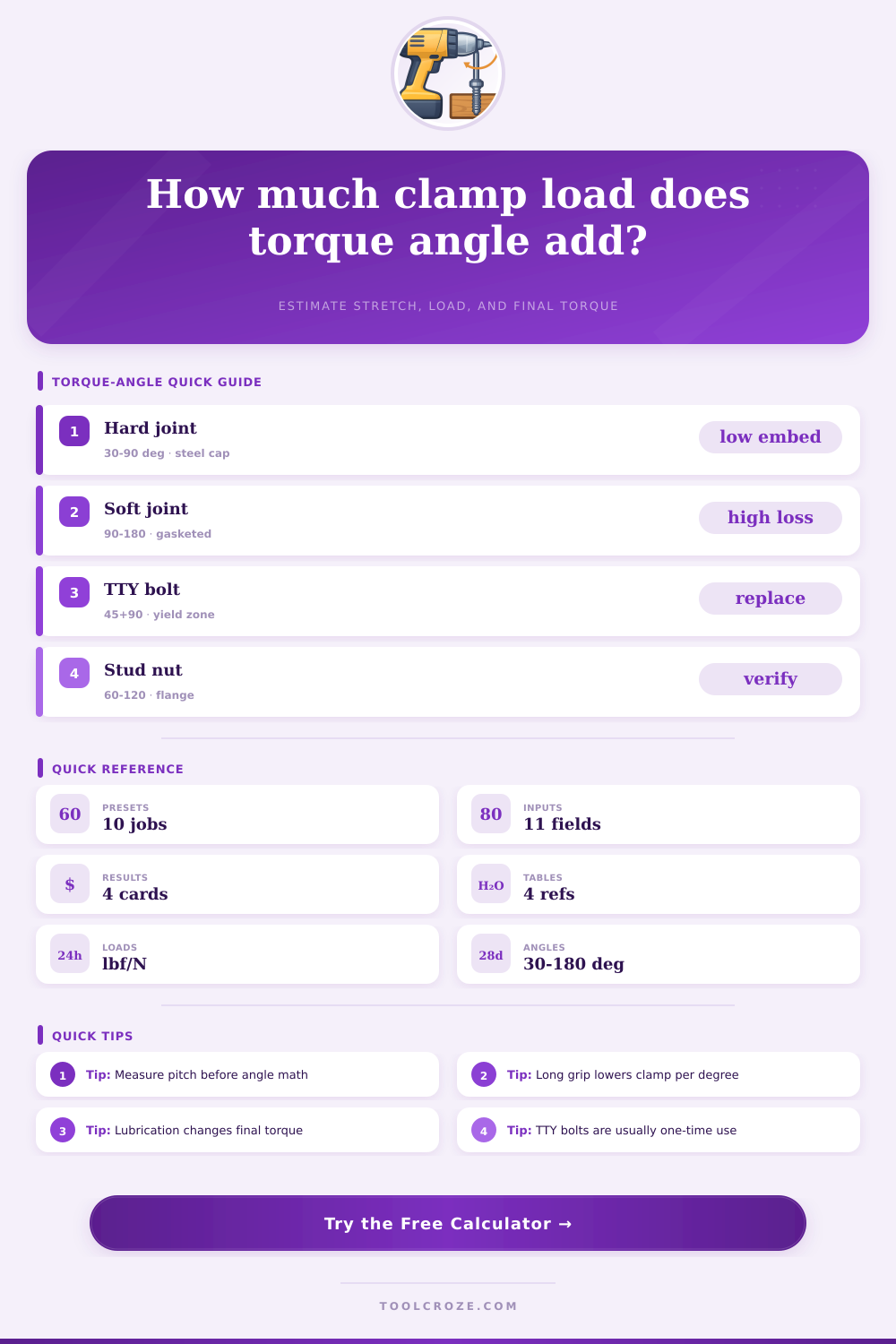
| Hard joint | 30–90° | 5–15% | Most rotation becomes stretch |
| Medium joint | 60–120° | 10–20% | Coatings and paint absorb some turn |
| Soft gasket joint | 90–180° | 15–30% | Compression consumes angle first |
| TTY joint | 45+45 to 90+90 | Procedure specific | Service manual governs |
| Thread size | Lead | Stress area | 1 turn stretch potential |
|---|---|---|---|
| M6 x 1.0 | 1.00 mm | 20.1 mm² | 1.00 mm per rev |
| M8 x 1.25 | 1.25 mm | 36.6 mm² | 1.25 mm per rev |
| M10 x 1.5 | 1.50 mm | 58.0 mm² | 1.50 mm per rev |
| M12 x 1.75 | 1.75 mm | 84.3 mm² | 1.75 mm per rev |
| 3/8-24 UNF | 0.0417 in | 0.0775 in² | 0.0417 in per rev |
| 1/2-13 UNC | 0.0769 in | 0.1419 in² | 0.0769 in per rev |
🗂 Material And Spec Comparison
High-strength alloy bolts
10.9, 12.9, Grade 8, and ARP-type bolts create more preload per degree because higher proof strength allows more elastic stress before permanent set. Angle windows are usually shorter and more controlled.
Stainless and low-proof fasteners
A2-70 and similar corrosion-resistant fasteners reach their proof limit sooner. Use a lower target angle, verify lubrication carefully, and expect more preload scatter for the same torque stage.
Short grips versus long grips
Short grip stacks act like stiff springs, so a small angle can spike preload quickly. Long grip joints spread the same thread advance over more length and usually need more rotation to reach the same load.
Hard joint versus soft joint
Metal-to-metal joints convert most angle into stretch. Gasketed joints spend more rotation on embedment and compression, so seating efficiency is lower and extra angle is often required to stabilize clamp load.
💡 Torque-Angle Tips
This torque angle calculator estimates bolt stretch, clamp load, and final torque from snug-plus-angle tightening so you can compare joint stiffness, lubrication, and proof limits before assembly.
Torque-angle tightening is a method that is utilized to secure fasteners. Torque-angle tightening provides a repeatable amount of preload to the joint that the bolt is being secure by. A person can utilize a torque wrench to tighten the bolt to a specific snug value.
After the bolt is tightened to the snug value, the bolt can be rotated to a specific angle to further secure the bolt. This method is utilized because the measurement of the torque that is applied to the bolt often vary. For instanse, friction can vary according to whether the bolt is lubricated or not, as well as the condition of the threads.
Using Torque and Angle to Tighten Bolts
Because of these varying friction, the bolt may not consistently measure the same amount of preload when utilizing torque measurements alone. Therefore, the use of angle measurements is more reliably in providing the fastener with the preload necessary to secure the joint. When utilizing torque-angle tightening methods, the rotation of the bolt will stretch the bolt elasticly.
The elastic stretch of the bolt provides a clamp load that will secure the joint. The efficiency of the clamp load will depend on the type of joint that is being secured. For instance, if the joint is formed by metal to metal components, most of the rotation of the bolt will be translated into stretch of the bolt.
However, if the joint includes a gasket, some of the rotational force will be used to compress the gasket. Therefore, the joint with the gasket will develop less stretch in it’s bolt than a metal-to-metal joint that experience the same angle of rotation. The pitch of the bolt will impact how far the bolt moves during tightening.
For instance, a fine thread will move a shorter distance per degree of rotation than a coarse bolt. Because a coarse bolt moves a greater distance with each degree of rotation, a smaller angle will be required to rotate the bolt to the same distance as a bolt with a fine thread. Additionally, the grip length of the bolt will impact the tension that the rotation of the bolt is create by.
A long grip length will distribute the tension over a larger area than a short grip length. Lubrication of the bolt will alter the behavior of the bolt during the tightening process. For instance, different lubricants has different nut factors.
A nut factor of a bolt with molybdenum grease will be low, indicating that the bolt will be stretched to a greater tension with that lubricant. In contrast, stainless steel anti-seize will have a higher nut factor for the bolt; it will require more rotation of the bolt to achieve the same amount of tension. Therefore, bolts will have different tension levels based off the types of lubrication that are used, so the lubrication must be accounted for during installation.
The grade of the bolt is another critical factor in the bolt’s rotation to a specific angle. High strength bolts, such as ISO 10.9 bolts, are able to withstand high amounts of stress. Low grade bolts, such as A2-70 stainless steel bolts, cannot withstand many stress.
Therefore, a smaller angle of rotation should of be used in the lower grade bolts. Utilizing an angle that is too great on a low grade bolt will cause the bolt to reach its yield point. Beyond the yield point of a bolt, the bolt will experience permanent deformation, which will cause the bolt to no longer return to its original length.
One of the most common mistakes with installing bolts is to skip the initial snugging of the bolt. By not snugging the joint prior to the rotation to an angle, the joint will not ensure that the bolt will reach the accurate amount of stretch. Another of the most common mistake with bolts is to reuse bolts that were tightened to a torque-to-yield specification.
These types of bolts are manufactured to be stretched beyond their elastic limit. Because these bolts were stretched beyond their elastic limit, they cant be reused. Otherwise, the clamp load that is created will be significantly less than the necessary load to secure the joint.
Bolts should be monitored to ensure that they are within the proof load of the bolt. The proof load is the stress that the bolt can take without experiencing permanent deformation. For most joints, the proof load should be within the 70% to 85% range.
Any bolt that is operated at 90% or more of its proof load may experience permanent deformation. Additionally, other external factor, such as temperature and vibration will impact the joint. High temperatures will cause the joint to expand.
Vibration will cause the gaskets within the joint to compress further over time. These factors will alter the properties of the joint, so the joint should be periodically check if it is susceptible to these factors.