';
}
getEl('tgsSpecGrid').innerHTML = html;
}
function printTongueGrooveSiding() {
calculateTongueGrooveSiding();
window.print();
}
function attachEvents() {
var ids = ['tgsWallWidth', 'tgsWallHeight', 'tgsWallCount', 'tgsSidingDirection', 'tgsGableBase', 'tgsGableHeight', 'tgsGableCount', 'tgsManualCourses', 'tgsBoardExposure', 'tgsBoardWidth', 'tgsBoardLength', 'tgsStudSpacing', 'tgsOpenQtyA', 'tgsOpenWidthA', 'tgsOpenHeightA', 'tgsOpenQtyB', 'tgsOpenWidthB', 'tgsOpenHeightB', 'tgsOpenQtyC', 'tgsOpenWidthC', 'tgsOpenHeightC', 'tgsOpenQtyD', 'tgsOpenWidthD', 'tgsOpenHeightD', 'tgsCornerCount', 'tgsCornerHeight', 'tgsExtraTrim', 'tgsWaste'];
var i;
var el;
for (i = 0; i < ids.length; i++) {
el = getEl(ids[i]);
if (el) {
el.oninput = calculateTongueGrooveSiding;
el.onchange = calculateTongueGrooveSiding;
}
}
}
window.setTongueGrooveSidingPreset = setTongueGrooveSidingPreset;
window.setTongueGrooveSidingUnits = setTongueGrooveSidingUnits;
window.calculateTongueGrooveSiding = calculateTongueGrooveSiding;
window.printTongueGrooveSiding = printTongueGrooveSiding;
renderSpecGrid();
attachEvents();
updateUnitLabels();
calculateTongueGrooveSiding();
})();
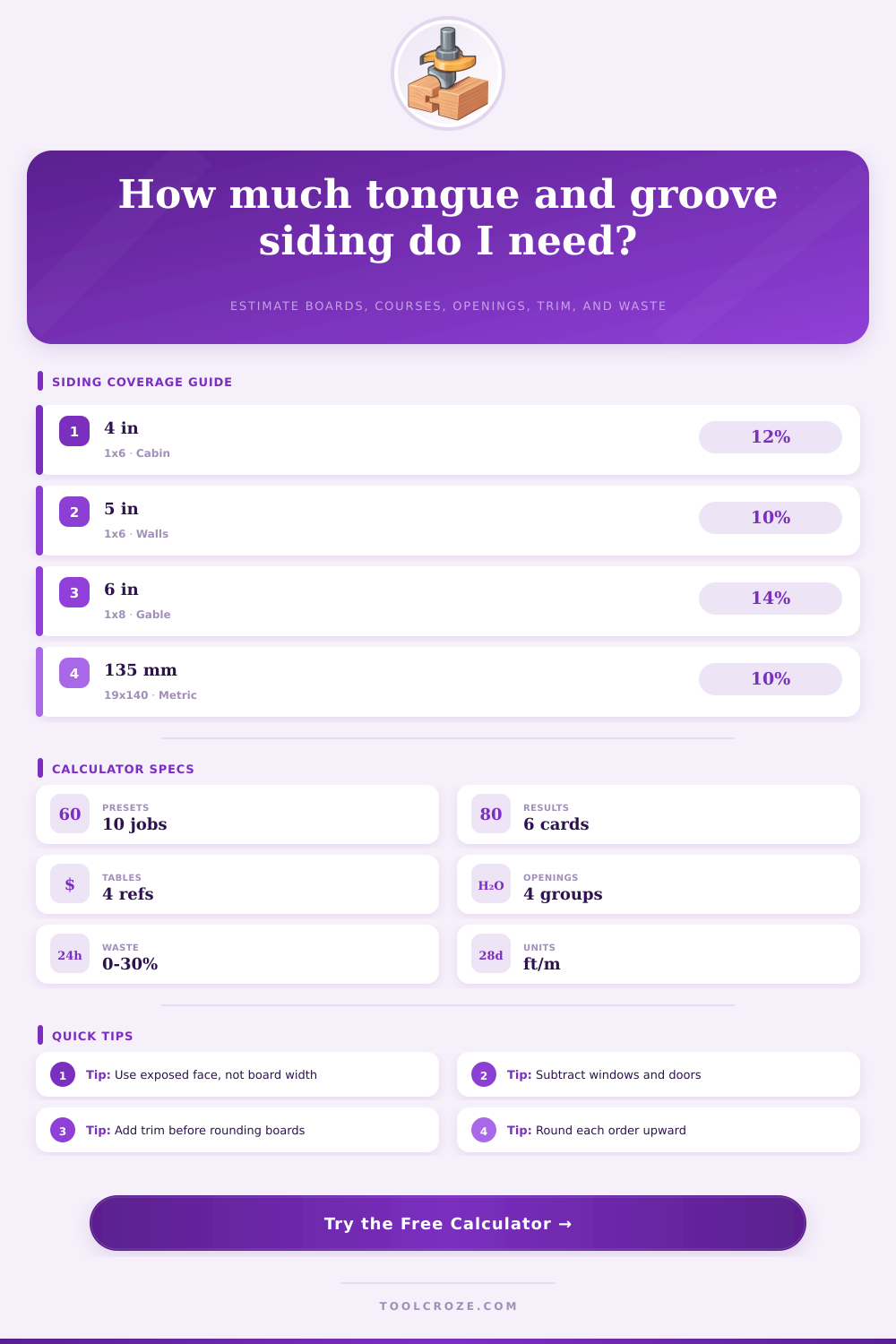
In order to calculate an amount of tongue and groove siding required for a project, it is first necesary to gain an understanding of the difference between the width of a tongue and groove siding board and the width of the surface that will be covered by that siding board. The siding boards has a tongue that fits into the groove of the next siding board, meaning that the portion of the board that is covered by the tongue is not visible and dont contribute to the width of the siding board that is expressed. For these reasons, the measurement of the exposure of the siding board must be utilized rather than the total width of the siding board; the calculator that is provided include this calculation for the user after entering the exposure measurement of the desired tongue and groove siding boards.
Many individuals order the incorrect amount of tongue and groove siding due to the tendency of those individuals to measure the total width of the siding boards rather than the exposure measurement of the siding boards. The exposure measurement of the siding will determine the number of “courses” of siding that is installed along the wall. If the top course is of a different width than the remainder of the courses of siding, the appearance of the siding will differ along the wall compared to if each course were of the same width.
How to calculate how much tongue and groove siding you need
It is possible to make small adjustments to the exposure measurement of the siding to ensure that each course of siding have the same width, and the calculator will reflect the number of courses of siding that will result from such an adjustment. The areas of the building that require openings for windows and doors will reduce the amount of surface area that will be covered by the tongue and groove siding boards. The calculator will automatically subtract the area that will be occupied by the windows and doors in the area of the building to be sided, but will add an allowance for linear trim siding for the corners and returns of the building.
It is necessary to include an allowance for linear trim siding for the doors and windows, as the linear trim siding will require additional tongue and groove siding boards for coverage of the doors and windows. Finally, additional tongue and groove siding will be lost due to the need to waste some of the siding boards in order to have siding boards of desired colors or without knots within the wood. The triangular portions of the gables of the building will require angled cuts of the siding boards, as opposed to the straight cuts that is required for the main walls of the building.
The angled cuts will create triangular portions of the siding boards that cannot be utilized for any other portions of the building, thus creating additional waste of the siding boards. The calculator will determine the area of the gable by multiplying half of the base of the gable by the height of the gable. Furthermore, the calculator will apply the exposure measurement that you have chosen to determine the number of courses of siding that will run up the peak of the gable roof.
The calculator will allow you to see if the percentage of waste that you have chosen will allow for the triangular offcuts of the siding to be accounted for; you can also change the percentage if you find that the triangular offcuts will require more waste from the siding boards. The length of the tongue and groove siding boards that you choose will impact both the number of tongue and groove siding boards that are required for the project, as well as the number of joints that is created in the siding installation. Longer tongue and groove siding boards will create fewer joints in the siding installation on a tall wall, but may be more difficult to handle if they are too long.
Shorter tongue and groove siding boards are often used in small structures (like sheds) because they will not waste any tongue and groove siding on small walls. The calculator can convert the length of each board to the number of linear feet that each siding board will cover. The calculator will provide a count of the number of fasteners that will be required to attach the tongue and groove siding to each stud or furring strip.
The user can set the distance between each fastener, and the calculator will determine the number of fasteners that will be required for each tongue and groove siding board. This fastener count will help to price the tongue and groove siding installation, as well as allow the user to ensure that they have enough fasteners (screws or nails) to complete the project before the siding is delivered to the building site. The percentage of waste of the siding is another variable that the user must select.
The percentage of waste is dependent upon the complexity of the project. Simple walls dont require much waste, but walls with numerous gables and windows may require a higher percentage of waste. If the siding is cedar or redwood, and if the color sorting must occur, a waste percentage of 12-15% may be more realistic.
The user can test the percentage of waste with the calculator to determine how many tongue and groove siding boards will be required with each percentage of waste. Finally, the purpose of the calculator is to assist the user in detecting any problems with the layout of the tongue and groove siding prior to beginning installation of the siding. If the number of courses appears to be incorrect, or if the trim allows the siding costs to become too high, the user can always change the length of the siding boards or the exposure measurement of the siding.
This is much more efficient than creating these alterations after the siding has been delivered to the job site.

-
Hi, I am Thomas Martinez, the owner of ToolCroze.com! As a passionate DIY enthusiast and a firm believer in the power of quality tools, I created this platform to share my knowledge and experiences with fellow craftsmen and handywomen alike.
View all posts