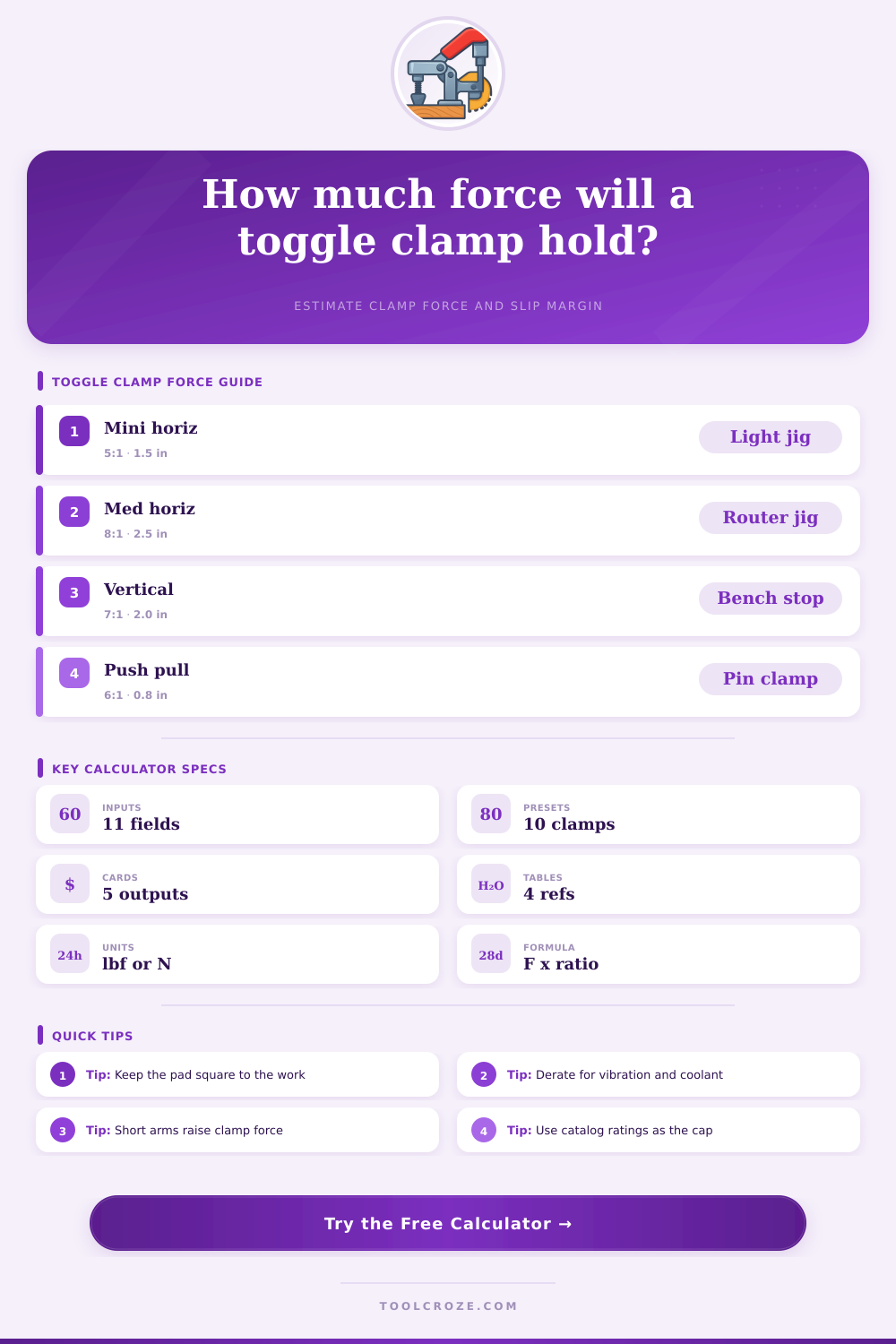
Toggle Clamp Holding Force Calculator
Estimate the practical holding force of a toggle clamp from handle effort, linkage ratio, clamp arm length, toggle angle, pad friction, material, vibration, and margin.
Toggle clamp force results
Calculation breakdown
| Workpiece material | Typical pad friction | Marking risk | Clamp note |
|---|---|---|---|
| Hardwood with rubber pad | 0.45 to 0.65 | Medium | Use a swivel pad for uneven grain |
| Softwood with rubber pad | 0.50 to 0.75 | High | Spread load with a larger pad |
| Plywood or MDF | 0.40 to 0.60 | Medium | Watch veneer crushing near edges |
| Dry aluminum | 0.25 to 0.45 | Low | Use serrated or urethane pads for side load |
| Dry mild steel | 0.20 to 0.35 | Low | Oily surfaces need a heavy derate |
| Stainless steel | 0.18 to 0.32 | Low | Smooth sheet can slip with light pressure |
| Acetal or acrylic | 0.20 to 0.40 | High | Use soft pads and lower pressure |
| Clamp style | Typical rating | Arm or stroke | Best use |
|---|---|---|---|
| 201-B style mini horizontal | 100 to 150 lbf | 1.3 to 1.8 in arm | Small stops, thin sheet, light inspection fixtures |
| 225-D style horizontal | 300 to 500 lbf | 2.0 to 3.0 in arm | Woodworking jigs, router fixtures, drill stops |
| 227-U style vertical | 450 to 700 lbf | 2.0 to 3.5 in arm | Bench fixtures where handle clearance matters |
| Heavy horizontal hold-down | 700 to 1200 lbf | 3.0 to 5.0 in arm | Weld tabs, machining nests, thicker stock |
| Push-pull plunger clamp | 150 to 600 lbf | 0.5 to 1.5 in stroke | Pinning, side stops, draw-in fixture points |
| Toggle latch / draw clamp | 200 to 1000 lbf | Adjustable hook | Door seals, covers, and pull-down closures |
| Fixture condition | Vibration factor | Holding margin | When to use it |
|---|---|---|---|
| Static inspection or glue-up | 1.00 to 1.10 | 20% to 30% | Low side load and no motor vibration |
| Router, saw, or drill jig | 1.20 to 1.35 | 30% to 45% | Intermittent cutting forces and hand feed variation |
| CNC machining fixture | 1.40 to 1.80 | 45% to 75% | Continuous vibration and possible coolant on pads |
| Welding or impact handling | 1.30 to 1.70 | 40% to 70% | Heat movement, knocks, and part distortion |
| Oily or polished surface | 1.50 to 2.00 | 60% to 100% | Low friction where slip is more likely than lift |
| Preset | Material | Clamp geometry | Primary concern |
|---|---|---|---|
| 201-B mini horizontal | Thin mild steel | 3.2 in handle, 1.4 in arm, 5:1 | Do not over-mark sheet stock |
| 225-D medium horizontal | Plywood | 5.0 in handle, 2.5 in arm, 8:1 | Keep router side load below friction hold |
| 207-U vertical hold | Hardwood | 4.2 in handle, 2.0 in arm, 7:1 | Pad squareness and denting |
| Push-pull plunger | Aluminum | 2.8 in handle, 0.8 in arm, 6:1 | Side load along plunger axis |
| CNC vibration clamp | Aluminum plate | 5.5 in handle, 2.2 in arm, 9:1 | Derate for coolant and vibration |
On a workbench, toggle clamps is easy to understand. Flip that lever and there’s a click as linkage snaps across center point. What really matters are how hard those clamps can absorbs when you’re using something like a weld gun or router. That figure determine if fixture will remain still or lurch in an unsafe direction.
What rating is on the catalog are not everything. Lock angle, arm length, handle effort and linkage geometry affect the force. A shorter arm mean more pressure on pad. A longer arm may be needed to clear thick stock but it reduces mechanical advantage. These is trade-offs that can seen using a calculator before bolting it down.
How Toggle Clamps Work
Locking power come from the angle. Generally, a good lock occurs when you have 3-8 degrees locked beyond center. Less than two degrees and it’s weak more than ten degrees and the self-lock will fail. So this little window convert your hand pressure to holding power.
The not-so-obvious variable are friction at the pad. Dry rubber on hardwood sticks realy well. Oily steel makes that same rubber slip right off. Your tool can adjusts the friction coefficient based off your material. Next it display what side force the clamp will resist before slipping. That’s usually difference maker in the shop. Sounds like 400-pounds normal force is good, but with 0.25 friction coefficient, you have only 100 pounds of side-load capacity.
Margin of Safety: Vibration is a factor here. There are modest margins on quiet glue up jig. A CNC router cause serious derating due to harmonic chatter and sudden starts. Polishing out friction reduce holding power. Coolant under the pad does too. Catalog charts don’t reflect these conditions. Seasoned builder increase their margin for unpredictable shop condition.
But there is common mistakes that take away from clamping force. You reduce advantage by using longest arm that will fit. You steal force by mounting clamp so the pad impacts at an angle. Not paying attention to pivot wear also reduces its effectiveness. The catalog ratings was made for specific handle loads and perfect conditions. Going above and beyond than that handle load voids the rating. Consider the manufacturer’s number a hard ceiling.
There is friction and surface damage. Plastics and softwood dent with heavy loads. Steel/aluminum takes it but can slip without a rough surface. Pads provides contact and prevent marking. Pad size spread pressure on soft surfaces and avoids it on metal where bite is needed. Bigger pads spreads load on soft stuff. Smaller pads avoid pressure on metal.
Use toggle clamps: Toggle clamps excel when you make sure the load, materials, fixture, and shop conditions all works in your favor. Respect their limits and do the numbers. If the math seem marginal, add an extra stop or even a second clamp. It’s a clever mechanism and it would of work as well as you set it up. Get those details right and lever holds firm.