
A timing belt connect two pulleys that keep the machine running in sync with each other. It sounds easy but if you have incorrect size your system will skip teeth. Choosing the right width, length, and pitch for your available space and load can make the difference between smooth running and total failure. Most folks ordering a replacement for the first time don’t realize how critical it is to get it matched up correctlyly.
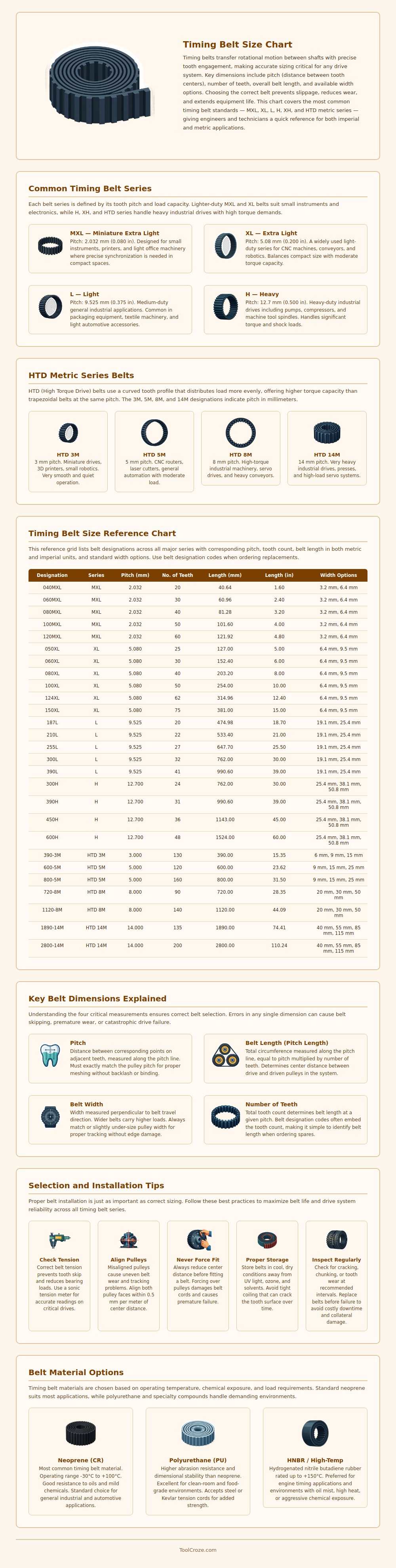
Because each machine has its own balance between compactness and strength, there are various belt series: the infographic breaks them down into main families based off their tooth spacing (with the smaller-pitch MXL for printers at the bottom, and H, L, XL for heavier-industrial uses higher up). So the bigger pitch give you more torque capacity… But also a bulkier belt. The chart lets you pick a series based on your power needs. It also help you find one that fits both the pulley diameter and your power requirements without needing to redesign anything.
How to Choose the Right Timing Belt
That’s where the HTD belts does things differently. Rather than using trapezoidal teeth, they has rounded teeth that spread out the force over a larger area. So a smaller belt can carries the same amount of load. There are 3M, 5M, 8M, and 14M size belts shown in infographic, covering everything from small desktop CNC machines up to large presses. For your own application, decide if you want the slightly quieter operation of the new curved design, or save a few bucks with old style H belt. There’s even a column for width that will remind you that a wider belt won’t add any capacity beyond what pulley face can accommodate.
By looking at those numbers, you should of be able to cut your choices quickly after identifying both the center-to-center distance of the pulleys and the belt series. But how do you use this information? Well, each number in the chart represent a belt code. That code appears as a stamp on the back of your used belt so you can refer to it and find corresponding length and tooth count on the list.
When measuring, there are four factor to consider each and every time. The first is pitch which needs to be perfect for the pulley in order to have the teeth bite correctly. Next is overall length, which gives your center distance between the shafts. Then width, which tell you at what point a belt will begin to stretch its internal cords and transmit less torque. And finally, tooth count ensure the proper length once you know the pitch. Get one wrong, it’ll either slip under load or bind.
The right tension and alignment are as important as selecting the proper size in the first place. Too loose tension result in jumping teeth. Too tight tension put unnecessary load on bearings. Slightly misaligned pulleys will wear one side of the belt more quick than the other. Addressing these two items at install time avoids having to deal with belt problems down the road such as missed steps or noise.
Then there’s the matter of materials. For most shops, neoprene is fine; clean room environments require a polyurethane because it keeps its size under those conditions. Around an engine, the heat and oil is no problem for an HNBR compound. These choices are included on the info graphic so you know which one matches up with the chemicals and temperatures where your machine operates.
Ultimately, you don’t have to remember codes, which takes the guesswork out of the process. Now that you’ve got a handle on width, length, and pitch, ordering the proper belt is a confident move.
