⚙️ Timing Belt Length Calculator
Calculate exact belt length, tooth count & center distance for any pulley drive system
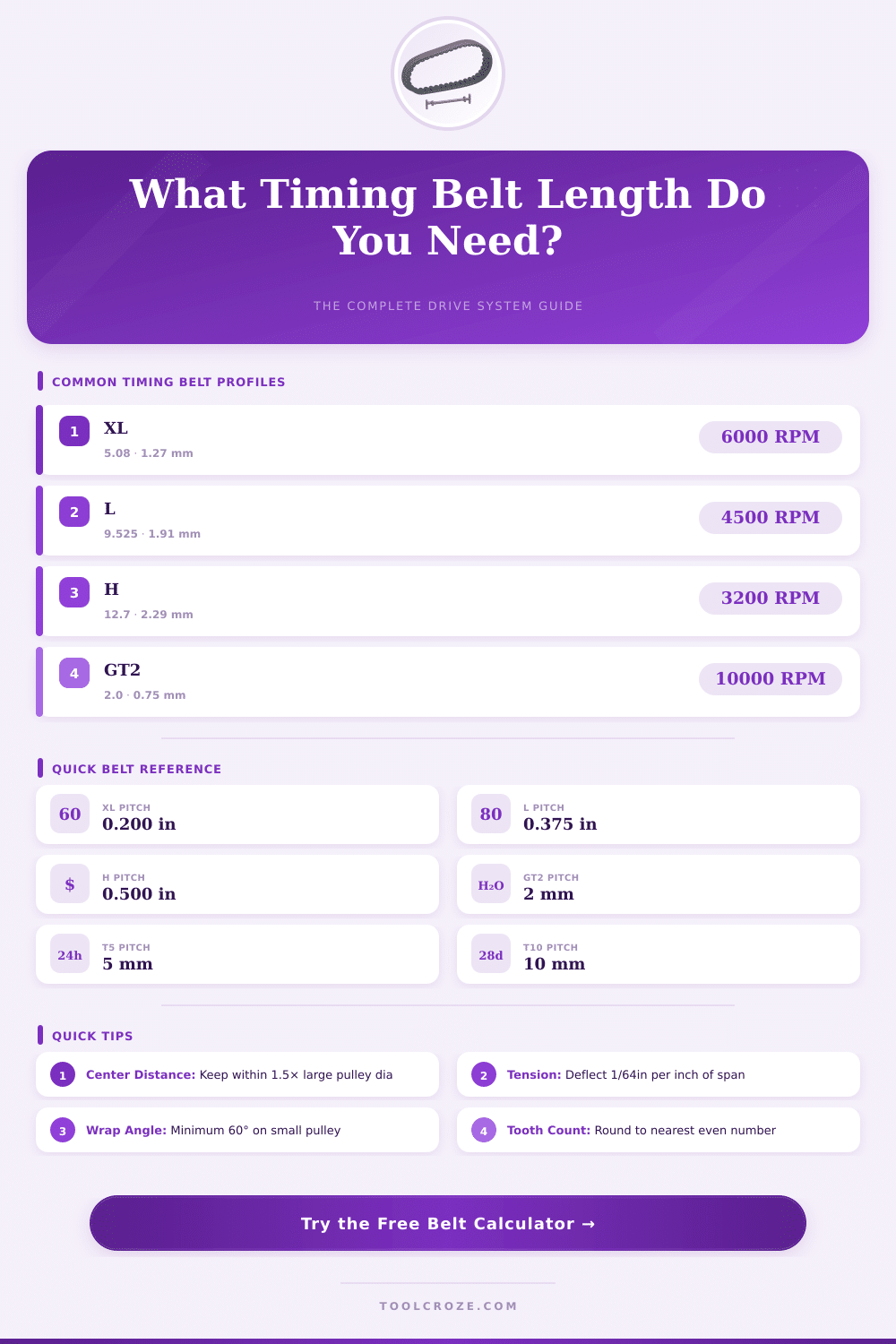
| Profile | Pitch | Tooth Height | Tooth Angle | Max Speed (ft/min) | Typical Application |
|---|---|---|---|---|---|
| MXL | 0.080" / 2.032 mm | 0.020" | 40° | 6,500 | Light instruments, precision |
| XL | 0.200" / 5.08 mm | 0.050" | 40° | 6,500 | Office machines, 3D printers |
| L | 0.375" / 9.525 mm | 0.075" | 40° | 4,500 | Automotive, small machinery |
| H | 0.500" / 12.70 mm | 0.100" | 40° | 3,200 | Industrial drives, conveyors |
| XH | 0.875" / 22.225 mm | 0.200" | 40° | 2,500 | Heavy industrial |
| XXH | 1.250" / 31.75 mm | 0.312" | 40° | 1,800 | Very heavy duty |
| GT2 | 2.0 mm / 0.0787" | 0.75 mm | 20° | 10,000+ | 3D printers, CNC axes |
| GT3 | 3.0 mm / 0.1181" | 1.14 mm | 20° | 8,000 | CNC routers, robotics |
| T5 | 5.0 mm / 0.1969" | 1.20 mm | 40° | 4,000 | Light servo, medical equip. |
| T10 | 10.0 mm / 0.3937" | 2.50 mm | 40° | 2,800 | Industrial servo drives |
| AT5 | 5.0 mm / 0.1969" | 1.60 mm | 50° | 5,000 | High-torque precision |
| AT10 | 10.0 mm / 0.3937" | 4.00 mm | 50° | 3,000 | High-torque industrial |
| Driver Teeth | Driven Teeth | Ratio | Input 1750 RPM | Output RPM | Belt Velocity (ft/min) |
|---|---|---|---|---|---|
| 12 | 12 | 1:1 | 1750 | 1750 | Depends on pitch |
| 18 | 36 | 2:1 reduction | 1750 | 875 | Medium speed |
| 20 | 40 | 2:1 reduction | 1750 | 875 | Medium speed |
| 24 | 48 | 2:1 reduction | 1750 | 875 | Medium speed |
| 18 | 54 | 3:1 reduction | 1750 | 583 | Lower speed |
| 20 | 60 | 3:1 reduction | 1750 | 583 | Lower speed |
| 30 | 15 | 2:1 increase | 1750 | 3500 | Higher speed |
| 40 | 20 | 2:1 increase | 1750 | 3500 | Higher speed |
| Profile | Common Tooth Counts | Belt Length Range | Typical Use | Belt Width Options |
|---|---|---|---|---|
| XL | 40–200 teeth | 8"–40" | Light machinery, printers | 1/4", 3/8", 1/2", 3/4" |
| L | 50–300 teeth | 18.75"–112" | Automotive, HVAC fans | 1/2", 3/4", 1" |
| H | 60–270 teeth | 30"–135" | Industrial, conveyors | 3/4", 1", 1.5", 2", 3" |
| XH | 50–150 teeth | 43"–131" | Heavy industrial | 1", 1.5", 2", 3" |
| GT2 | 80–2000 teeth | 160 mm–4000 mm | 3D printers, CNC | 6 mm, 9 mm, 15 mm |
| T5 | 90–600 teeth | 450 mm–3000 mm | Servo, automation | 10 mm, 16 mm, 25 mm |
| T10 | 50–400 teeth | 500 mm–4000 mm | Industrial servo | 16 mm, 25 mm, 32 mm |
| Application | Belt Profile | Driver Teeth | Driven Teeth | Typical Center Dist. | Typical Belt Length |
|---|---|---|---|---|---|
| 3D Printer (Cartesian) | GT2 | 20 | 20 | 200–400 mm | ~900 mm |
| CNC Router (X/Y axis) | GT3 / XL | 20 | 20 | 500–1500 mm | Open-end belt |
| Automotive Cam Drive | L / HTD | 19–23 | 38–46 | 8–12" | 60–130 teeth |
| Conveyor Drive (light) | H | 18–30 | 18–60 | 12–36" | 60–200 teeth |
| Lathe Headstock | T5 / XL | 20–30 | 40–80 | 6–15" | 50–150 teeth |
| Servo / Stepper Drive | T10 / AT10 | 20–36 | 20–72 | 100–500 mm | 600–2000 mm |
| ATV / Go-Kart Jackshaft | H / XH | 18–30 | 36–60 | 8–20" | 72–180 teeth |
| Printer (wide format) | XL / GT2 | 20 | 20 | 600–2000 mm | Open-end |
Get the right length for your timing belt is very important. If you mess up here, you risk bad tension, slide, misalignment or even whole motor stoppage. So accuracy in the calculations matters a lot.
Good start? The online calculators remove the biggest part of the issues about that. You simply enter the distance between the centres of your pulleys together with their diameters, or if you already know the length of the belt, only one step for direct calculation.
Find the Right Timing Belt Length
Some programs work in both modes, they estimate the belt length from the sizes of your shafts or from the central distance, when you lay other variables in. They aim to be really easy.
To count the length of a timing belt yourself you require two main pieces of info: the gap between your two shafts and the pitch diameters of every pulley (makers usually list them). There is a real formula for all this, but it is not fully simple. Assume, you work with pulleys of 6 inches and 20 inches; then the timing belt would be around 153.72 inches long.
The math includes pi, the two diameters and how far apart your shafts are.
When buying a timing belt, the sellers give three main numbers: pitch, pitch length and width. The pitch length shows the whole number of teeth times the pitch distance. About the pitch, it measures from one edge of a tooth to the matching edge on the next tooth.
For instance, L-type timing belt with 3/8-inch pitch matches around 9.53 millimeters. HTD timing belts measure pitch differently, from the centre of one toth to the centre of the next, so that 8-millimeter HTD-pitch is very usual. Here is advice: never measure a timing belt by means of string.
It simply is not precise enough.
If you already have the write timing belt, lay it flat without any twist and pull a flexible tape along the outer edge. You can also count the teeth, if you want (mark one tooth as a starting point), so you do not lose the rhythm. Broken timing belt?
Simply measure it from end to end.
The timing belts come in a set of widths, 1/4 inch, 5/16 inch, 3/8 inch, 1/2 inch… And you can get custom widths cut also. Their typical tooth count range goes from 21 to 590, what covers everything from short to really long drives.
Standard inch and metric widths come in 9 different sizes, plus special widths that stores can cut from stock.
Real builds get surprisingly tricky sometimes. If you work with 36-tooth and 15-tooth HTD5 pulleys with 15 mm timing belt? It needs carefully entered data in the calculator.
I saw cases, where some used 24-tooth and 48-tooth pulleys in 4.5-inch central distance, and the program showed teeth between 110 and 115 teeth for GT2 3 mm timing belt. Adding idler pulleys helps take up extra slack, while you get more contact of timing belt on the drive pulleys. If you overtighten by means of a toolarge timing belt, your tensioner will not be able to make up for the loosening, then you risk tooth skipping.