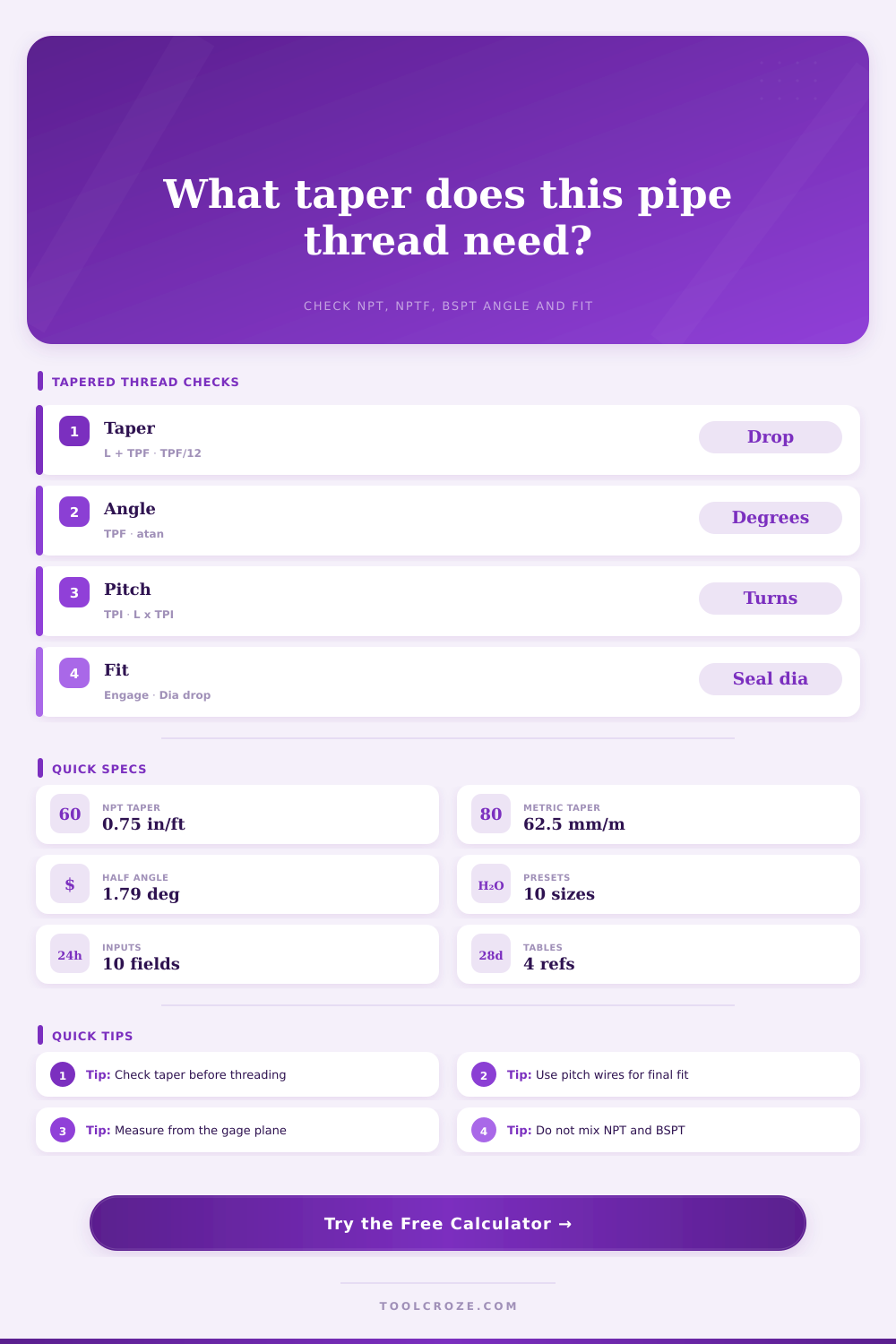
Thread Taper Calculator
Calculate tapered pipe thread diameter change, taper angle, compound setting, turns of engagement, and pitch diameter estimates for NPT, NPTF, BSPT, and custom taper work.
| Nominal pipe thread | Threads per inch | Approx outside diameter | Typical hand-tight length | Taper per turn on diameter |
|---|---|---|---|---|
| 1/16-27 NPT | 27 TPI | 0.313 in | 0.242 in | 0.0023 in/thread |
| 1/8-27 NPT | 27 TPI | 0.405 in | 0.260 in | 0.0023 in/thread |
| 1/4-18 NPT | 18 TPI | 0.540 in | 0.400 in | 0.0035 in/thread |
| 3/8-18 NPT | 18 TPI | 0.675 in | 0.408 in | 0.0035 in/thread |
| 1/2-14 NPT | 14 TPI | 0.840 in | 0.533 in | 0.0045 in/thread |
| 3/4-14 NPT | 14 TPI | 1.050 in | 0.545 in | 0.0045 in/thread |
| 1-11.5 NPT | 11.5 TPI | 1.315 in | 0.682 in | 0.0054 in/thread |
| BSPT designation | Threads per inch | Approx major diameter | Thread form | Common check point |
|---|---|---|---|---|
| R 1/8 | 28 TPI | 0.383 in / 9.73 mm | 55° Whitworth | Parallel Rc or Rp fitting |
| R 1/4 | 19 TPI | 0.518 in / 13.16 mm | 55° Whitworth | Gauge plane contact |
| R 3/8 | 19 TPI | 0.656 in / 16.66 mm | 55° Whitworth | Gauge plane contact |
| R 1/2 | 14 TPI | 0.825 in / 20.96 mm | 55° Whitworth | Seal length plus turns |
| R 3/4 | 14 TPI | 1.041 in / 26.44 mm | 55° Whitworth | Seal length plus turns |
| R 1 | 11 TPI | 1.309 in / 33.25 mm | 55° Whitworth | Gauge ring confirmation |
| Calculation | Formula | Typical NPT value | Use in setup |
|---|---|---|---|
| Diameter taper per inch | Taper per foot / 12 | 0.0625 in/in | Diameter drop over axial travel |
| Half taper angle | atan((TPF / 2) / 12) | 1.7899° | Compound set from spindle axis |
| Included taper angle | 2 x half angle | 3.5798° | Included cone angle on diameter |
| Drop per thread | (TPF / 12) / TPI | 0.00446 in at 14 TPI | Expected diameter change each pitch |
| Turns in engagement | Length x TPI | 7.46 turns at 0.533 in | Gage and wrench-tight planning |
| Threaded part material | Machining note | Fit sensitivity | Typical allowance |
|---|---|---|---|
| Brass adapter | Cuts cleanly, tends to seal smoothly | Medium | 1% to 2% diameter drop |
| Carbon steel pipe | Watch torn crests and die wear | Medium | 2% setup margin |
| Stainless fitting | Work hardens; avoid rubbing passes | High | 2% to 3% margin |
| Cast iron port | Brittle chip; confirm gage contact | High | 1% to 2% margin |
| Aluminum manifold | Easy to oversize soft internal threads | High | 0% to 1% margin |
| PVC adapter | Do not over-tighten tapered pipe threads | Very high | Use specification limit |
The threads aren’t really the thing; it is usually the taper that gets ignored. Usually the issue is a taper that was overlooked.
When tapered pipe threads close, they don’t clamp onto a flat surface and seal that way. They seal because the diameter of one closes on diameter of the other, with their respective flanks bending to fit around each other. It’s the angle: Get that wrong, or the amount of engagement wrong and you’ve got yourself a fitting leak.
Why Taper Is More Important Than Threads
While the number on the calipers may be scary, the math isn’t hard at all. A thread taper is simply a ratio. In other words, for every foot of length, actual diameter decreases by three quarters of an inch. That means it’s a 1 to 16 taper for regular NPT and NPTF threaded parts. It’s not a big angle, in fact it’s barely perceptible, but it adds up fast.
What happens then is the calculator translates that into a particular diameter reduction and compound angle for your part. But knowing how to work with it is one thing. Knowing what to do with the numbers is another.
Measuring from the incorrect location are the most frequent error. The measurement location makes all the difference. There are two diameters to consider in the thread. The major diameter is at large end of the thread. The minor diameter is one pitch inside the large end. Depending on where you make the measurement, you will have different numbers. On a 14 TPI thread, change between these two measurements is small; but real. To ask for outside diameter at the large end of the thread means the most reliable reference point. From there you cut based off the taper angle. On an NPT thread this is approximately 1.79 degrees. Then you set your compound rest to that taper angle and cut based on that known reference. For a seal that has to hold, that level of precision isn’t negotiable.
Length of engagement is another key variable here. For example, you may reason that if you spin the fitting onto the hose tighter than it will seal better. That’s generally untrue in tapered threads. When over tightened, tips of the threads gets crushed, which results in a loss of metal where the seal forms. As the table of references shows, each size has its own suggested hand-tight and wrench-tight lengths. And those numbers aren’t pulled out of thin air. They’re determined so as to provide enough overlap between the threads to form a pressure barrier while not exceeding material’s yield strength.
Be cautious with aluminum and brass, because they deform easier than steel do. They’ll make a seal with less turns, but they’ll also be destroyed with too many turns.
NPTF means dry seal. The “F” indicates this. This means the thread has a slightly altered flank that seals with exact fit without any added compound or tape. Additives fill the tiny gaps in standard NPT.
Trying to insert an NPT plug into a BSPT hole? Or vice versa? You’re going against geometry. The flank angles is different. An NPT has a 60 degree flank angle. A BSPT has 55. You might be able to fight your way past that, but you won’t get a seal. The calculator switches back and forth between standards. It doesn’t make incompatible threads work together.
What about material? Different materials require different approaches as well. For instance, stainless steel work hardens. Repeatedly rubbing the cutting tool over the material will make it harder and more difficult to cut but weaker. You’re looking for clean cuts.
What’s the appropriate allowance? Set it right. There’s an allowance setting on the calculator to make up for either material inconsistency or tool wear. Most of the time, 2 percent is a good bet for shop work. That provides a bit of breathing room while still maintaining integrity.
A taper is a mechanical promise: A promise that if you connect two pieces of metal together with a taper they’ll form an impervious barrier against pressure. To keep that promise takes some humility regarding materials, care when checking the engagement length and respect for the taper. You should of checked it twice. Pay attention to your angles. Honor the length.
Also, understand that even a small change in diameter on the big end makes a big difference to the seal. It’s a small thing. But it matters.