🔧 Thread Pitch Diameter Calculator
Calculate pitch diameter, minor diameter, and thread engagement for UN, UNC, UNF, and Metric threads
| Thread Size | Standard | TPI | Major Dia (in) | Pitch Dia (in) | Minor Dia (in) | Pitch (in) |
|---|---|---|---|---|---|---|
| #4 | UNC | 40 | 0.1120 | 0.0958 | 0.0813 | 0.02500 |
| #6 | UNC | 32 | 0.1380 | 0.1177 | 0.0997 | 0.03125 |
| #8 | UNC | 32 | 0.1640 | 0.1437 | 0.1257 | 0.03125 |
| #10 | UNC | 24 | 0.1900 | 0.1629 | 0.1389 | 0.04167 |
| 1/4 | UNC | 20 | 0.2500 | 0.2175 | 0.1887 | 0.05000 |
| 1/4 | UNF | 28 | 0.2500 | 0.2268 | 0.2062 | 0.03571 |
| 5/16 | UNC | 18 | 0.3125 | 0.2764 | 0.2443 | 0.05556 |
| 3/8 | UNC | 16 | 0.3750 | 0.3344 | 0.2938 | 0.06250 |
| 3/8 | UNF | 24 | 0.3750 | 0.3479 | 0.3239 | 0.04167 |
| 1/2 | UNC | 13 | 0.5000 | 0.4500 | 0.4001 | 0.07692 |
| 1/2 | UNF | 20 | 0.5000 | 0.4675 | 0.4387 | 0.05000 |
| 5/8 | UNC | 11 | 0.6250 | 0.5660 | 0.5069 | 0.09091 |
| 3/4 | UNC | 10 | 0.7500 | 0.6850 | 0.6201 | 0.10000 |
| 1 | UNC | 8 | 1.0000 | 0.9188 | 0.8376 | 0.12500 |
| Thread | Pitch (mm) | Major Dia (mm) | Pitch Dia (mm) | Minor Dia (mm) | Tap Drill (mm) | Tolerance |
|---|---|---|---|---|---|---|
| M3 | 0.5 | 3.000 | 2.675 | 2.459 | 2.5 | 6H |
| M4 | 0.7 | 4.000 | 3.545 | 3.242 | 3.3 | 6H |
| M5 | 0.8 | 5.000 | 4.480 | 4.134 | 4.2 | 6H |
| M6 | 1.0 | 6.000 | 5.350 | 4.917 | 5.0 | 6H |
| M8 | 1.25 | 8.000 | 7.188 | 6.647 | 6.8 | 6H |
| M10 | 1.5 | 10.000 | 9.026 | 8.376 | 8.5 | 6H |
| M12 | 1.75 | 12.000 | 10.863 | 10.106 | 10.2 | 6H |
| M14 | 2.0 | 14.000 | 12.701 | 11.835 | 12.0 | 6H |
| M16 | 2.0 | 16.000 | 14.701 | 13.835 | 14.0 | 6H |
| M20 | 2.5 | 20.000 | 18.376 | 17.294 | 17.5 | 6H |
| M24 | 3.0 | 24.000 | 22.051 | 20.752 | 21.0 | 6H |
| M30 | 3.5 | 30.000 | 27.727 | 26.211 | 26.5 | 6H |
| Material | Brinell Hardness | Tap Speed (SFM) | Cutting Fluid | Thread Quality | Engagement Factor |
|---|---|---|---|---|---|
| Steel (Alloy) | 200–300 HB | 20–40 | Cutting oil required | Excellent | 1.0x |
| Mild Steel | 120–160 HB | 30–50 | Cutting oil | Excellent | 1.0x |
| Stainless Steel | 150–250 HB | 10–20 | Sulphurized oil | Good (work-hardens) | 1.2x |
| Aluminum | 30–95 HB | 60–120 | Light oil / WD-40 | Good | 1.5x |
| Brass / Bronze | 60–100 HB | 50–100 | Dry or light oil | Excellent | 1.0x |
| Titanium | 300–370 HB | 8–15 | Heavy cutting oil | Difficult | 1.5x |
| Cast Iron | 180–220 HB | 25–45 | Dry | Good | 1.0x |
| Plastic / Nylon | – | 50–150 | Dry | Fair (soft threads) | 2.0x |
| Class | Fit Type | Pitch Dia Tol (6H) | Application | Allowance |
|---|---|---|---|---|
| 2g / 2H | Precision / Close | ±0.010 mm | Instruments, aerospace | Minimal |
| 4g / 4H | Close Fit | ±0.018 mm | Precision assemblies | Small |
| 6g / 6H | Standard (General) | ±0.025 mm | General engineering | Standard |
| 8g / 8H | Free Fit | ±0.040 mm | Heavy industry, coated parts | Large |
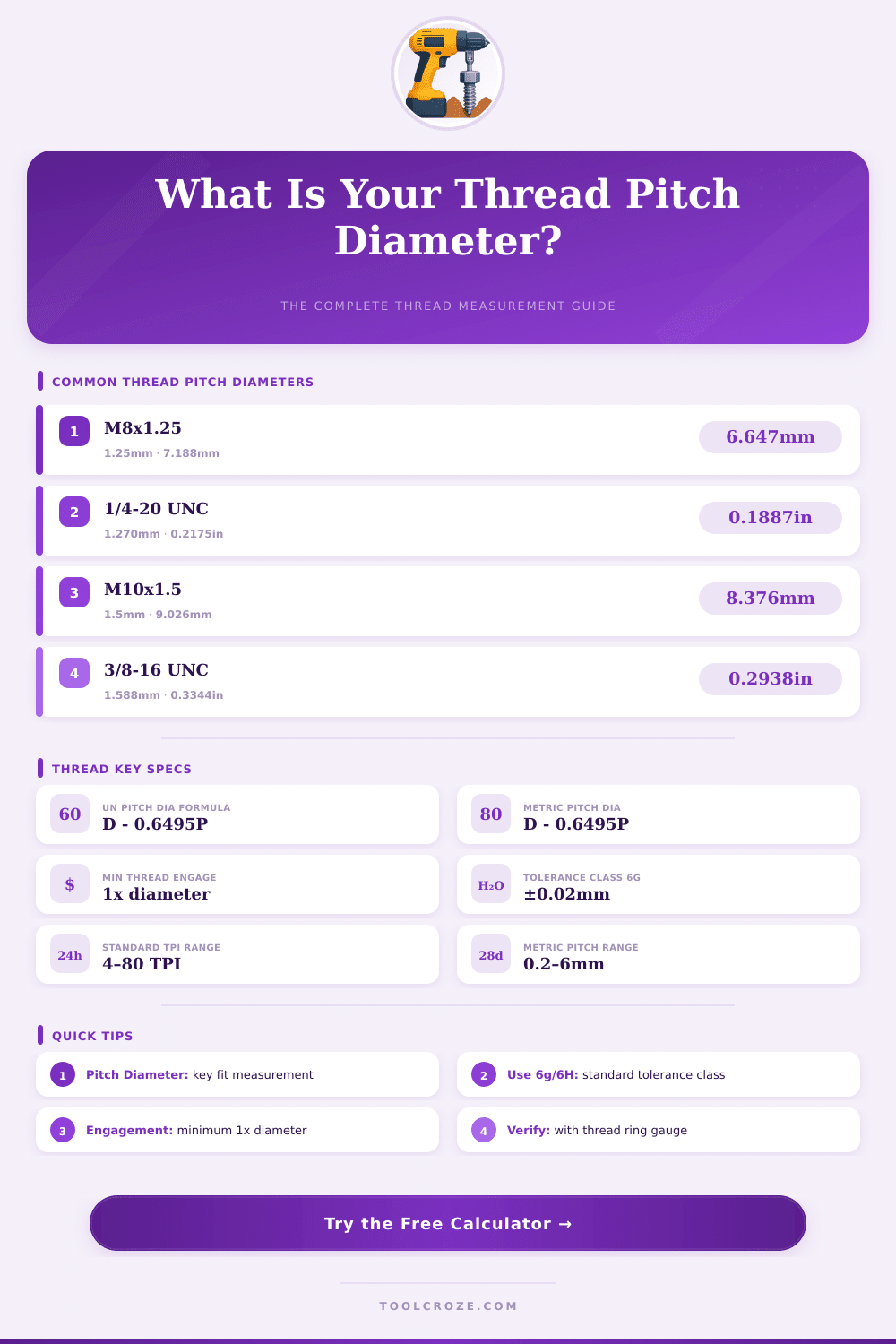
The diameter of the pitch ranks between the most important sizes that you find on any seal with Thread. Some call it efficient diameter, and truly, that phrase helps to understand what it truly means. Even so here is the key spot: one can not touch it physically or keep in the hand.
It shows the diameter of fake roll, that runs through the profile of the Thread, placed here, where the beam of the Thread matches to the space between threads.
What Is the Pitch Diameter of a Thread
Does it yet seem a bit abstract? Allow that I explain it otherwise. Every screw or bolt has a main diameter, that is the outer size, that one sees.
Later comes the key diameter, that one measures from root to root on the outsides of threads. The pitch diameter sits exactly between those two. Here happens the real contact between the seal and that, in what it draws.
And note this: the height of the Thread can be figured out, if one knows the main and key diameters.
So, why does one care about the pitch diameter? It decides, will the seal fit well with its match. Everything depends on the force and the pressure on it.
When threads are rolled (rather than cut), the internal diameter always matches to the pitch diameter of the ended Thread, like this works the roller as a process of forming.
To measure the pitch diameter does not require being a rocket scientist, but it requires attention. The method with three wires is very used, one places wires in the Thread and measures by means of a tool the efficient diameter. Also checks by means of Thread gauges and optical tools work well.
With proper skill and aids for checking, one can estimate internal pitch diameter until half of a thousandth of inch. Checks by means of wires give solid and steady results, while Thread gauges for particular size, pitch and tolerance controls the pitch diameter of internal threads.
Different series of threads exist, based on combinations of diameter and pitch. In the imperial system we use threads per inch. Metric threads work otherwise; the pitch is simply the distance between threads in millimeters.
For instance, M18x2.5 means 18-millimeter diameter with 2.5 millimeters between every pair of threads. Small pitch makes the Thread more fine, while big pitch makes it more coarse. The SAE-system stays with threads per inch as main measure.
There does exist a math formula for counting the base of the pitch diameter. It matches to the basic main diameter decrease multiplied by 0.75 and the cosine of 30 degrees multiplied by the pitch. Or, other version: main diameter decrease multiplied by 0.649519 and the pitch.
Both formulas answer for united and ISO-metric forms of threads.
Some favor double or triple tools. There is a singel device, that estimates Thread pitch, diameter of bolt and grade of bolt all at once. That removes the kneed to bear three different tools only forrecognizing one seal.