
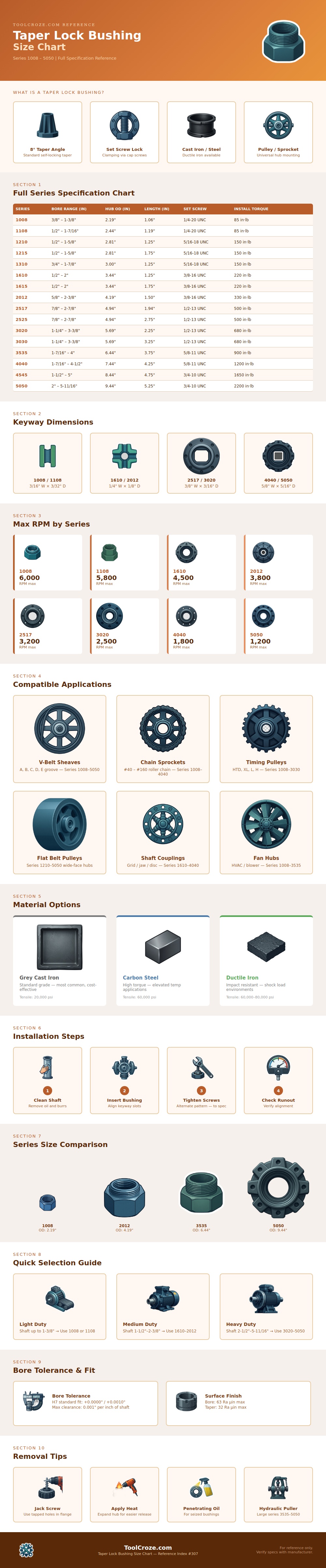
The selection of a proper taper lock bushing begins here. How does sizing it affect everything else? An oversize bushing increase cost and adds unneeded weight. Too small and it slips under a load. The sizing affect how securely the pulley or sprocket stay on the shaft and how much torque the assembly can handle before something shift or loosens.
So how do we know what size series match our shaft? Well, you can see it all laid out in infographic. You’ll be able to instantly match your shaft diameter with a series. This series will provide the proper combination of hub length and hub diameter. Why does it matter to make this matching step? Because each bushing have a taper angle built into it, and unless both parts is sized properly from the beginning, they won’t create that self-locking fit.
How to Choose the Right Bushing Size
With the proper series, you want to reach these torque values when tightening the screws. The screws should then seats the bushing equally on both sides and not cause common issue of grabbing tighter on one side versus another. A lot of folks overtighten because they think it’s safe. However, that can distort the hub and make future removal more harder than necessary.
Keyways also vary by series size, and chart shows their sizing. On a small shaft, a narrow keyway will suffice, however, on a larger shaft you want a deeper wider key to transmit more torque without shearing. Getting the right sized keyway for your application will ensure that the key isn’t your weakest link in the chain.
The bushing sizes are followed by max speed ratings; generally speaking, bigger bushings goes on the slowest, heaviest gear. Even though a big bushing might last forever in theory, it will shorten bearing’s life and add vibration when run fast. So the ratings represent your realistic limit, not some theoretical maximum.
One level below selecting size, we have the material. For typical uses, grey cast iron is cheapest and works for most stuff. Ductile iron or carbon steel is worth the higher prices if you’re anticipating higher temperature or shock loads which could fracture plain old iron. These choices appear in infographic to help you decide if your current stock is good enough or if you should of pay more for better material specs to match your operating conditions.
All of these come off and go back on similarly: clean out the shaft, line up the keyways, and snug down the retaining screws with an alternate cross pattern. Then check for runout after installation. That will catch any slight misalignment that can lead to vibration issues. If it’s had a set of bushings for several years, you might need some light heat and use the jack screw holes to get it loose for removal.
This brings me to the meat and potatoes of why the size chart matters. Although installing this type of mechanical connection isn’t exactly rocket science, there is enough room for error that you might wonder if you have done it correctly. If everything lines up, torque, bore, series and keyway with your load and shaft, the bushing will stay in place and do its job quietly until you choose to relocate it.
