
When you hear a table saw motor hum but it does not turn, you will typicaly hear a low and unhappy drones that comes from the saw’s motor. This drone indicates that the table saw blade will not spin, even if you turn the switch on the saw many times. This noise is one that many woodworkers dread.
Furthermore, this noise is typicaly unpleasantly to the ears when it occurs at a bad time. A bad time is one where you are in the middle of a project and have a deadline loom. The fact that the saw hums but the motor does not turn indicates an electrical problem or a mechanical problem within the saw.
However, the fact that the saw hums but does not turn also indicates that the saw motor has not experienced a total failure. This is good news for saw owners, since this typically means that the problem is not a total failure. These problems can typically be fixed without having to call a professional to fix the saw.
Most of these problems can also be fixed without having to replace the entire saw. By understanding the reasons why a table saw motor hums while the saw blade does not turn, you will save yourself time and money and reduce your frustrations with your saw. The hum from the motor indicates to the saw owner that the motor is receiving power.
However, the hum also indicates to the saw owner that there is an issue in the saw that is preventing the saw blade from spinning. This clue as to the cause of the humming motor will make it more easy for the saw owner to find the problem. You can fix the issue by following the steps listed below, which will go from the easiest fixes to those that require the most physical effort from the saw owner.
Common Reasons Your Table Saw Motor Hums
1. Tripped Overload Protector or Thermal Reset Button
The first issue to rule out is the most obvious cause of the motor hum without the table saw blade turning: a tripped overload protector or a thermal reset button. These reset buttons, which are located on many contractor saws and many cabinet saw models, will automatically open the circuit supplying power to the motor if the motor draw too much current when the motor is turned on. The motor may have tripped this safety feature if the saw saw’s blade is stuck or if the saw is connected to an extension cord that does not supply enough voltage to the saw motor.
When the circuit is opened, the motor will hum while the saw is on because the start winding is receiving power, but the reset button has cut the power to the run winding. To fix this problem, you should press the reset button firmly. If the saw motor hums without the saw blade turning and the reset button is now in the on position, then you can attempt to use your saw again.
This simple fix has fixed more saw motor than any other fix. If, however, the reset button pops back into the “off” position while you are attempting to use the saw, then you have a deeper problem within the motor that requires you to continue reading to find a fix. If the table saw motor hums without the saw blade turning and you have ruled out the overload protector, your next step is to inspect the start capacitor.
2. Failed Start Capacitor
These start capacitors provide the saw motor with the surge of energy required to start the saw motor. If the start capacitor has failed, the motor will hum loudly as the run winding of the motor is doing all of the work by itself. The capacitor is typically located on the motor and has two wire attached to it.
You should look at the capacitor to see if the sides of the capacitor are bulging, if there is oil that has leaked from the capacitor, and if the case of the capacitor is cracked. If you find any of these issues, you should replace the start capacitor with a new one with the same microfarad and voltage as the old start capacitor. By swapping the old start capacitor for a new one, the saw motor should start to work normaly.
You must not skip this step of discharging the old start capacitor using an insulated screwdriver. This potential jolt of electricity from the discharged start capacitor may startle you, but it is a vital step in the saw motor repair process. If the motor hums without the saw blade turning and you have ruled out both the overload protector and the start capacitor, your next problem is to check if there is any mechanical binding in the saw blade and arbor assembly.
3. Mechanical Binding in Blade and Arbor Assembly
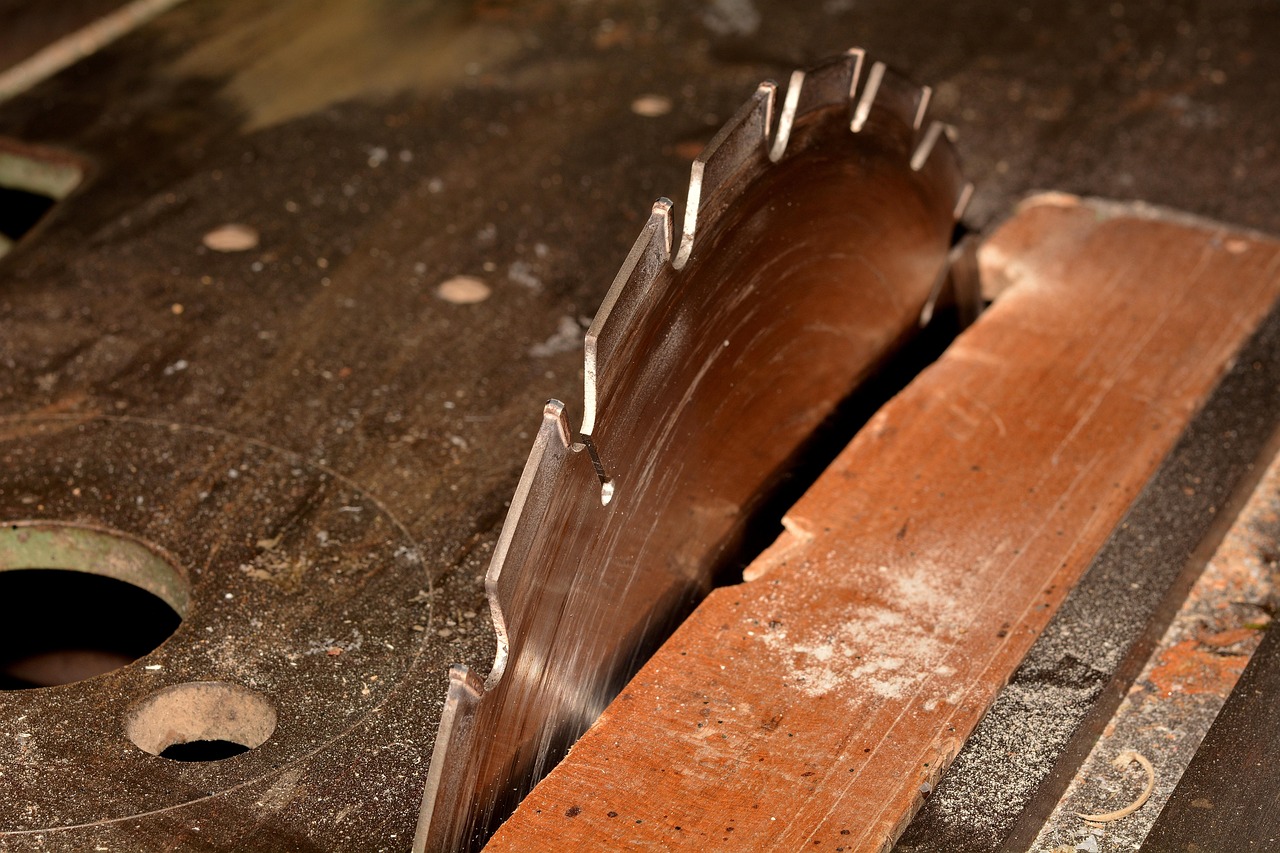
Even if the motor itself is in perfect condition, there are several reasons that the saw blade will not turn. These reasons include if the saw blade is pinched, the saw arbor bearings is seized, or there is an object that has fallen into the saw blade path. To check this issue, unplug the saw from the electrical outlet.
Remove the throat plate on the saw. Then manually turn the saw blade. There should be no resistance when turning the blade.
If there is any grit or resistance when turning the blade, you have found the problem. Remove the buildup of pitch, scrap, and fasteners from the saw blade. On models that use a saw belt, inspect the saw belt to ensure it is not glazed, cracked, or improperly tensioned.
4. Worn or Improperly Tensioned Saw Belt
If the belt slips when the saw is under load, it may be one of the cause of the humming saw motor. In this case, you should replace the belt. Additionally, realign the saw pulleys while you are performing this maintenance to prevent future issues with the saw motor.
If the saw motor hums but the saw blade does not turn and you have ruled out the overload protector, start capacitor, saw blade mechanical binding, and belt issues, you need to examine the centrifugal switch.
5. Stuck Centrifugal Switch
Motors that are of the older model may have a centrifugal switch and a set of weights on the saw motor that are used to disconnect the start winding from the motor once it reaches around 75% of its operating speed. If the centrifugal switch sticks in the “on” position, or if the weights that activate the switch are covered in sawdust, the saw motor will hum without turning the saw blade.
You can access this switch by removing the end bell on the saw motor. This is not a five-minute job to perform this diagnostic. However, the job is relatively straightforward if you are comfortable with using hand tools to disassemble the saw motor.
Remove the sawdust from the switch’s contact points using a fine emery cloth. Ensure the weights on the centrifugal switch move freely back and forth. Reassemble the saw motor while taking note of where the springs are positioned on the switch.
Once you have successfully completed this repair, the motor should start up in a normal way instead of vibrating and overheating. If the motor hums but the blade does not turn and you have ruled out the centrifugal switch and weights, you may have a problem with the power supply or the wiring between the power supply from the wall outlet to the motor. The voltage drop from a long extension cord that has high resistance in the cord may be preventing the saw motor from receiving enough amperage to start the motor.
6. Power Supply or Wiring Issues

Using a voltage tester, measure the voltage delivered to the motor’s leads while someone else attempts to start the saw. The voltage measured should be within 10% of the voltage supplied to the saw motor by the electrical outlet in the shop. Additionally, trace the power supply wiring from the electrical outlet to the motor to ensure that the electrical connections is secure and in good enough condition.
Over time, saw motor vibrations may have loosened some of the electrical connectors. Poor electrical connections will produce heat and resistance in the motor. This heat and resistance will manifest itself first as a humming sound from the motor and then as the motor’s circuit breakers getting tripped.
If you have followed each of the steps listed above to fix your saw motor that hums yet will not turn the saw blade, and if the motor is still not working correctly, then the motor itself may have experienced a failure in the motor windings. If a winding in the motor is shorted or if one of the motor’s phases is open, there will be a hum from the motor and there will be a burning smell from the motor after a few seconds of operation. In this case, use a multimeter to test for resistance in the motor’s windings.
7. Shorted Motor Windings
Follow the wiring diagram of the motor that is typically printed on the inside of the motor’s cover. The resistance of each of the motor’s windings should be the same. If the resistance in the saw motor’s windings is the same, then the motor is in good condition.
If the resistance in the motor is different from each other, or if the resistance in one of the phases is infinite, then it is time for motor motor repair or saw motor replacement. The cost to rewind the saw motor may be less than buying a new saw motor for large saws. However, only a qualified motor repair shop should undertake rewinding the motor.
8. Old or Worn Out Motor
Finally, if the saw motor hums without the saw blade turning, consider the age of the saw motor. If your saw motor is fifteen years old and you leave it in the dusty garage where it lives, the saw motor may be time for a motor replacement. The bearings that support the motor may have worn out.
The insulation that coats the motor’s windings may have degraded. The saw motor’s sawdust buildup may have eroded to form an abrasive material that shortens the life of the saw motor. If your saw motor is fifteen years old and lives in a dusty garage, the hum from the motor may be one of the signs that the saw motor’s motor is at the end of its life.
It may be time for the saw owner to invest in a new motor for the saw or to upgrade the saw itself. A new motor for the saw motor will run more quietly, start more quickly, and make the saw owner feel good about the operation of the saw motor when the owner use the switch. By following the steps above to fix the issue with your saw motor, you will find the problem and fix it yourself.
Taking the time to diagnose the hum of your saw motor will save you time and money. Additionally, if you follow the steps listed, you will feel good about yourself knowing that you are the one who fixed the motor. When you silence the unhappy drone from your motor and when the saw blade reaches full speed humming loudly, you will feel good about yourself knowing that you are the one who found and fixed the problem with your saw motor.
