Table Load Capacity Calculator
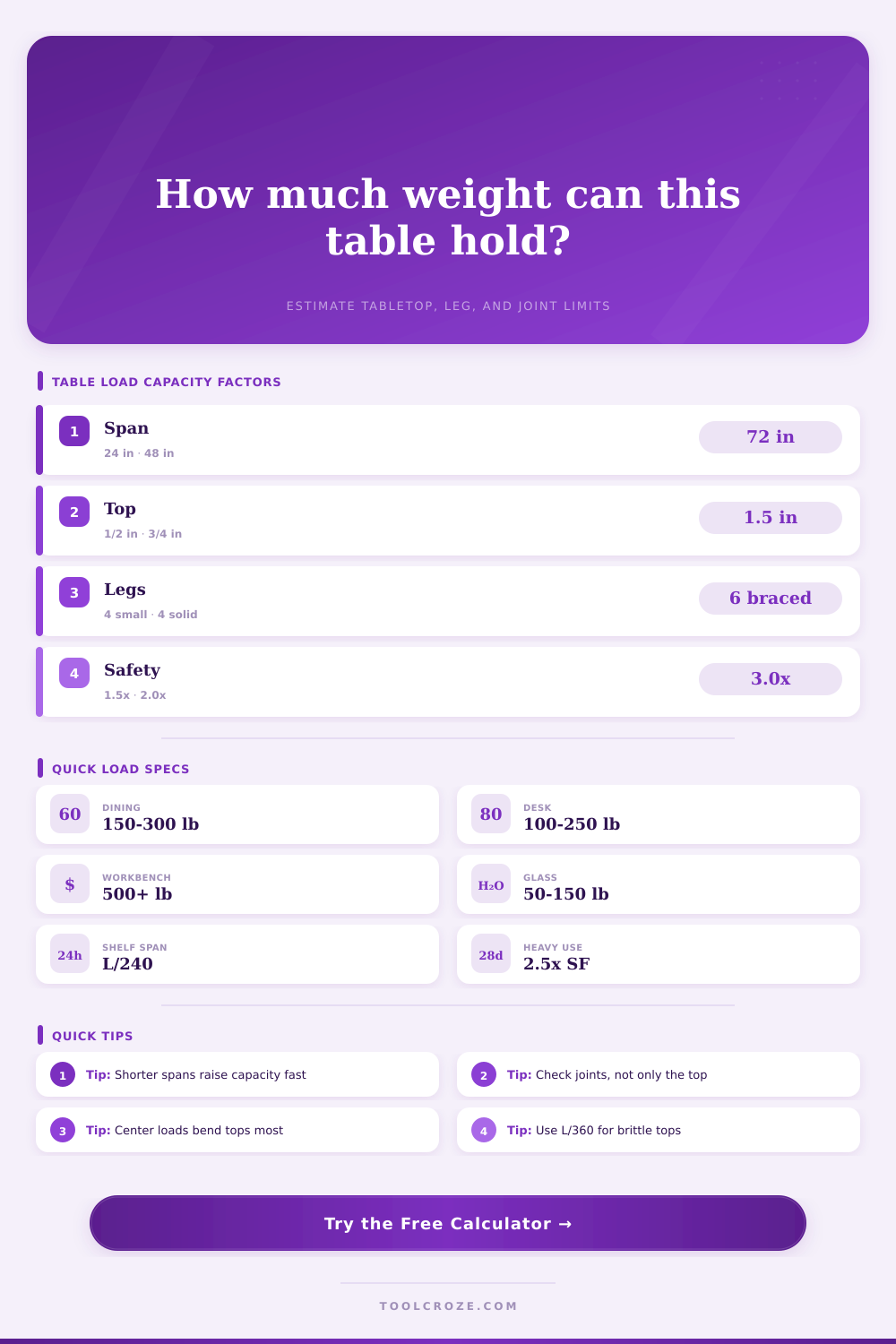
Estimate safe table load from tabletop bending, deflection, leg compression, connection strength, load placement, and a selected safety margin.
Calculated Table Load Capacity
Formula Breakdown
| Tabletop material | Approx density | Modulus of rupture | Best use in tables |
|---|---|---|---|
| Construction pine or fir | 28-35 lb/ft³ | 7,000-9,000 psi | Picnic tables, utility benches, light-duty tops |
| Red oak hardwood | 43-48 lb/ft³ | 13,000-15,000 psi | Dining tables, desks, framed tops with moderate spans |
| Hard maple butcher-block | 42-46 lb/ft³ | 15,000-16,500 psi | Work surfaces where dents and point loads matter |
| Furniture-grade plywood | 32-40 lb/ft³ | 5,000-8,000 psi | Folding tables, cabinet tops, wide panels with edge banding |
| MDF panel | 42-50 lb/ft³ | 3,500-5,000 psi | Craft tables and desks with short spans and broad support |
| Tempered glass | 150-160 lb/ft³ | 10,000-24,000 psi | Coffee tables and inserts with pads and conservative deflection |
| Support type | Approx allowable stress | Typical weak point | Capacity note |
|---|---|---|---|
| Softwood legs | 900 psi | Cross grain splits near screws | Use aprons to prevent racking before compression governs. |
| Hardwood legs | 1,500 psi | Mortise, bolt, or plate connection | Often stronger than the tabletop when well braced. |
| Mild steel tube legs | 12,000 psi | Weld, bolt plate, or floor leveling foot | High compression capacity, but check connection plates. |
| Aluminum tube legs | 8,000 psi | Buckling or thin wall denting | Good for display tables with wide, braced frames. |
| Threaded steel pipe legs | 8,500 psi | Flange screws pulling from top | Fastener count and top thickness usually control. |
| Plastic folding legs | 450 psi | Hinge bracket and lateral sway | Use lower safety ratings for moving or edge loads. |
| Load case | Bending moment model | Deflection model | Use this when |
|---|---|---|---|
| Evenly distributed table load | M = W L / 8 | δ = 5 W L³ / 384 E I | Books, dinnerware, evenly spread storage, or flat boxes. |
| Single heavy load at center | M = P L / 4 | δ = P L³ / 48 E I | A heavy tool, aquarium, appliance, or display object centered on the span. |
| Front-edge or overhang-heavy load | Center-point capacity × 0.75 | Center deflection capacity × 0.75 | Someone leaning on the front edge, monitor arms, or cantilevered use. |
| Rolling or moving shop load | Uniform capacity × 0.60 | Uniform deflection capacity × 0.60 | Tool carts, vibration, sliding loads, or repeated impact. |
| Table type | Typical top size | Common support span | Recommended safety factor |
|---|---|---|---|
| Coffee table | 24 × 48 in | 30-42 in | 2.0x, or 2.5x for glass |
| Dining table | 36 × 72 in | 54-66 in | 2.0x for normal household use |
| Computer desk | 30 × 60 in | 42-54 in | 2.0x, 2.5x with monitor arms |
| Folding utility table | 30 × 72 in | 50-64 in | 2.5x because brackets and sway govern |
| Garage workbench | 30 × 72 in | 24-48 in | 3.0x for impact and shop uncertainty |
Furniture fails most often in quiet moments, not party time, when you sit down in a chair or set a big kettle in its corner. And reason a table doesn’t fold up has far more to do with span and support shape than with how thick the wood is. A thick tabletop appears solid, but if it’s spanning across too great an expanse between legs, it’ll bend then break; or even just bend and sag. Structural bones are what matter; dont let yourself get distracted by the surface.
Once you know your material properties and dimensions, the calculator above do all the complicated bending math for you. You won’t have to guess whether that stone planter will be ok on your pine top.
Why Furniture Breaks
There are 4 types of failure modes. Tabletop bending depends a lot on the length of the span without any support. Deflection (this is sagging), and even if it doesn’t break, a table that wobble can feel psychologically unsafe. Leg compression, when the legs are vertical posts they buckle under the most extreme weight.
Connection strength is realy the weak point most of the time. People think the wood fails. The wood almost never fail. Brackets, screws or dowels fail first.
The second consideration is behavior of your table under load. This depends primarily on material choices. Hard maple will be stiff and heavy. It is great as a short span table, such as a workbench, when there are point loads involve. But construction pine is lighter and more flexible which is fine for picnic tables but risky for long dining spans without an apron. Pine is great if you don’t need to worry about bending, think picnic table! But it can bend quite easy on a long dining table.
Glass is interesting because it is very strong when squeezed but also breaks easily when stretched. So it needs to bend only a little so it doesn’t break. That’s why a half-inch maple top might hold more weight then a 1-inch glass top in some configurations. It’s not all about density. It’s also about how the material distributes forces.
Where you put the load matters more than you think. The best situation for any tabletop is an even distribution of weight (e.g., a stack of books). A concentrated load (i.e., big appliance) at the midpoint of the span produce maximum bending moment in the span’s middle. Edge-loading produces a torque and shear force (e.g., someone leaning into the desk’s face). Standard formulas barely account for these issues without significant safety margins. Dynamic impact from rolling loads doubles the joint stress. Acceleration? Static calculations don’t care about that. Life does. So if your table supports a heavy tool cart or treadmill, factor in its motion.
The best solution? Reduce the unsupported span! Make it longer! Lengthening a leg makes little difference; however, reducing the unsupported span dramatically raises capacity. Double the safe load with a Trestle Base or a Center Stretcher. These add nothing but gain so much. Small change, big difference!
A thicker top also helps. But there’s a limit. If it is too thick, the weight of the top itself burden your joints and legs. The calculator takes all this into account. It also adds a safety factor that depends on how you use it. A 2.0 factor is reasonable for normal use at home: dining in. A 3.0 is wise if you’re using it in a shop setting or plan for public access where things may be bumped around or unknowns exist.
Now let’s talk about joint construction. Screw holes on any softwood species do not hold well. Bolted joints on hard lumber are stronger but only if they’re aligned. Folding table hinges are a great convenience but structurally speaking, have moving parts that compromise the strength of the joint. The weakest part of your furnitures is also the most easily overlooked, its joints. The best tabletop in the world won’t help you if your joints fail. Make sure you check the rating and number of fasteners used. Make sure the apron joints are secure.
When it comes to tables: less bulk and good bracing is better than lots of bulk with no bracing. A thin, lightly braced table can outperform a thick unbraced tabletop.
Take all estimated capacities with a grain of salt. Algorithms cant account for defects in the grain, moisture variation, and knots in wood. Flaws are hiding inside glass. Over time metal will fatigue. Treat them as guidelines for planning, not engineering stamps. Add some support. Reduce the load. Hire a pro if you’re in doubt.
If it feels solid to you, chances are it was built with extra space, and you don’t get to see it. Design around that extra space and your furniture will last a century. A single bracket, or even just a little extra space in a span, is the difference between lasting a century or collapsing.