⚡ SWG Wire Gauge Calculator
Convert Standard Wire Gauge sizes, find diameter, current capacity, resistance & cross-section
| SWG | Diameter (mm) | Diameter (in) | Area (mm²) | Cu Current (A) | Al Current (A) | Resistance Ω/m (Cu) |
|---|---|---|---|---|---|---|
| 1 | 7.620 | 0.3000 | 45.60 | 170 | 130 | 0.000379 |
| 2 | 7.010 | 0.2760 | 38.59 | 150 | 115 | 0.000448 |
| 4 | 5.893 | 0.2320 | 27.27 | 105 | 80 | 0.000634 |
| 6 | 4.877 | 0.1920 | 18.68 | 75 | 58 | 0.000926 |
| 8 | 4.064 | 0.1600 | 12.97 | 55 | 42 | 0.001333 |
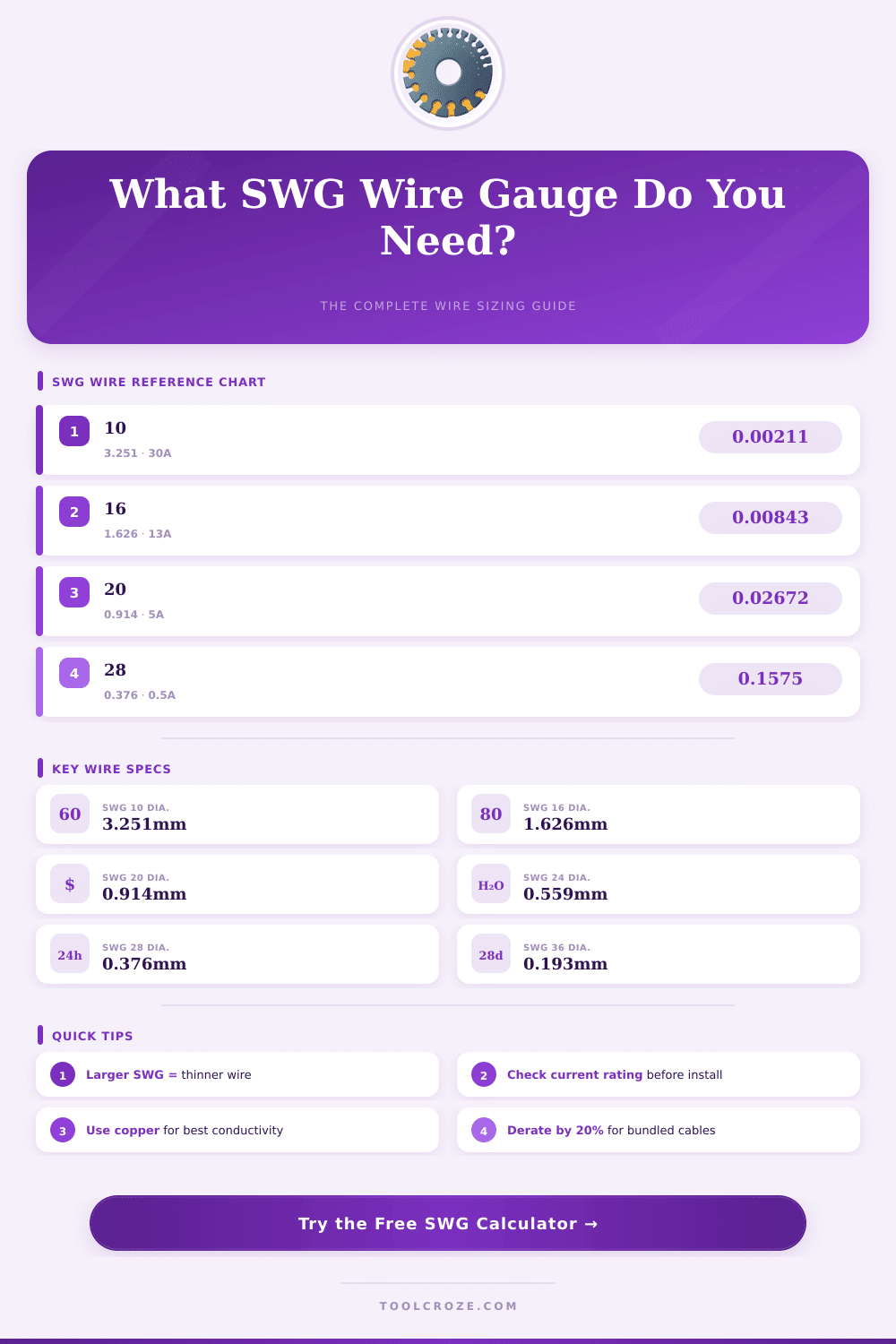
| 10 | 3.251 | 0.1280 | 8.302 | 35 | 27 | 0.002084 |
| 12 | 2.642 | 0.1040 | 5.484 | 23 | 18 | 0.003155 |
| 14 | 2.032 | 0.0800 | 3.243 | 15 | 11 | 0.005334 |
| 16 | 1.626 | 0.0640 | 2.075 | 10 | 7.5 | 0.008343 |
| 18 | 1.219 | 0.0480 | 1.167 | 6 | 4.5 | 0.014832 |
| 20 | 0.914 | 0.0360 | 0.6567 | 3.5 | 2.6 | 0.026349 |
| 22 | 0.711 | 0.0280 | 0.3970 | 2.0 | 1.5 | 0.043580 |
| 24 | 0.559 | 0.0220 | 0.2454 | 1.0 | 0.75 | 0.070483 |
| 26 | 0.457 | 0.0180 | 0.1642 | 0.65 | 0.50 | 0.105360 |
| 28 | 0.376 | 0.0148 | 0.1111 | 0.40 | 0.30 | 0.155640 |
| 30 | 0.315 | 0.0124 | 0.07793 | 0.25 | 0.19 | 0.221920 |
| 32 | 0.274 | 0.0108 | 0.05894 | 0.18 | 0.13 | 0.293200 |
| 36 | 0.193 | 0.0076 | 0.02927 | 0.08 | 0.06 | 0.590700 |
| 40 | 0.122 | 0.0048 | 0.01169 | 0.025 | 0.019 | 1.478000 |
| 50 | 0.025 | 0.0010 | 0.000491 | 0.001 | — | 35.25000 |
| Material | Resistivity (μΩ·cm) | Conductivity (%IACS) | Density (g/cm³) | Temp Coefficient (/°C) | Melting Point (°C) | Tensile Strength (MPa) |
|---|---|---|---|---|---|---|
| Copper (Annealed) | 1.724 | 100 | 8.96 | 0.00393 | 1083 | 220 |
| Copper (Hard Drawn) | 1.777 | 97 | 8.96 | 0.00381 | 1083 | 400 |
| Aluminum (1350) | 2.826 | 61 | 2.70 | 0.00403 | 660 | 160 |
| Silver | 1.587 | 108 | 10.49 | 0.00380 | 961 | 170 |
| Gold | 2.214 | 78 | 19.32 | 0.00340 | 1064 | 130 |
| Mild Steel | 17.20 | 10 | 7.87 | 0.00650 | 1480 | 500 |
| Stainless Steel | 69.00 | 2.5 | 7.93 | 0.00094 | 1400 | 700 |
| Nichrome | 110.00 | 1.6 | 8.40 | 0.00017 | 1400 | 700 |
| SWG | Diameter (mm) | Open Air (A) | In Conduit (A) | Buried (A) | In Wall (A) | Typical Use |
|---|---|---|---|---|---|---|
| 6 | 4.877 | 75 | 60 | 80 | 45 | Sub-mains, large motors |
| 8 | 4.064 | 55 | 44 | 58 | 33 | Cooker, electric shower |
| 10 | 3.251 | 35 | 28 | 37 | 21 | Cooker circuits |
| 12 | 2.642 | 23 | 18 | 24 | 14 | Ring mains (large) |
| 14 | 2.032 | 15 | 12 | 16 | 9 | Ring mains, general power |
| 16 | 1.626 | 10 | 8 | 11 | 6 | Lighting circuits |
| 18 | 1.219 | 6 | 4.8 | 6.5 | 3.6 | Low-power, controls |
| 20 | 0.914 | 3.5 | 2.8 | 3.8 | 2.1 | Signal, low-voltage |
| 24 | 0.559 | 1.0 | 0.8 | 1.1 | 0.6 | PCB traces, data |
| 28 | 0.376 | 0.4 | 0.32 | 0.43 | 0.24 | Instrumentation |
| SWG | SWG Dia. (mm) | Closest AWG | AWG Dia. (mm) | Difference (%) | Common Application |
|---|---|---|---|---|---|
| 8 | 4.064 | 6 | 4.115 | +1.3% | Heavy power feeds |
| 10 | 3.251 | 8 | 3.264 | +0.4% | Cooker, A/C circuits |
| 12 | 2.642 | 10 | 2.588 | -2.1% | Ring mains, dryers |
| 14 | 2.032 | 12 | 2.053 | +1.0% | General purpose |
| 16 | 1.626 | 14 | 1.628 | +0.1% | Lighting, low power |
| 18 | 1.219 | 17 | 1.150 | -5.7% | Control circuits |
| 20 | 0.914 | 20 | 0.812 | -11.1% | Signal, data |
| 22 | 0.711 | 22 | 0.644 | -9.4% | Electronics |
| 24 | 0.559 | 23 | 0.574 | +2.7% | PCB wiring |
| 28 | 0.376 | 27 | 0.361 | -4.0% | Instrumentation |
Thought about wire gauge help to estimate as numbers in the world of wires says “how thick is this stuff?”. The number of the measure points the diameter, what matters because it directly shows how much current the wire can bear without overheating. One finds references to those measures in electrical and mechanical situations, although most folks meet them on the electrical side.
In United States the system AWG, that is the American wire gauge, is the usual for sizing wires. It exists almost since 1857 and received official approval in the specification ASTM B 258. The system operates for round, solid, non-iron electrical wires, that one mostly uses through North America.
What Wire Gauge Numbers Mean
What makes AWG interesting is that it is logarithmic, what sounds difficult, but really only shows that the sizes follow mathematical order instead of jump around randomly.
Here where folks commonly get confused. Opposite to your expectation, less big numbers point to thicker wires. Wire of 10th measure is much thicker compared to that of 20th measure.
The higher the number, the thinner the wire becomes. It is the reverse of that, what your mind probably wants to believe. The whole cause came from pulling of metal rod through plate with gradually more little holes; kind of cold pressure, where the metal gets narrow step after step to more final sizes.
Even so AWG is not the only option around. SWG, Standard wire Gauge, was the British method and it still appears in sum areas. Also exists the metric mode, that simply measures the cross-section area in square millimeters and leaves away the whole numerical trouble.
When it comes to really counting, what measure you have in hand, one uses physical tools for measuring. They usually are made up of round or oval discs with slices cut around the edge. Every slice bears stamped number, and you lay your wire in it, until it seats flatly.
Besides that one can take calipers and measure the diameter directly. Stainless steel gauge discs cost around six dollars.
For everyday home work the wire of 12th measure is the usual choice. Thinner types, like 16 to 18 AWG, work for short, low-power circuits, think about cables for speakers. And cost only pennies.
If you deal with longer ways or heavy power needs, even so, one wants 12 AWG or even thicker. The loss of voltage becomes a real problem hear. I observed, that 12th measure in 40 feet have only 0.2-volt loss, but if one goes down to 14th, it reaches 0.3 volt.
At 16th you find around 0.5 volt, and 18th push it to almost 0.8 volt. Typical USB-cables use 28 AWG for both energy and data. Telecom setups favour 24 or 22nd measure with solid wire.
Using thicker wire than required does not create troubles (it onlyexhausts your purse).