Subfloor Adhesive Calculator
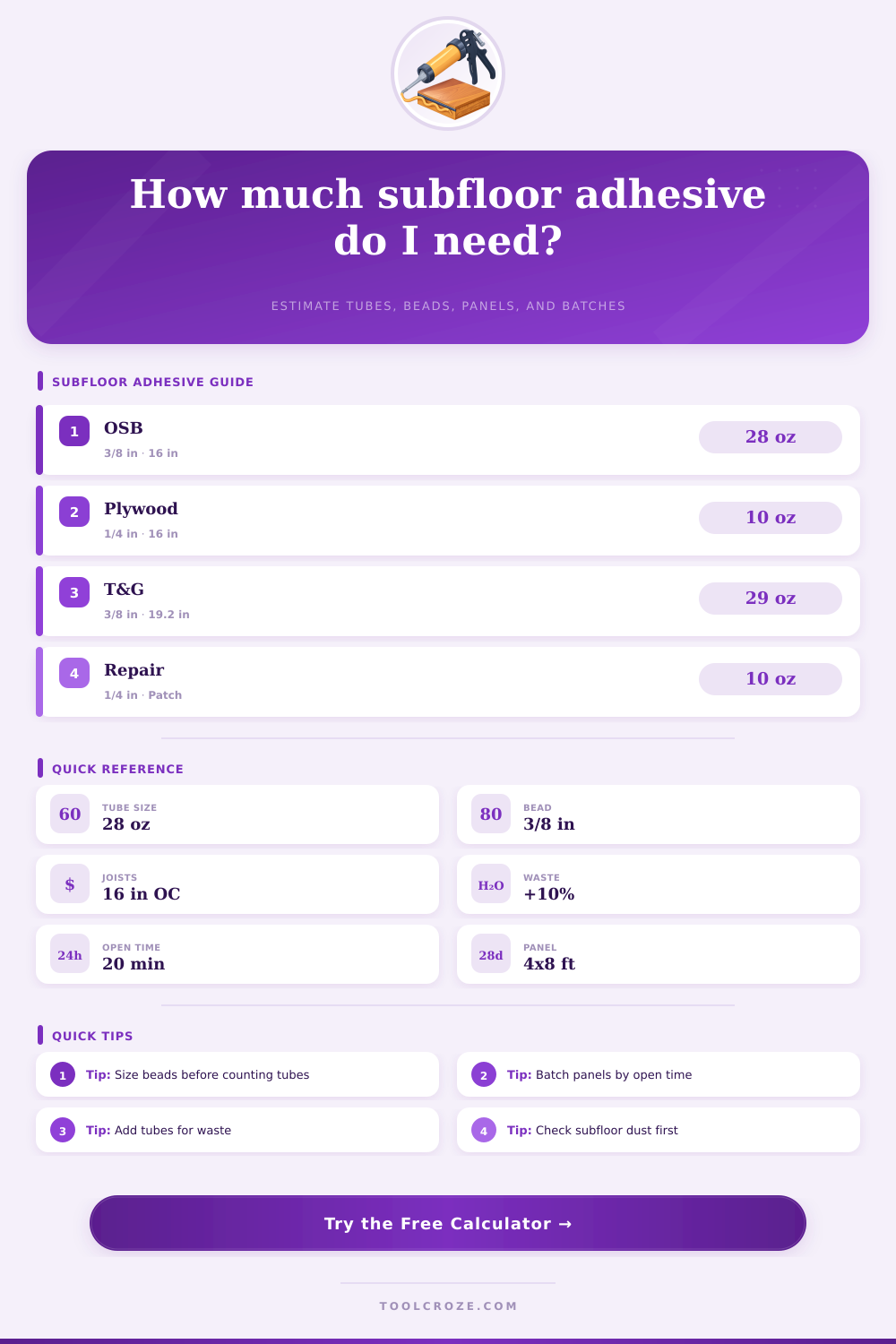
Estimate adhesive tubes from panel size, joist spacing, bead diameter, cartridge volume, squeeze loss, and working time.
📌Preset Subfloor Jobs
⚙Calculator Inputs
📊Results
Calculation breakdown
🧪Coverage Factor Grid
🗂Layout Comparison Grid
- Lowest adhesive volume
- Best for simple new framing
- Depends on clean, flat joists
- Adds end and edge support
- Useful at cut panel edges
- Moderate tube increase
- Highest bead footage
- Helpful for high-load floors
- Plan smaller open-time batches
- Uses serpentine coverage
- Matches patch work better
- Use extra loss allowance
📚Subfloor Adhesive Reference Tables
| Cartridge | Volume basis | 1/4 in bead | 3/8 in bead | Best use |
|---|---|---|---|---|
| 10 fl oz tube | 18.0 in³ | 36 ft | 16 ft | Patch or small room |
| 28 fl oz tube | 50.5 in³ | 103 ft | 45 ft | Subfloor deck |
| 29 fl oz tube | 52.3 in³ | 107 ft | 47 ft | Heavy-duty adhesive |
| 600 ml sausage | 36.6 in³ | 75 ft | 33 ft | Production work |
| Joist spacing | 4 ft panel lines | 8 ft panel joist bead | 10 panels | Notes |
|---|---|---|---|---|
| 12 in OC | 5 lines | 40 ft | 400 ft | Stiff floor layout |
| 16 in OC | 4 lines | 32 ft | 320 ft | Common framing |
| 19.2 in OC | 4 lines | 32 ft | 320 ft | I-joist layout |
| 24 in OC | 3 lines | 24 ft | 240 ft | Check panel rating |
| Panel type | Common size | Area | Typical bead | Planning note |
|---|---|---|---|---|
| OSB sheathing | 4 x 8 ft | 32 ft² | 3/8 in | Clean joist crowns |
| Plywood sheathing | 4 x 8 ft | 32 ft² | 1/4 to 3/8 in | Watch veneer gaps |
| T&G panel | 47.5 x 95.9 in | 31.6 ft² | 3/8 in | Allow edge fit loss |
| Patch panel | 2 x 4 ft | 8 ft² | 1/4 in | Higher start-stop loss |
| Condition | Open time | Loss factor | Batch advice | Calculator input |
|---|---|---|---|---|
| Cool and clean | 25 to 30 min | 5% | Normal panel pace | 5% loss |
| Warm and dry | 15 to 20 min | 8% | Shorter bead runs | 8% loss |
| Dusty remodel | 10 to 15 min | 12% | Vacuum before bead | 12% loss |
| Irregular repair | 8 to 12 min | 15% | Small batches | 15% loss |
💡Practical Tips
⚠Safety Note
Floor squeaks occurs due to the friction between the subfloors and the joists. The friction between these two component of the floor occurs due to a gap between the subfloor and the joists that allow for these two components to move against each other when someone walk on the floor. The use of subfloor adhesive can help to preventing these floor squeaks.
Adhesive works to fill the gap between the subfloor and the joist. By filling the gap, the subfloor and the joists cannot move against each other. The elimination of the movement between the subfloor and the joists prevent the friction between those two component that results in the noise created by the floor squeaks.
How to Use Subfloor Adhesive to Stop Floor Squeaks
To determine how much subfloor adhesive is need for a project, the calculation of the amount of subfloor adhesive is difficult. The reason that the calculation of the amount of subfloor adhesive is difficult is that one does not measure the square footage of the room. Instead, the calculation involve measuring the volume of the subfloor adhesive beads.
The volume of the subfloor adhesive beads depend on the diameter of the bead. A small increase in the diameter of the subfloor adhesive beads result in a large increase in the volume of the subfloor adhesive that is required to fill the gaps between the subfloor and the joists. The spacing of the joists also affects the amount of subfloor adhesive that is required to perform the task.
The closer the joists are spaced together, the more line of subfloor adhesive will be applied to the same area of the floor. The layout of the subfloor adhesive will affect the total amount of subfloor adhesive that is required to fill the gaps between the subfloor and the joists. If using a basic layout, the subfloor adhesive will only be applied along the top of the joists.
In a perimeter layout, the subfloor adhesive will be applied to the edge of the subfloor panels as well. A perimeter layout will require more subfloor adhesive than a basic layout. Additionally, a premium layout use double edges of subfloor adhesive and field beads of subfloor adhesive.
A premium layout will require significantly more subfloor adhesive then a basic or perimeter layout of subfloor adhesive. One factor that can impact the effectiveness of the subfloor adhesive is the condition of the floor. For instance, if there is any amount of dust on the joists, the subfloor adhesive will bond to the dust rather than the wood.
If the subfloor adhesive bond to the dust, the floor will still squeak. When calculating the amount of subfloor adhesive to purchase, it is important to account for any waste of the adhesive. Some of the subfloor adhesive are lost in the nozzle of the subfloor adhesive container.
Additionally, some of the subfloor adhesive is lost during the application process to the subfloor. Furthermore, one should allow some margin for error in the calculations for the amount of subfloor adhesive that will be purchased for a project. With a margin for error in the calculations, the subfloor adhesive will not run out before the subfloor panels is applied to the subfloor.
The open time of the subfloor adhesive should also be consider in purchasing subfloor adhesive. The open time is the length of time that the subfloor panels must be laid onto the subfloor adhesive before the subfloor adhesive begin to skin over. If the subfloor adhesive skins over, the subfloor panels will not adhere proper to the subfloor.
Due to the open time of the subfloor adhesive, it is impossible to apply the subfloor adhesive to an entire subfloor at once. Only small batch of the subfloor adhesive need to be applied to create the subfloor. Subfloor adhesive is available in different size of cartridges.
The most common size of the subfloor adhesive is a twenty-eight ounce tube. This size is often sufficient for the amount of subfloor adhesive that is required to complete most projects. Smaller ten-ounce tubes is available for those needing small patches of subfloor adhesive.
However, the ten-ounce size is not as efficient in purchasing the necessary amount of subfloor adhesive for large projects. By calculating the volume of the subfloor adhesive beads that will be used, the distance between the joists, and allowing for waste, it is possible to calculate how many tube of subfloor adhesive are necessary to complete a project.