🏗 Stair Stringer Calculator With Landing
Turn total rise and run into code-aware riser counts, tread depth, stringer angle, blank length, and lumber needs before you cut.
| Rise | Tread | 2R+T | Status |
|---|
| Type | Total rise | Steps | Angle |
|---|
| Item | Formula | Use | Check |
|---|
Landings split a single staircase into two or more flight. Stairs may require one or more landings for various reason. For example, if the stairs is too long to fit into a straight line, or if the stairs need to change direction at some point along the flight, a landing will be necessary.
Furthermore, using a landing will divide the total vertical rise that the staircase must cover. Using a landing allow the staircase to maintain a safe angle. Additionally, by using a landing, the staircase will follow teh building code related to stairs.
How to Measure and Build Safe Stairs
Finally, the flat surface of the landing make it easier for a person to climb the stairs. To determine the rise and run of the staircase, a person must first calculate the total rise and total run of the staircase. The total rise is the vertical distance from the ground to the upper floor.
A person should take the measurement from the finished surface of the floor to the finished surface of the upper floor. In determining the total rise, the thickness of the subfloors and the overhang of the stair nosing may be excluded. Additionally, the total run of the staircase is the total horizontal distance that the staircase will cover.
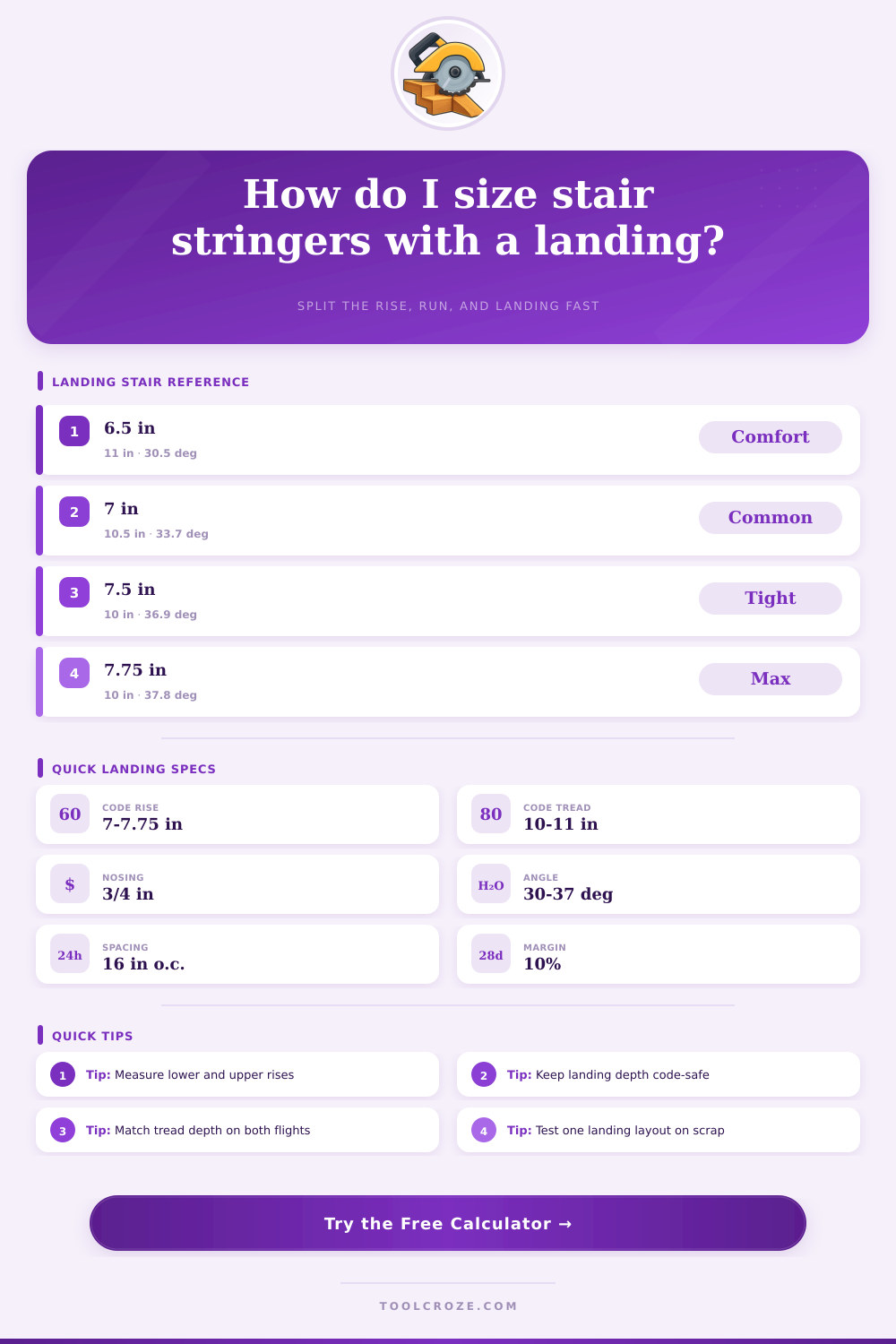
Once a person determines the total rise and total run of the staircase, the dimension of the staircase can be defined. The riser height of the staircase is the distance between each of the steps of the flight. The standard riser height is seven inches.
A riser height of seven inches is comfortabley for a person. Most building code, however, limit the riser height of stairs to a maximum of 7.75 inches; risers higher than this height make the staircase too steeply for a person to climb. The tread depth of the staircase is the horizontal distance of each step of the flight.
A depth of each tread of at least ten inches are required; otherwise, a person heel may hang off of the edge of the stair. Additionally, each tread of the staircase must have the same depth and riser height. Otherwise, the staircase will be difficult and potentially unsafe for a person to walk on.
The landing of a staircase should be at least as wide as the staircase itself. The landing must also have sufficient depth to allow for a person to turn around. Because the landing is a structural component of the staircase, the same support as the rest of the stairs must support it.
Additionally, the stringer of the staircase must be correctly spaced. If the stringers are spaced more than sixteen inches apart, the treads of the stairs may sag beneath a person. A person can divide a flight into an upper flight and a lower flight using a calculator; this will ensure that the number of risers in each flight will be a whole number.
A person can use a formula to ensure that the comfort of the stairs for a person. If the result of the formula of (riser height x 2) + tread depth falls between 24 and 25.5 inches, then the stairs will have an even pacing for a person. Additionally, the angle of the staircase should ideally be between 30 and 37 degrees.
A staircase with an angle of 30 degrees will be gradual in its slope; one of 37 degrees will be steeper. Stringers are the structural component of the staircase that support the stairs and the people that walk on them. A builder should make stringers of thick lumber to support the staircase; 2×10 and 2×12 lumber are standard sizes.
A plumb cut of the stringer should match the angle of the staircase; a seat cut ensures that a stringer rest on a flat surface. Stringers should be cut to allow for extra length to account for any adjustment to the staircase. In measuring the treads of the staircase, the nosings of the treads should be accounted for.
The nosings are the edges of the treads that extend beyond the risers. These extend the feeling of depth of each tread; however, they do not impact the total rise of the staircase. Additionally, the landing should be placed in a way that ensures the riser heights of both the upper and lower flight of the staircase are almost identical.
Otherwise, a person may trip over the landing when they reach it. Finally, another consideration for the staircase is the materials to be used and any safety feature to include. If the staircase is to be built outdoors, treated pine or cedar is an option; these types of lumber are naturaly rot-resistant.
Additionally, if the total rise of the staircase is 30 inches or higher, the stairs should have handrails to provide a person with a necessary railing to hold onto for grip and safety. If lighting is to be included on the staircase, it should be placed in a way that will not create shadows on the nosing of the staircase; shadows on the nosings may cause a person to accidental step on the edge of the stair.