
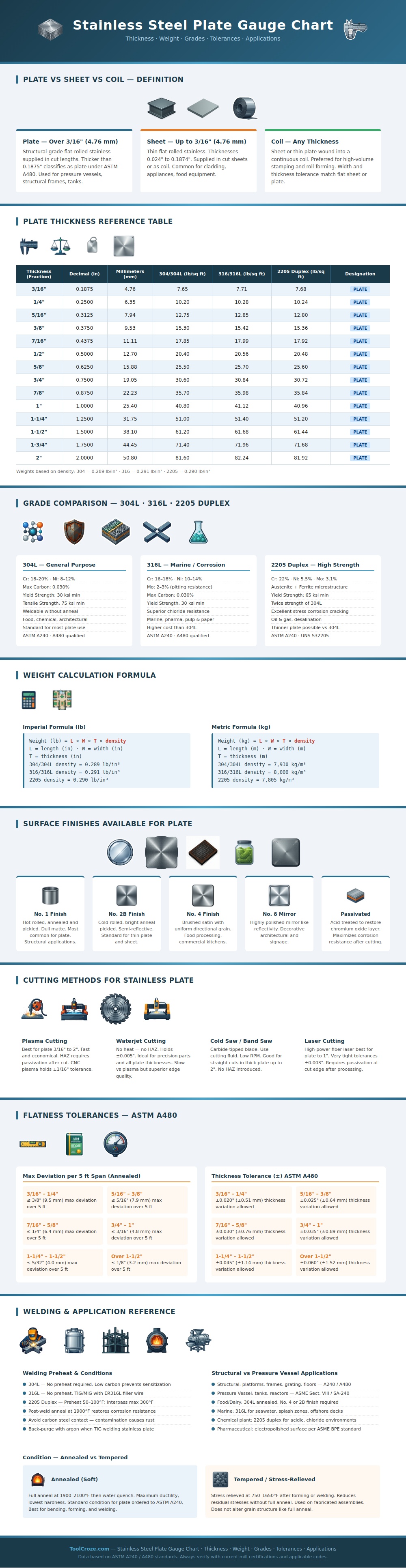
When you’re standing in the aisle or paging through a catalog, you’ll get lost in all the thickness choices available on stainless steel plate. It’s more than choosing some good strong stuff. There are technical definitions and specifics. These details realy make a difference to your project and your wallet.
Industry-wide, anything 3/16″ thick or more is considered “plate”, a distinction made by how it reacts to stress and how it must be handled throughout its making process. Knowing where that line lies will prevent you from ordering the wrong thing altogether.
How to Choose the Right Stainless Steel Plate
As you can see in the chart above, the thicker the metal, the more it weigh per square foot, though the exact weight will vary depending on the grade’s density. For example, if you’re using something like 304, 316, or one of the heavier duplexes, you’d think they would all be about the same weight because they are all stainless steel. However, since stainless steels has different densities, a 1/4″ thick piece of 304L would actualy be quite a bit lighter than the same size sheet of 2205 duplex. It’s not trivia stuff.
When building a tank or some sort of structurally important frame, knowing the exact weight will greatly impact both shipping and the design of your supports. 316 has a bit more molybdenum in it, which give it its increased corrosion resistance. This also means it will have a slightly higher density. That little bit make a big difference when you’re purchasing by the pound.
So which type (or grade) do you choose? For most projects, it’s a matter of dollars vs environment. For general purpose work, grade 304L strikes the balance between enough corrosion protection and easy weldability (at an affordable price). You’ll find it everywhere from food processing plants to most building exterior cladding.
If your application will be exposed to chemicals, saltwater, or other acidic conditions, however, then consider 316L or perhaps the extra-strong duplex alloy 2205. With about double the yield strength compared with conventional austenitic steels, 2205 lets you apply less thickness plate to achieve the same load-bearing structure. Big efficiency win if you can afford the material premium.
But there are some other challenges that most novices didn’t expect: fabrication issues. When you cut stainless steel, it gets hot and when it’s hot, the metal characteristics change at the edge. The plasma cutter is quick and cheap on thick plate but leaves a heat-affected zone that needs to be passivated so it doesn’t rust again. It cuts faster than water jet which will avoid all of this thermal damage by leaving a clean edge to work with, although at a higher cost and slower time. Laser cutting is somewhere in-between; it works well with precise measurements on thin material but also requires post-cut treatment. Every time you get something fabricated, you’ll need to consider how quickly you want it versus the quality of the finished edges.
Another thing to think about at this stage that affects how it looks and works is the type of surface finish. The No. 1 finish is matte, or hot-rolled, and works well for structure when appearance doesn’t matter. The No. 4 brushed finish is the default for kitchen use in restaurants and offices. It can be cleaned easily and hides scratches better then a mirror finish. If someone attempts to brush something rough down in the field, that’s a recipe for disaster. Always order your finish from the mill. Not only will it ensure consistency over large areas, but it will save time too.
Tolerances are the quiet killers of precision. As the plate thickens, there will be some variation on flatness and even thickness which is within tolerance according to ASTM standards. But if your assembly needs precise fit then don’t expect that a quarter inch plate is precisely a quarter inch all over. Check the mill certifications. That tells you how much they actualy deviated so you won’t be surprised when it comes time to assemble.
Stainless steel can be finicky to weld, so respect it. Unless you’re using a duplex steel such as 2205, preheat isn’t necessary (304L and 316L don’t require it). However, you must be mindful of temperatures and keep your microstructure intact when working with the duplex. If you choose to TIG weld, use the proper filler and back-purge with argon. This will ensure a clean weld zone and prevent contaminants from weakening the weld.
So how do you choose between stainless steel plates? It’s all a matter of balancing the cost, corrosion resistance, and strength. And while the gauge chart can seem like a bunch of numbers, it really is a set of guidelines on how to make that balance fit your application. Think about environment first, grade second, and thickness and weight calculations third.
