
This is stainless steel. Have you ever wondered why some metals rust and others don’t? Why does your old car door turn rusty but your industrial equipment and kitchen sink remains shiny? The answer are due to chromium in stainless steel. Chromium create a protective oxide layer which is invisible to the eye.
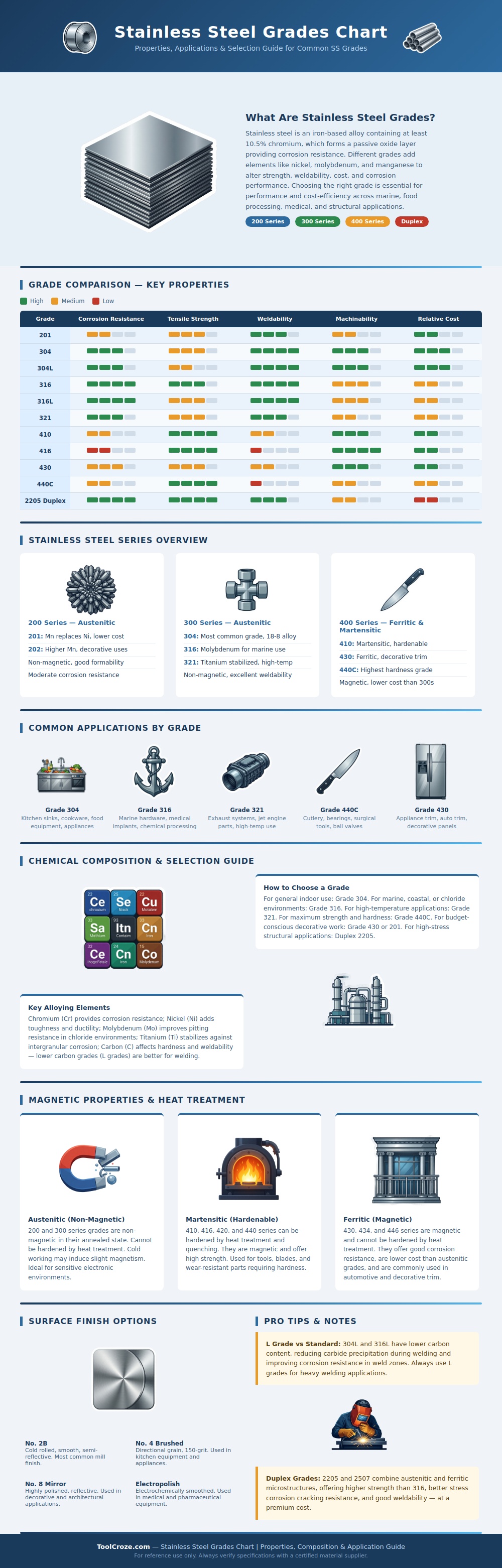
There’s no such thing as stainless steel, rather, there’s a family of alloys known as stainless steel, each with its own strengths and grades. Select right grade by balancing performance needs against cost, depending on your task. Don’t think all stainless steel are created equal; different grades exists for different uses. These is grouped by microstructure in this chart.
How to Choose the Right Stainless Steel
For a fair price, grade 304 (the most popular) from the 300 series is also easy to work with and does not rust. That make it popular for appliances and food processing. If your application has harsh conditions (e.g., chemical plants, coastal), you require grade 316. It has molybdenum that resist pitting in chloride-containing settings. So more expensive metal is worthwhile for marine hardware. The chart show which metals can withstand acids or salt air.
Grades in the 400 series are harder and more magnetic than austenitic grades. Because these steels have a martensitic structure that can be heat treated, grade 440C is used for surgical tools and cutlery that holds an edge well. The austenitic grades in the 200 and 300 series are softer (and therefore not suitable for being heated to harden), but easier to weld and form into complex shapes. Remember that weldability and hardness is traded off against one another.
A blade on your knife won’t be welded out of 400-series steel without trouble, nor will you make a bearing out of 304 if wear resistance matter more then ease of fabrication. If you’re doing any serious welding, carbon content makes a difference. Lowering the amount of carbon means that it’s not as likely to precipitate out during welding. That maintains corrosion resistence throughout heat-affected zones, which is why these grades (like 316L, 304L) are called out for structural welds. Failing to take note of this will result in premature failure at the joint even if rest of base material appears to be okay. Small change, big impact on durability.
A third group of stainless steel consists of duplex steels such as 2205 which have qualities of both martensitics and ferritics but in a different form. While they do not reach strength levels of either type, they are stronger then typical austenitics and exhibit greater resistance to stress corrosion cracking. However, because of their hybrid structure, they come at a premium price point. When the application demands it, especially when the consequences of failure is too severe, duplex is the way to go. Note that because of their different performance, the duplex grades are listed apart on chart.
How do you use the material? Surface finish matters. Mirror finish: nice, but fingerprints. Brushed No. A No. 4 finish (found on everyday appliances) covers up scratches. The super-smooth electropolished finish have fewer places for dirt and germs to hide. It’s used in medicine because it is easy to clean. Pick a finish that matches your maintenance needs.
Don’t just choose the highest number; match the property to what you want from it. Whether you’re making a barbecue stand or a boat railing, having this knowledge eliminates hassle and cost of getting it wrong. It also shows which metals will last and which ones will rust. That comes down to choosing the right alloy that suits your use.
