
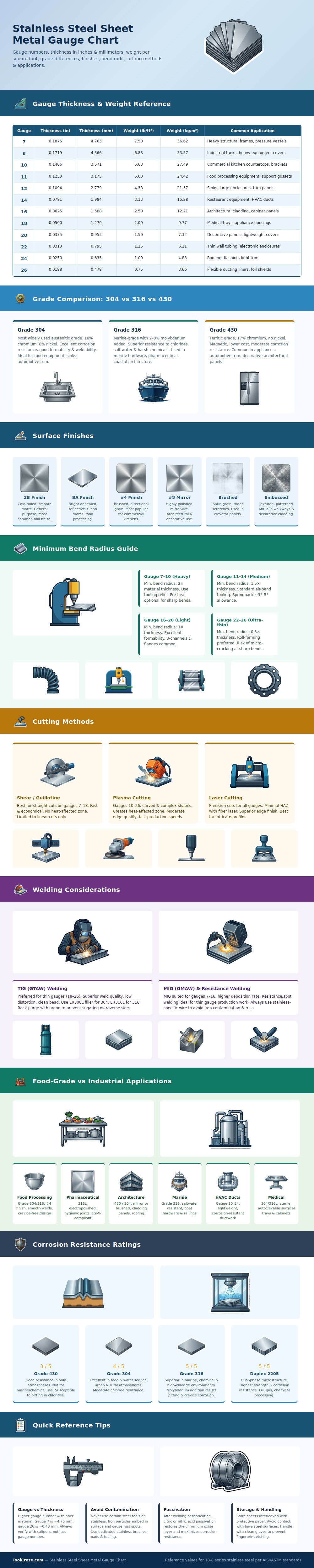
Not all stainless steel are the same. Just as there’s a big difference between different woods, stainless steel also differ in toughness and use. Because they look alike (shiny and seemingly indestructible), you’d think all stainless steel would be equal. But that thinking quick leads to a project that cracks, bends or otherwise lets you down. Know your grade, know your thickness and know how it react to heat. Failure to respect the stuff will cost you somewhere down the line in cracked welds or warped part.
The system of gauges is backwards. Thinner material have a larger number. For instance, if your design require gauge 16 but you buy gauge 20, you’ll end up with something flimsier then what you need. It won’t hold together as well or last longly. The gauge system is counterintuitive to someone unfamiliar with it so be aware of that before ordering any parts. Always check thickness with calipers. Don’t rely solely on box label.
Tips for Using Stainless Steel
The true engineering come in choosing the proper grade. The go-to is typically Grade 304, which is fine for urban use and food processing. But if you’re designing for harsh chemicals, or if your project is close to ocean, Grade 304 won’t last as long as you’d like before it starts getting all corroded up on you. For these conditions, Grade 316 is the one to choose (the extra molybdenum act as a shield against chlorides).
If cost is an issue, there’s also Grade 430. It is magnetic and less expensive but it contains no nickel. Nickel is what give other grades their resiliency. It is good for use inside but bad for anywhere around salt water. This is what separates a good engineer from a great one; saving you from a catastrophic failure down the line.
Finishes affect the look, and they are a big deal that no one seem to talk about. They’re even bigger than the metal’s appearance since finishes impact whether or not dirt adhere to the metal. Architectural panels have a stunning mirror finish, yet they show all the fingerprints and scratches. Commercial kitchen love the brushed finish because it conceals the daily wear and tear. Remember, this isn’t just about looks; it affect how easily the metal can be cleaned over time.
When it comes to fabrication, keep in mind that the gauge matter. Thin gauge is easy to roll form but fragile (micro cracks if bent too sharply). Thick gauge hold form nicely but doesn’t like to be moved around without a fight. It takes more pressure and is sometimes better heat up before making a tight corner. As you go thinner, bending rules change and you’ll need to tune your tools to match. What might be fine on a thick tank shell will crush an electronic enclosure.
There are also hazards with welding such as heat, which can degrades corrosion resistance. The chromium oxide layer protect against corrosion, but if you don’t control your heat input during welding, you will destroy that protective layer. Argon back purging ensures that the weld area remain clean and strong by preventing sugar from forming on the opposite side.
Never cut or clean stainless steel with any type of carbon steel tool. Iron particles becomes embedded into surface of the steel and eventually become rust spots. It is a little detail, but it kills the look and integrity of the piece.
The last thing people forget about is storage. This is where things realy matter. Sheets should be stacked using protective paper between each sheet. Avoid any surface that will cause damage such as direct contact with concrete or dirty pallet wood. Always use gloves when handling your sheets because oils from your hands can stain the metal and etch over time. After making it, the protective passivation process restore its protective coating and lets the metal work as promised.
Treat it well and it will last decades. Don’t pay attention to detail and before you know it you’re starting all over again. Those little decisions in the beginning are often the ones that makes all the difference between success and failure.
