🎨 Stain Coverage Calculator
Calculate exactly how many gallons of wood stain you need for interior and exterior surfaces — decks, siding, furniture, fences, and more.
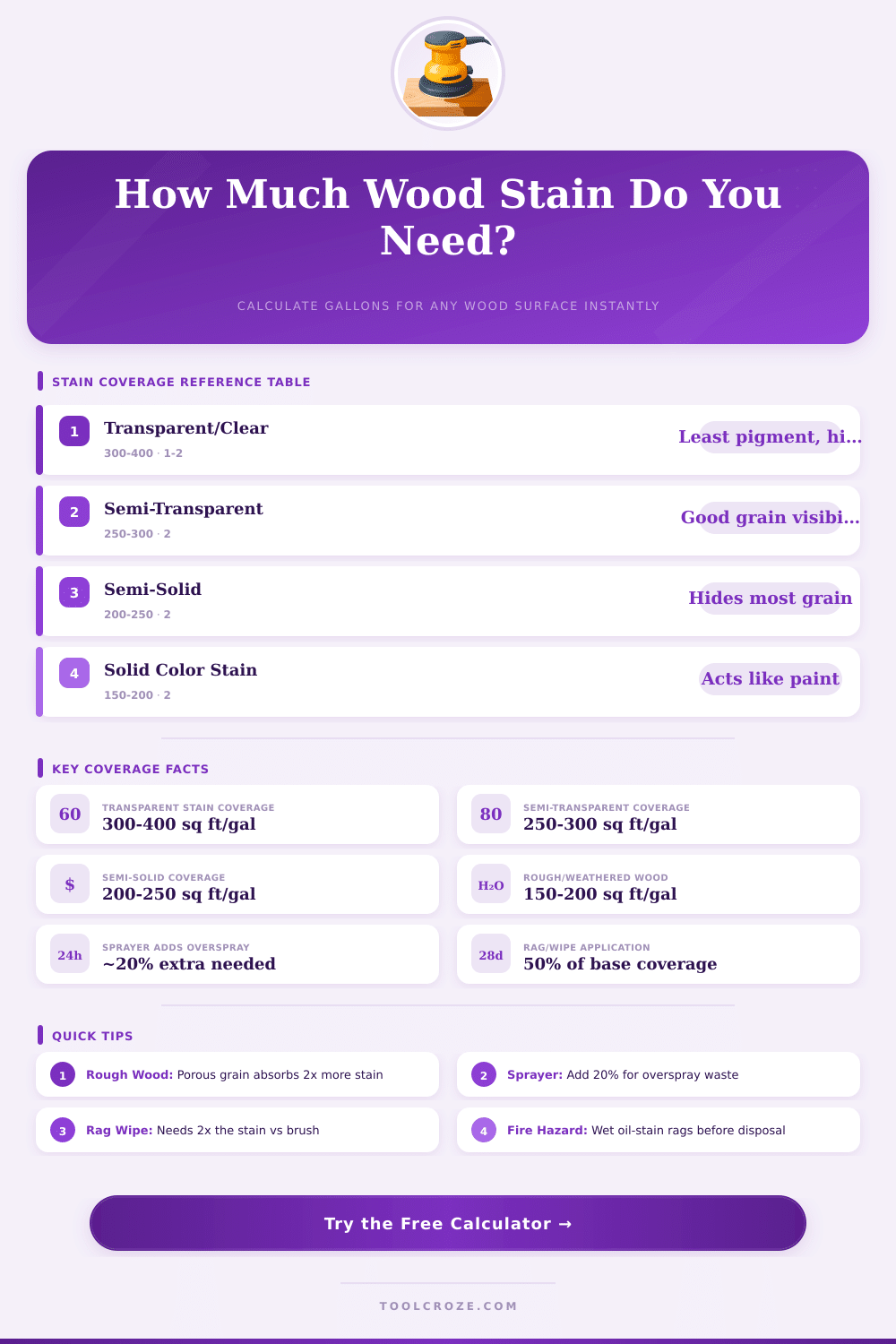
| Stain Type | Sq Ft/Gal | Opacity | Typical Coats | Interior / Exterior |
|---|---|---|---|---|
| Transparent / Clear | 300–400 | None — natural grain shows | 1–2 | Both |
| Semi-Transparent | 250–300 | Low — grain visible | 2 | Both |
| Semi-Solid | 200–250 | Medium — grain slightly visible | 2 | Both |
| Solid Color Stain | 150–200 | Full — acts like paint | 2 | Both |
| Oil-Based Penetrating | 200–250 | Low to medium | 1–2 | Both |
| Water-Based Acrylic | 250–350 | Low to medium | 2 | Both |
| Wood / Condition | Absorption Level | Base Coverage | Recommended Stain Type |
|---|---|---|---|
| Maple, Cherry (smooth hardwood) | Low | 300–400 sq ft/gal | Semi-transparent or transparent |
| Pine, Fir, Poplar (medium grain) | Medium | 250–300 sq ft/gal | Semi-transparent |
| Ash, Red Oak, Walnut (open grain) | Medium–High | 200–250 sq ft/gal | Semi-transparent or oil-based |
| Rough-Sawn / Weathered Wood | Very High | 150–200 sq ft/gal | Solid color or semi-solid |
| Previously Stained (good condition) | Low | 300–350 sq ft/gal | Match existing stain type |
| New Pressure-Treated | Medium | 200–250 sq ft/gal | Oil-based penetrating (tannins affect absorption) |
| Method | Efficiency | Coverage Impact | Notes |
|---|---|---|---|
| Brush / Roller | 100% | Full base coverage | Best penetration; recommended for most surfaces |
| Sprayer | ~83% | Add ~20% for overspray | Fast on large areas; back-brush for penetration |
| Rag / Wipe | 50% | Needs ~2× more stain | Deep grain penetration; very labor intensive |
| Stain Type | Dry Time | Recoat Time | Full Cure |
|---|---|---|---|
| Transparent / Clear (water-based) | 1–2 hrs | 2–4 hrs | 3–7 days |
| Semi-Transparent (water-based) | 1–2 hrs | 4 hrs | 3–7 days |
| Semi-Solid (water-based) | 2–4 hrs | 4–6 hrs | 7 days |
| Solid Color Stain (water-based) | 2–4 hrs | 4–6 hrs | 7–14 days |
| Oil-Based Penetrating | 4–8 hrs | 24 hrs | 72 hrs – 7 days |
| Water-Based Acrylic | 1–2 hrs | 2–4 hrs | 3–7 days |
Figuring out how many stain to buy can seem hard. Even so, it mostly depends on the condition of the wood area and the control of the info about covering on the product. First multiply the length by the width of the surface which gives the area in square feet.
Later check the label of the tin for the listed cover and consider how many coats will be used.
How Much Stain Do You Need?
The most many brands for covers cover around 150 to 300 square feet per gallon. That range is quite wide, because bare wood grips much more than before treated wood. Commonly the tins point even bigger range, of 150 to 400 square feet per gallon, because of the different soaking properties.
For a deck or patio up to 175 square feet, one gallon will be enough. When the area gets to 550 square feet, plan to buy two gallons.
Similarly it happens with fences. For a small fence up to 175 square feet, one gallon will be needed. For bigger, up to 550 square feet, you need two.
Do not forget to measure both sides. Double the square area if both sides of the fence must be stained.
For a deck of 20 by 20 feet, around two and half gallons will be enough for one coat. One particular brand points 150 to 200 square feet per gallon for the first coat, and 200 to 300 for the second. While applying two coats wet on wet, the cover usually drops too around 100 to 125 square feet per gallon.
There are several ways to apply stain. A roller helps to cover large areas quickly. A sprayer can cover a deck in some minutes, ensuring good covering in one coat without marks of brush or roller.
A brush for stain works well on big surfaces like decks and fences, helping to reach smooth and even results. Use a brush to reach between the boards and ensure full covering. On pine or similar wood, soaking is the best method for lasting cover.
Also the kind of stain matters. Clear stain well shows the wooden grain. Solid stain works more for old decks that need full covering.
The amount of covering depends on what most shows the grain. A dark deep color stresses the natural wooden grain, but itself does not give lasting protection. Sometimes the actual cover differs from what says the label.
One experience shows that on a deck the actual cover was almost twice what the maker listed. It is always good to get thedata sheets about materials, that detail cover and apply methods, before you start a project.