
A metal supply shelf stands before you with a chunk of square tubing roughly two inches across. It’s substantial, maybe more than necessary for your project. Then another question: Do you want precision tubing or structural grade? Suddenley purchasing a piece of pipe has turned into a physics test.
Before most projects has begun, this is where things go awry. Choosing the wrong size isn’t as simple as lugging around excess weight in your truck. You’ll also be wasting money on materials. They might be too heavy for your design or collapses under their own weight. This results in weak joints, warped frames, and more.
How to Choose the Right Square Tubing
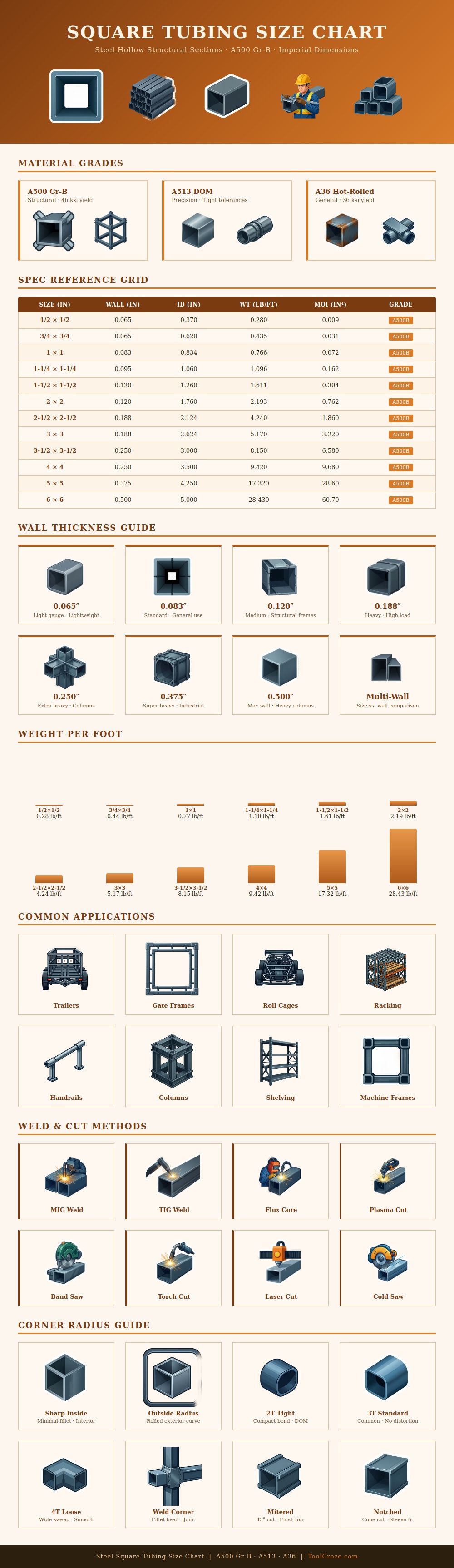
This is broken down in chart and illustrates how wall thickness, the overall size, and weight per foot all play into one another. It’s an interaction you have to consider collectively instead of individually. For instance, just because something has a bigger outside diameter doesn’t necessarily make it tougher, it could be made from paper-thin walls. Or you may find a small-diameter tube with thick walls can hold up better under point loads then a giant empty square tube that collapses too readily.
This visual guide makes that balance easy to see among various grades from A36 hot-rolled to A500 structural steel. Most general fabricating rely on A500 Grade B. It has a decent yield strength (46 ksi) at an affordable price and doesn’t require precision tubing.
The most important aspect of this decision is likely understanding wall thickness. As infographic points out, a half-inch tube with a 0.065-inch wall behaves completely different than one with a quarter-inch wall. Specifically it affects what’s called the moment of inertia, i.e., its ability to resist bend forces. If you’re using this for a lightweight cart frame or perhaps a trellis for a garden, a thinner gauge will be easier to work with (cut and weld) while saving weight.
On the other hand, if you’re creating a trailer frame to haul heavy stuff on bumpy roads, that thin tube will flex under stress. You need enough wall thickness to absorb the force without adding so much bulk as to make working with it difficult. But no one realizes just how much this really affects things until they’re attempting to hoist what they’ve made.
When you look at the chart, you’ll notice that very rapidly the weight-per-foot is increasing with each increase in size. For example, a 6 by 6 inch tube with a half-inch thick wall weighs almost thirty pounds per foot! Multiply that times ten feet and you can see how that adds up in a piece as tall as ten feet. When you’re building something that needs to be easily movable such as a portable work bench or a vehicle frame, every pound means increased fuel economy, as well as added maneuverability. Going down a size or two may not seem like a big deal but could of been the difference between being able to drive your creation home or having to drag it home.
The type of material is also determined by fabrication methods. For example, a thick-walled tube isn’t easy to bend without special tools. Welding processes are mentioned as well, such as MIG for fast welding and TIG for precise welding with thin wall tubes. Are you running something like this through a regular bender or brake? Stick to smooth surface DOM tubing which will allow for tighter tolerances and no cracking at bends.
Mill scale (the stuff you see on hot-rolled steel) will impede weld penetration unless removed correctly. It’s a little thing but if you don’t pay attention it messes up the finish and compromises weld strength.
Joining Joint corner Surprisingly, corner radii make a big difference in structural integrity as well as aesthetics. Square tubing will rarely have those hard 90-degree corners on the inside. It’ll have some sort of very slight radius so that the metal can flow through when it’s being made. If you’re joining two pieces of tubing together, if you don’t account for the radius there will be gaps which means having to use a lot more fill material.
A miter cut looks nice, but it is wasteful because you lose material. In contrast, a notch or cope cut maintains strength because you can weld all along the surfaces. The chart makes it easy to visually compare different types of cuts and what they do to the final joint profile. Use this Square Tubing Size Chart.
For most applications, choosing square tubing isn’t about getting the largest chunk of metal as much as it is comparing its properties to the real world forces involved. When designing handrails, machine supports or even a simple gate frame, the ideal size for you should be one that’s strong but also manageable. Using this size chart prior to cutting will keep both your wallet and your equations honest.
Ultimately you’ll have a build that holds up while not failing you at each turn. Turns out purchasing the tool and knowing precisely what you’re getting is equally important.
