Square Tubing Load Capacity Calculator
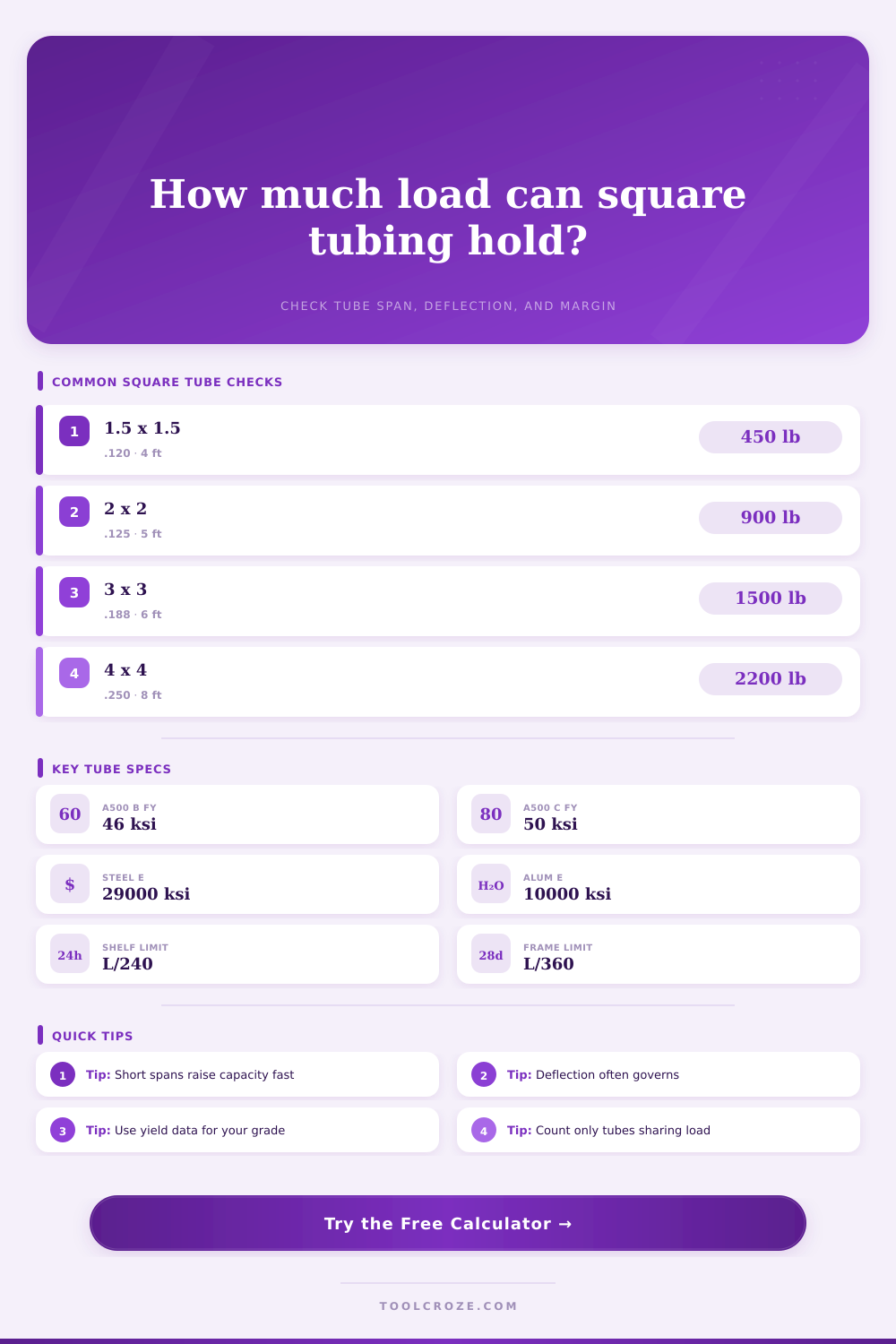
Estimate allowable service load, bending stress, deflection, shear demand, self-weight, and utilization for square tube spans using real section-property formulas.
The selected case controls moment and deflection formulas.
Enter the total external load before sharing between parallel tubes.
| Load case | Maximum moment | Maximum deflection | Typical use |
|---|---|---|---|
| Simple span, center point | W × L / 4 | W × L³ / 48EI | Jack point, single machine foot, central hanger |
| Simple span, uniform load | W × L / 8 | 5W × L³ / 384EI | Shelf rail, platform joist, distributed cargo |
| Two third-point loads | W × L / 6 | 23W × L³ / 1296EI | Two brackets, pallet feet, paired mounts |
| Cantilever, end point | W × L | W × L³ / 3EI | Gate arm, boom, projecting support |
| Cantilever, uniform load | W × L / 2 | W × L³ / 8EI | Canopy edge, shelf overhang, guard extension |
| Fixed-end uniform load | W × L / 12 | W × L³ / 384EI | Welded frame member with real rotational restraint |
| Tube material | Yield strength | Elastic modulus | Density | Best-fit load check |
|---|---|---|---|---|
| ASTM A500 Grade B steel | 46 ksi | 29,000 ksi | 0.283 lb/in³ | General frames, racks, trailer members |
| ASTM A500 Grade C steel | 50 ksi | 29,000 ksi | 0.283 lb/in³ | Higher-capacity structural HSS checks |
| ASTM A513 mild steel tube | 36 ksi | 29,000 ksi | 0.283 lb/in³ | Fixtures, carts, furniture frames |
| 6061-T6 aluminum tube | 35 ksi | 10,000 ksi | 0.098 lb/in³ | Light racks where deflection is checked closely |
| 304 stainless square tube | 30 ksi | 28,000 ksi | 0.290 lb/in³ | Guard rails, washdown frames, handrail supports |
| 4130 normalized chromoly | 63 ksi | 29,700 ksi | 0.283 lb/in³ | Compact high-strength frames with quality welding |
| Nominal square tube | Wall | Area | Moment of inertia | Section modulus |
|---|---|---|---|---|
| 1 in × 1 in | 0.065 in | 0.243 in² | 0.033 in⁴ | 0.066 in³ |
| 1.5 in × 1.5 in | 0.120 in | 0.662 in² | 0.198 in⁴ | 0.264 in³ |
| 2 in × 2 in | 0.125 in | 0.938 in² | 0.552 in⁴ | 0.552 in³ |
| 3 in × 3 in | 0.188 in | 2.109 in² | 2.705 in⁴ | 1.803 in³ |
| 4 in × 4 in | 0.250 in | 3.750 in² | 8.984 in⁴ | 4.492 in³ |
| Deflection limit | Use when | What usually controls | Calculator setting |
|---|---|---|---|
| L/120 | Rough utility tube or temporary fixture | Yield stress or local damage | Rough utility frame |
| L/180 | Gate rail, light storage frame, non-finish work | Visible sag before yield | Light rack or gate |
| L/240 | Shelf rail, trailer crossmember, equipment support | Deflection and fatigue margin | Shelf or trailer rail |
| L/360 | Platform, floor support, finished alignment frame | Stiffness, not just strength | Stiff platform or floor |
| L/480 | Precision tooling, sliding hardware, sensitive machines | Serviceability at low stress | Precision support |
A tube rack will look great at first, then someone walks through it and it all droop sideways. That’s not typically because the metal broke right in two, but rather that bending exceeded patience or your safety margin shrank to nothing. Material stiffness, wall thickness, and span length often determines whether you have something rigid for shelving or something just barely hanging together like a hazard.
Builders is mostly concerned with the breaking of the tube under load. And they make a fundamental error by testing bending stress vs. Yield strength and stopping there. They test yield strength and end there. That’s an elementary mistake in casual engineering. Yield strength informs you of when it begin to permanently deform. But it doesn’t inform you when, prior to reaching yield strength, the member will visibly sag.
How to Stop Metal Tubes From Bending
This trap is well illustrated by aluminum. You may find a 6061-T6 tube has sufficient yield strength for your desired load. But then you look at its elastic modulus, which are about one-third that of steel. What happens? You have a piece of metal that supports the weight but sags quite a bit because material isn’t very stiff. You can have strong metal that acts like rubber if you don’t consider its stiffness.
While there is some fancy formulas for calculating beams with various types of supports, those are not necessary when you use the calculator above. It will do all that math based off the dimensions you input (span and loads). What it comes down to are the inputs.
The selection of load makes a difference as well. A center point load on a simply supported beam will result in far worse moment distribution compared to a uniform load applied over same distance. Consider a shelf loaded with evenly spaced box vs. Just one heavy machine foot. In first example, force is concentrated onto a small space requiring more strength to be carried by the tube section. Get this wrong and your design could be either way over-built or under-designed.
The strongest lever you have available to you is thickness of those walls. Adding a little bit of extra outside dimension to a square tube will add some strength, but adding the thickness of the wall do it exponentially. The moment of inertia determines bending resistance (and deflection), and this number are based on how far the material is from the neutral axis. The thicker the wall, the more it pushes that material outwards, so it dramatic increases that number. A tube that’s 2×2 with a quarter inch wall is more than just a bit stronger then a tube with an eighth inch wall. It’s a completely different type of structural component.
That’s why those thin walled tubes fails so catastrophically when they’re asked to do their thing over a longer span. They simply don’t have any kind of geometric reserve to allow them to bend within reasonable deflection limits such as L/240, common in shelving applications.
Intuition also go out the window with safety factors. A static fixture loaded with tools in a dry shop environment is very different than a dynamic load like a crossmember on a trailer bouncing down a gravel road. Fatigue, impact, vibration, those all need far more margin than even a static calculation allows. These parameters can be adjusted by the tool based on how severe your application is. If it’s going to see movement or vibrations or carry people, go way up on the safety multipliers. Better safe than explaining why the weld failed at month 3 of operation because you were “too heavy”.
And then there’s fabrication details and corrosion eating into your theoretical capacity. Localized weaknesses from welded brackets in areas of high stress aren’t fully accounted for with raw formulas. These situations are shown in the calculator as allowances for the messiness of the real world compared to textbook examples. Remember: check your tube condition before finalizing your design. Notches from poor cuts and rust pitting can lower your effective strength up to twenty percent or more.
This is the short version. So really all this talk around square tubing means finding a balance between performance, weight and look. Thinner is better as long as it can deflect what you need but not give way. This balance mean testing for stiffness limits and stress limits together. Your builds will be solid no matter which material you use once you start treating deflection as a main design constraint instead of an afterthought. When the numbers sync up with reality, the bowing ceases. It should of been easier to explain than that. You’ll recieve better results if you follow these steps for any moddern project involving furnitures.