Square Footage to Yards Calculator
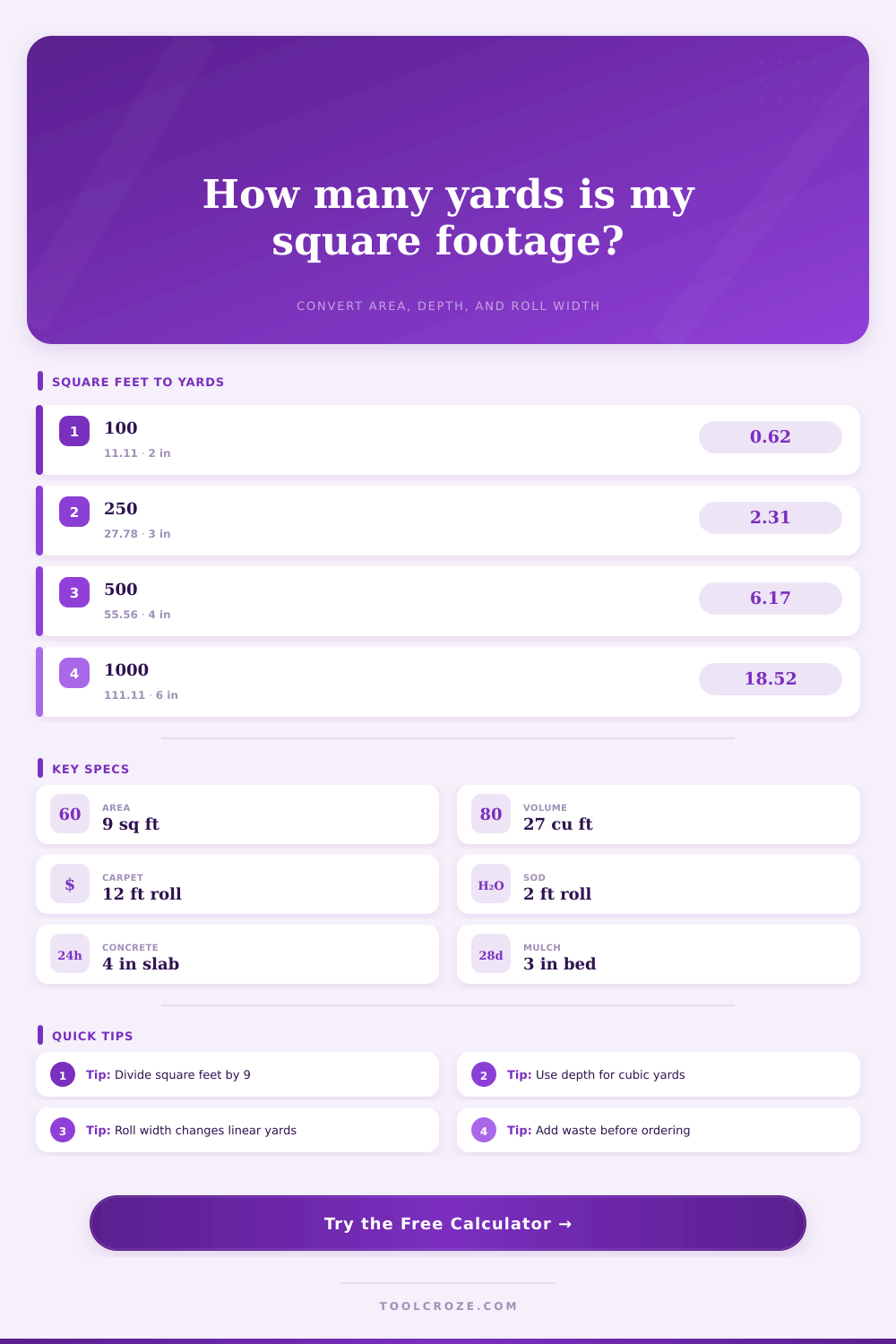
Convert room, yard, slab, fabric, and roll-goods square footage into square yards, cubic yards, linear yards, and allowance-adjusted totals.
Calculated Yardage
Full Breakdown
| Measured Area | Square Yards | With 10% Waste | 12 ft Roll Linear Yards |
|---|---|---|---|
| 50 sq ft | 5.56 sq yd | 6.11 sq yd | 1.53 yd |
| 100 sq ft | 11.11 sq yd | 12.22 sq yd | 3.06 yd |
| 250 sq ft | 27.78 sq yd | 30.56 sq yd | 7.64 yd |
| 500 sq ft | 55.56 sq yd | 61.11 sq yd | 15.28 yd |
| 1,000 sq ft | 111.11 sq yd | 122.22 sq yd | 30.56 yd |
| Coverage Type | Typical Depth or Width | Yard Formula | Common Allowance |
|---|---|---|---|
| Carpet or broadloom | 12 ft roll width | sq ft / width / 3 | 10% to 15% |
| Sod and turf | 2 ft roll width | sq ft / 9 or roll yd | 5% to 10% |
| Concrete slab | 4 in thickness | sq ft x depth ft / 27 | 5% to 10% |
| Mulch or compost | 2 to 3 in depth | sq ft x depth ft / 27 | 10% settling |
| Landscape fabric | 3 ft or 4 ft roll | sq ft / width / 3 | 8% to 12% |
| Project Example | Typical Dimensions | Measured Sq Ft | Baseline Sq Yd |
|---|---|---|---|
| Small bedroom | 10 ft x 12 ft | 120 sq ft | 13.33 sq yd |
| Carpet runner | 4 ft x 30 ft | 120 sq ft | 13.33 sq yd |
| Patio slab | 12 ft x 16 ft | 192 sq ft | 21.33 sq yd |
| Garden bed | 6 ft x 24 ft | 144 sq ft | 16.00 sq yd |
| Garage mat area | 20 ft x 22 ft | 440 sq ft | 48.89 sq yd |
| Conversion Need | Formula | Use When | Example |
|---|---|---|---|
| Square feet to square yards | sq ft / 9 | Area material is sold by sq yd | 180 / 9 = 20 |
| Square feet to cubic yards | sq ft x depth ft / 27 | Material has depth | 180 x 0.25 / 27 |
| Square feet to roll yards | sq ft / roll width / 3 | Material has fixed roll width | 180 / 12 / 3 |
| Linear feet to yards | linear ft / 3 | Edge, seam, or border length | 60 / 3 = 20 |
| Allowance adjusted area | sq ft x (1 + allowance) | Cutting and trimming are expected | 180 x 1.15 |
Your bedroom is 10 feet by 12 feet. That sounds like a pretty good size when you’re out shopping but then the salesperson want to know how many square yards and you’re fuzzy on your math skills. Divide by nine.
And there’s the problem. That little mathematical task trip folks up because we think in feet and yet the material world tends to talk to us in yards. With the calculator above you don’t have to do that mental math of dividing by nine with a tape measure in hand. That conversion from area to material is simple enough.
How to Calculate the Right Amount of Material
Where it gets interesting is the distinction between area and volume: A floor with the same square footage isn’t the same if one has a four-inch thickness and the other has a two-inch depth. A roll of fabric depend on its width and length; it’s about linear yards different than just area. You’re buying rolls or thickness, rather than two dimension, when most products come as volume (in cubic yards) instead of area (in square yards).
That’s what we’re calculating with the depth entry. Enter the area (the size of floor) and the depth (how deep you want it, in inches). The calculator figure out the volume and converts it to cubic yards. The math’s not hard; the reason people order based off area rather than cubic yards is because they don’t think about it. They think about a room and then order by the room but what happens if there’s too much or not enough? Now you have a pile of extra dirt, or a half-full truck.
And what about the rolls? Landscaping materials like sod and carpet don’t come in loose piles; they come in fixed widths, like two-foot wide strip or twelve-foot wide rolls. If your material come in rolls two feet across, you should of hoped that you know how long the linear roll length is because it’s not going to be a nice even number of square feet. The calculator does too. It also lets you enter width of the roll so it adjusts the total square footage to match. It divides the total by the width and converts it into linear yards. This way, you won’t be embarrassed when you ask for fifty square yards of sod and get quoted based off someone thinking you have a twelve-foot machine to put it down.
Waste is the budget buster that doesn’t say anything. There will be waste. There always is! No roll of material go down perfectly. No room is perfectly rectangular. There are always door frames to work around and grain patterns to match. Ten to fifteen percent? That’s not being conservative, that’s realistic. This allows for waste when the tool calculates the final numbers. What you see is what you should buy. Ignore waste, and you may end up cutting a room short by a few inches with a bare patch on one side and six inches of carpet at the other. That’s where folks go wrong. They measure the room instead of measuring what the project actualy requires.
Materials also act differently depending on their depth. Mulch settles. Gravel compacts. Concrete cures. Because of these physical properties, the volume of loose mulch you purchase won’t take up the same amount of space once it is install. This is where the compaction factor in the tool come into play. By adjusting the volume a little bit higher than it was originally estimated, you are able to calculate how much material to buy so it can settle and still fill the area. This is another detail that makes a professional estimate different than just a good guess.
This is laid out in the reference tables on the page so you can check it quickly: Here’s the common dimension and here’s what that translates into all those other units. You can see your little patio slab or bedroom turn into a series of numbers you can manage. There are no conversion factor to memorize. Just know what each one represents. Linear yards tell you how long the roll must be. Volume tells you how much material you need. Area tells you how much ground you cover.
It transforms a stressful landscape or home renovation job into a simple matter of getting what you need: converting these items becomes second nature and removes the guesswork from the process. You know exactly what to order, how much you’ll need, and how to make it all work within budget, no more miscalculations, no more waste on your wallet, just numbers that add up and materials that fit. That’s the language of what you’re making with them.