Square Feet to Linear Yards Calculator
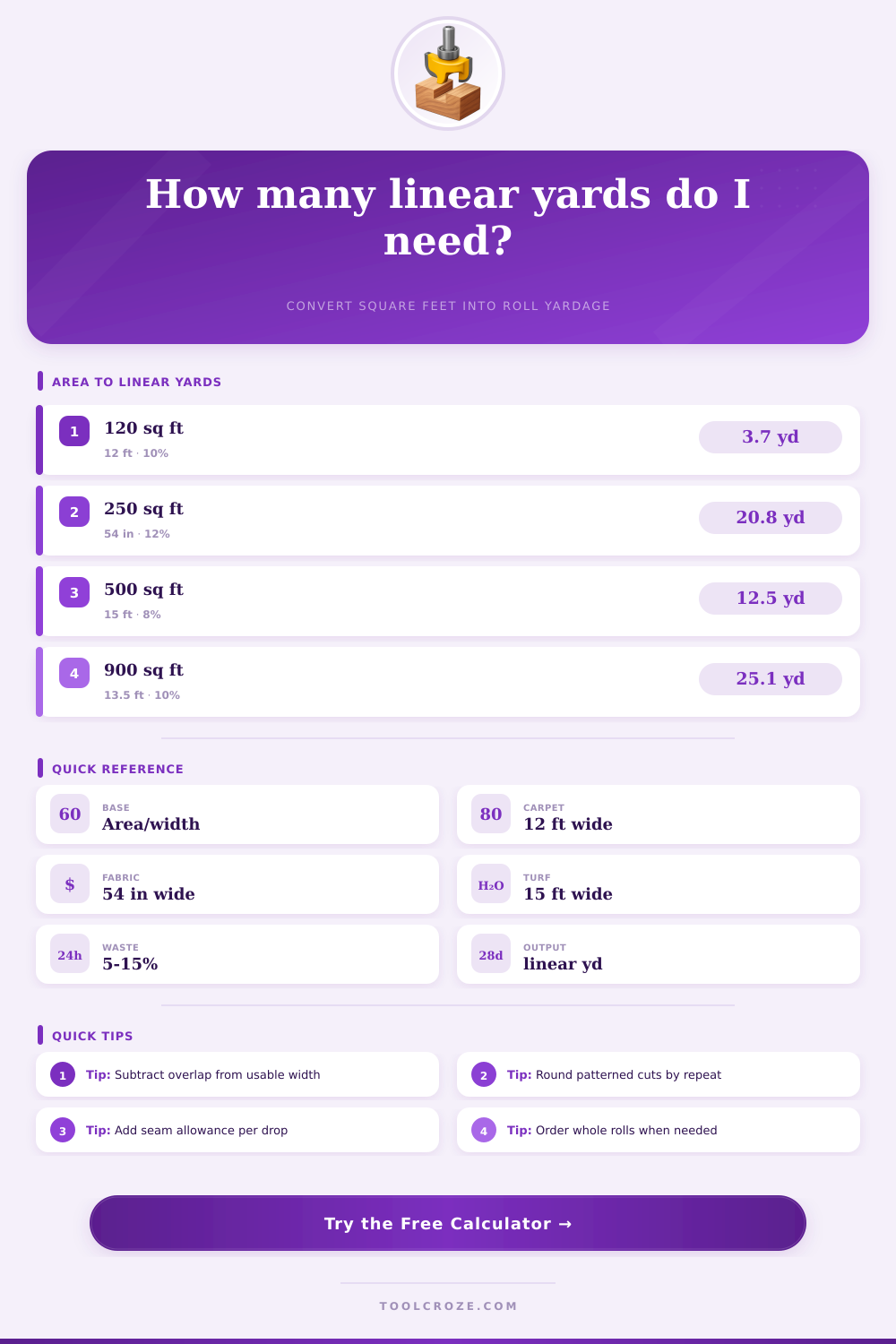
Convert square footage into linear yards for carpet, vinyl, turf, fabric, felt, upholstery, and other rolled materials using width, overlap, seam allowance, repeat, waste, and roll rounding.
1Flooring and fabric presets
Choose a starting point, then adjust width, waste, repeat, and seam settings for the exact roll you plan to cut.
2Roll yardage inputs
Use measured coverage area before waste. In metric mode, enter square meters.
This changes the estimated drop length and seam count used in the breakdown.
For common carpet, 4 yards equals a 12 ft roll width.
Use this for 13 ft 6 in rolls, 54 in fabric, or metric centimeter additions.
Subtracted from roll width to find usable coverage width.
Covers trimming, layout direction, defects, and offcuts.
Set to 0 for solid materials. Repeats round each estimated drop upward.
Added to both ends of each drop before pattern-repeat rounding.
Used for whole-roll count and leftover estimate. Use 0 to ignore roll rounding.
Controls the practical order quantity shown in the results.
Linear yardage results
Calculation breakdown
3Roll and material grid
4Reference tables
| Roll material | Typical width | Usual waste | Repeat concern |
|---|---|---|---|
| Room carpet | 12 ft or 13 ft 6 in | 8% to 15% | Directional pile and seams |
| Sheet vinyl flooring | 6 ft, 12 ft, or 13 ft 2 in | 5% to 12% | Printed tile or plank repeat |
| Upholstery fabric | 54 in to 60 in | 10% to 20% | Large motif alignment |
| Artificial turf | 12 ft or 15 ft | 8% to 18% | Grain direction and joining tape |
| Width entered | Width in feet | Formula for 100 sq ft | Base linear yards |
|---|---|---|---|
| 36 in fabric | 3.00 ft | 100 / 3 / 3 | 11.11 yd |
| 54 in fabric | 4.50 ft | 100 / 4.5 / 3 | 7.41 yd |
| 4 yd carpet | 12.00 ft | 100 / 12 / 3 | 2.78 yd |
| 5 yd turf | 15.00 ft | 100 / 15 / 3 | 2.22 yd |
| Project type | Default drop length | Seam behavior | Suggested waste |
|---|---|---|---|
| Room carpet | 6 yd | Few long drops | 10% to 15% |
| Hallway runner | 10 yd | Long narrow cuts | 8% to 12% |
| Upholstery | 2 yd | Many small panels | 12% to 20% |
| Curtains | 3 yd | Paired drops | 10% to 18% |
| Pattern repeat | Where it matters | Calculator treatment | Planning note |
|---|---|---|---|
| 0 in | Solid carpet or plain felt | No repeat rounding | Waste mainly from trimming |
| 6 in | Small geometric fabric | Each drop rounds up | Check motif direction |
| 12 in | Tile-look vinyl | Drop length aligns to repeat | Keep rows visually square |
| 24 in plus | Large print upholstery | Higher repeat reserve | Dry-layout critical panels |
5Practical yardage tips
When you roll material for a job, you have to calculate how many yardage you will need. If you dont order the correct yardage of material, you will become frustrated at the idea of purchasing too much material but also at the thought of purchasing too little for your projects. Many people uses square footage to calculate the area they need for a job, but the rolls of material is measured in linear yards.
You must account for the width of the material when converting from square footage to linear yards. The width of the material will alter the total yardage you have to order because a twelve-foot carpet roll will have a different coverage then a fifty-four inch upholstery fabric. There are a few factors that will reduce the usable width of the material.
How to Figure How Much Material to Order
The first is the loss of width due to the overlap of the material. The second is the loss of material due to trim loss. The third is the loss of material due to pattern repeat.
Seams will take up extra length of the material, and there will always be waste in the cut of the material. These factors will always reduce the usable length of the material. You need to account for these features when planning your projects.
The type of project you will perform will change the amount of material that is needed. For carpet installation in a bedroom, you will require fewer drops compared to upholstery work, which will require many small panels to cover the area. Upholstery work will require extra allowance for waste in comparison to carpet.
Runner halls will require different calculations than the other types of projects. When using the yardage calculator, you will have to select the project type because it will determine the amount of waste you will produce. The percentage of waste for your project will change based on the type of material.
For example, five percent waste will be enough for sheet vinyl but fifteen percent for a material that has a large motif design. If the design motif is large, it will take up more of the material for upholstery or carpet. You will use a smaller percentage of waste for sheet vinyl than for a carpet with a large design.
The yardage calculator can adjust the waste percentage to show how it will affect the total yardage of material you order. The length of the roll will impact the total yardage you order. If you decide to order full rolls of material, the yardage calculator will round the total yardage to the nearest whole roll.
In this case, you might have more material than you need for the job. For small projects, it might cost more to purchase extra material than you would spend on the project. For large projects, it might be beneficial to purchase extra material for future repairs.
You must know the length of the stock roll before you calculate how much material you need because the tool will allow you to order either full rolls or cut yardage. There are a few mistakes people make when calculating the yardage of material they will order for a job. One mistake is using the full width of the roll of material without subtracting for the width of the trim loss.
People also do not account for the pattern repeat of the material. This will affect the length of the material required for each drop of carpet or upholstery. People also do not account for the differences in waste of carpet versus fabric.
If people use the incorrect methods when calculating the yardage, they will likely order too small an amount of material for the project. The reference tables will display the typical widths of the materials and the typical waste allowed in each category of material. These reference tables will allow you to get a sense of the typical amount of material for each type of roll.
You will use these tables to get an idea of the total material needed. Based off the area of the job, you will adjust the input fields of the yardage calculator. The yardage calculator will give you a more accurately calculation of the total yardage of material needed for the project by adjusting these fields.
The goal of the yardage calculator is to order a quantity of material that is practical for the project so that you will not have to guess at how much material you need. When you input the actual measurements of the area to be carpeted or upholstered, the yardage calculator will provide a practical quantity of material that will cover the area with the last seam aligned correct.