⚙ Sprocket Torque Ratio Calculator
Calculate output torque, speed ratio, chain efficiency & tension for any sprocket drive system
📊 Calculation Breakdown
#520–#530 chain
SF: 1.0–1.1
#35–#40 chain
SF: 1.1–1.3
#40–#80 chain
SF: 1.3–1.7
#40–#60 chain
SF: 1.0–1.3
| Driver (T) | 32T Driven | 40T Driven | 48T Driven | 52T Driven | 60T Driven | 72T Driven |
|---|---|---|---|---|---|---|
| 12T | 2.67:1 | 3.33:1 | 4.00:1 | 4.33:1 | 5.00:1 | 6.00:1 |
| 13T | 2.46:1 | 3.08:1 | 3.69:1 | 4.00:1 | 4.62:1 | 5.54:1 |
| 14T | 2.29:1 | 2.86:1 | 3.43:1 | 3.71:1 | 4.29:1 | 5.14:1 |
| 15T | 2.13:1 | 2.67:1 | 3.20:1 | 3.47:1 | 4.00:1 | 4.80:1 |
| 17T | 1.88:1 | 2.35:1 | 2.82:1 | 3.06:1 | 3.53:1 | 4.24:1 |
| 20T | 1.60:1 | 2.00:1 | 2.40:1 | 2.60:1 | 3.00:1 | 3.60:1 |
| Efficiency | Ratio 1.5:1 | Ratio 2.0:1 | Ratio 3.0:1 | Ratio 4.0:1 | Ratio 5.0:1 |
|---|---|---|---|---|---|
| 90% | 67.5 Nm | 90.0 Nm | 135.0 Nm | 180.0 Nm | 225.0 Nm |
| 95% | 71.3 Nm | 95.0 Nm | 142.5 Nm | 190.0 Nm | 237.5 Nm |
| 97% | 72.8 Nm | 97.0 Nm | 145.5 Nm | 194.0 Nm | 242.5 Nm |
| 98% | 73.5 Nm | 98.0 Nm | 147.0 Nm | 196.0 Nm | 245.0 Nm |
| 99% | 74.3 Nm | 99.0 Nm | 148.5 Nm | 198.0 Nm | 247.5 Nm |
| 100% | 75.0 Nm | 100.0 Nm | 150.0 Nm | 200.0 Nm | 250.0 Nm |
| Chain Size | Pitch (mm) | Max Safe Tension | Torque Cap @500 RPM | Torque Cap @1500 RPM | Typical Application |
|---|---|---|---|---|---|
| #35 | 9.525 | 1,900 N | ~28 Nm | ~18 Nm | Go-kart, mini bike |
| #40 / 08B | 12.7 | 4,000 N | ~80 Nm | ~55 Nm | Dirt bike, ATV, conveyors |
| #50 / 10B | 15.875 | 7,100 N | ~170 Nm | ~120 Nm | Light industrial, motorcycle |
| #60 / 12B | 19.05 | 10,000 N | ~290 Nm | ~210 Nm | Industrial conveyor |
| #80 / 16B | 25.4 | 17,800 N | ~680 Nm | ~480 Nm | Heavy industrial, compressor |
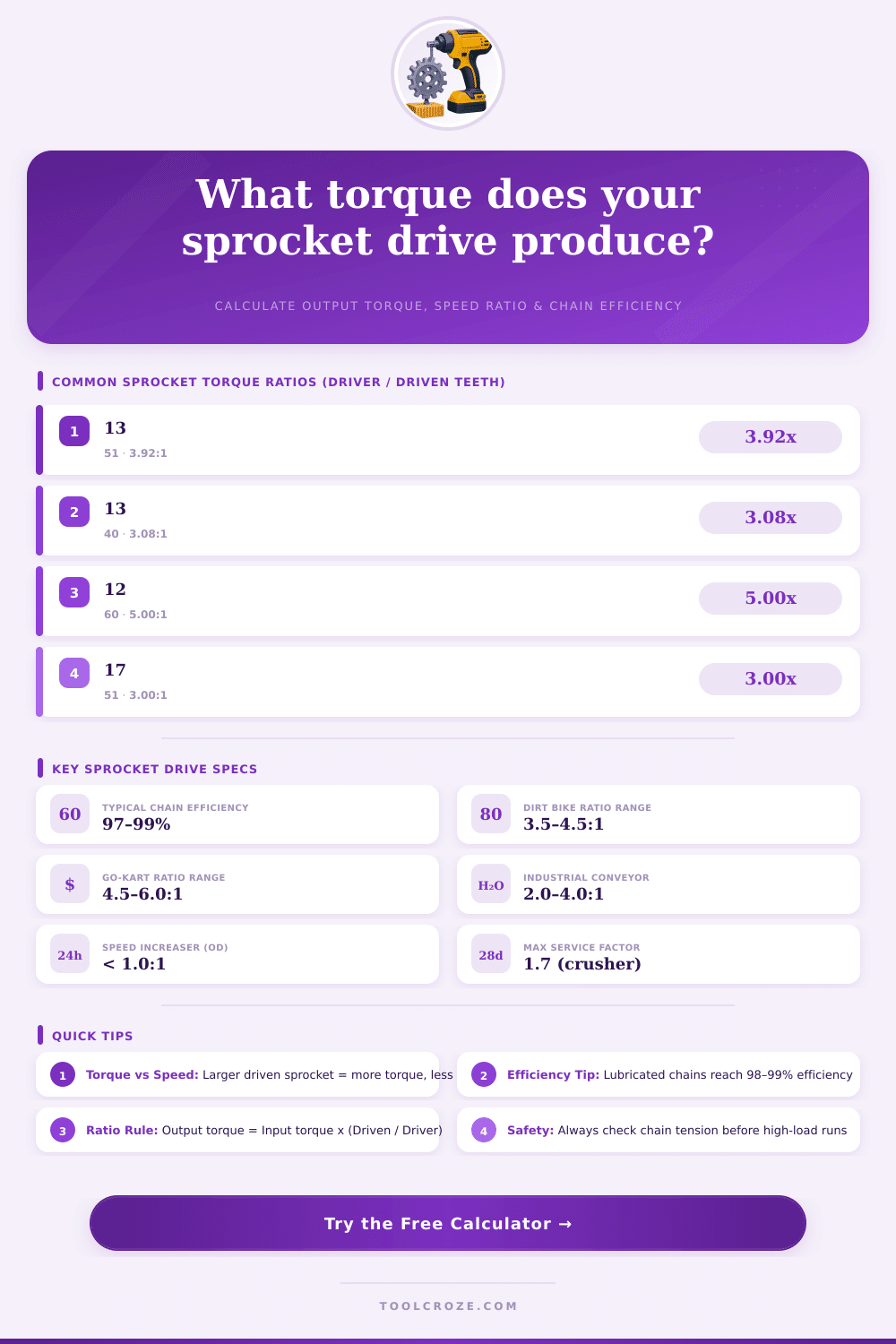
The report of the sprocket one finds sharing the tooth count of the back sprocket by the front. This shows how many torque and speed passes from the pedals to the moving part. If the report is bigger, then more torque reaches the back wheel, but the top speed drops.
On the other hand little report brings more speed, but with less torque. This change always happens, no matter the setup used.
How Sprocket Size Affects Speed and Torque
The link between the sizes of the input and output sprocket determine, the motion will be faster but with less torque, or less fast but with more. To get more torque, one tries to lower the report of the entry to the exit. So, one combines small front sprocket with big back.
The problem is that the small gear needs more turns to move the big, so the speeed drops.
Small front sprocket raise the weight, that the engine must turn to move the wheel. With fixed number of turns per minute, the bike moves more slowly, if the front sprocket are small or the back big. Still, the torque at the wheel grows, what helps for faster boost.
For instance, swapping 49-tooth back gear by 52-tooth on 13-tooth front sprocket, one changes the final pedal report to 4.00. Such counts seem simple, even though they could sound hard too review.
The usual thumb-rule says, that about three teeth back match to one front. Add three teeth back expand the torque, the same as remove one back or add one front. The back sprocket help to reach exactly the wanted report, while front care about the right sounds and rhythms.
Shared change is add one tooth front and remove two back, what keeps the chain length without grinding troubles. That brings a bit more force for the bottom part.
To estimate the percent change of torque between two setups, one share the new pedal report by the old. Later, share that result by the old report and multiply by 100. For instance, passing from 2.76 to 2.63, one gets a difference of minus 0.13.
Sharing at 2.76 and multiplying by 100, result 4.7-percent drop from the original setup. Other way is share the new report by the old and take one from the received value.
The only way to expand torque is grow the report between the sprocket. Changing the back sprocket, one does not change the power class of the engine itself. It only changes the torque at the back wheel through all turns per minute.
For instance, report of 11/53 boost more and reach higher turns per minute for the top speed compared to small report. If the top speed already limits because of the engine, then moresmall report has more sense for the extra fun of faster launch.
Online calculators for sprocket can help find the ideal sizes for a particular style of riding. They count the report of gear, the speed report and the mechanical advantage, where the mechanical advantage matches to the multiply of torque.