
Whether it’s a conveyor in your warehouse or wheels on your motorcycle, if you’ve ever operated one of these chain driven devices, then you’re familiar with sprockets. They can be any number of sizes, but when you pick up the wrong one you know it by the sound and feel of skipped teeth. The proper sprocket run smooth, increases components life span and most importantly transfers power.
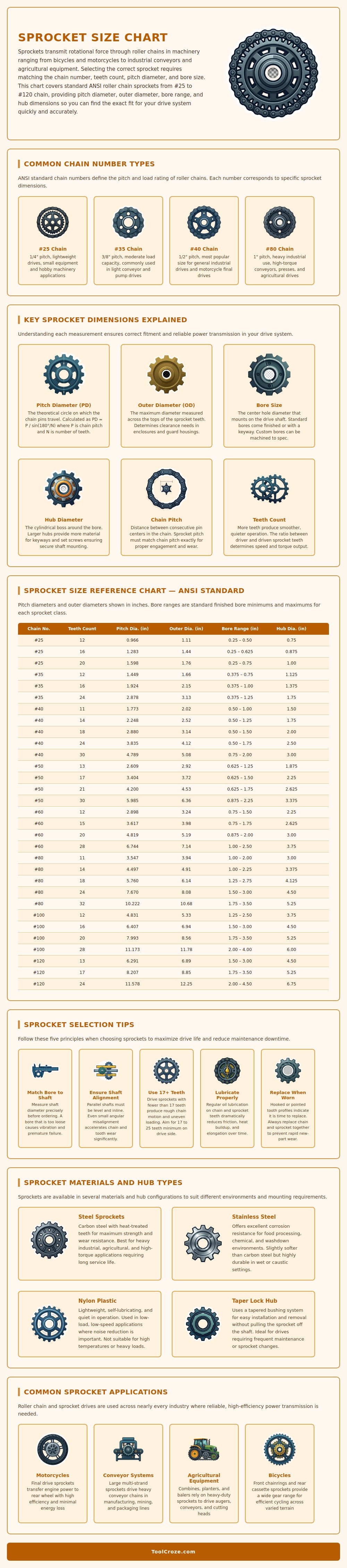
Here’s what the chart does. It lists these measurements in a table. This lets you see the bore range, outer diameter, pitch diameter, and hub size for any of these chains. Why do those numbers matter? Each one address a specific issue. The pitch diameter tells you how the chain will sit and how much torque will transfer. The outer diameter determine whether sprocket will clear its housing. And the bore range determines if it will mount to your shaft without custom machining.
How to Read a Sprocket Chart
This covers ANSI chains ranging from #25. #120. First off, you match on the chain. For example, a #40 chain are used in a lot of medium duty applications. It’s a half inch pitch chain. The sprocket you bolt onto it has to be an exact pitch match. That’s what the chart is grouping all of them by.
So now once you have the pitch matched, how many teeth do you want? Fewer teeth will provide more torque but a less smooth engagement. More teeth will make the engagement smoother, they will also take up more space and possibly reduce your overall ratio.
You get in trouble on bore size. The bore range you see listed needs to include your shaft diameter measurement. If near the high end of that range, you might want a bushing kit or hub with a different style. Hub diameter (also shown in the chart) is amount of material around the bore. More hub diameter mean extra space for set screws or a keyway. This is important if stopping and going or under shock loads from drive.
Beyond the numbers are materials, which alter durability over time. For example, steel sprockets can absorbs heavy torques and endure for years in an industrial setting. Stainless steel withstands exposure to food grade environments and washdown chemicals. Nylon is used when noise and weight is more important than straight power, yet nylon won’t hold up to serious loads or excesive heat.
It’s set up on a chart where you can go by measurement instead of guess work and get what you need in no time flat. Ultimately, you’ve got to see how the drive perform. Align your shafts before bolting anything tight. If they’re too far off then the chain rides up on the teeth on one side or the other, that will wear them both quicker.
Keep the chain lubricated and inspect tooth profiles regularly. When the teeth begin to point or catch each other, the sprocket is shot and you’ll just be wasting money by running a new chain on some old worn-out teeth. You should of checked it sooner.
A good sprocket doesn’t draw any attention to itself. It quietly transfers power. With this chart, you can choose which one will do it longest while machine continues to turn.
