Spring Rate Conversion Calculator
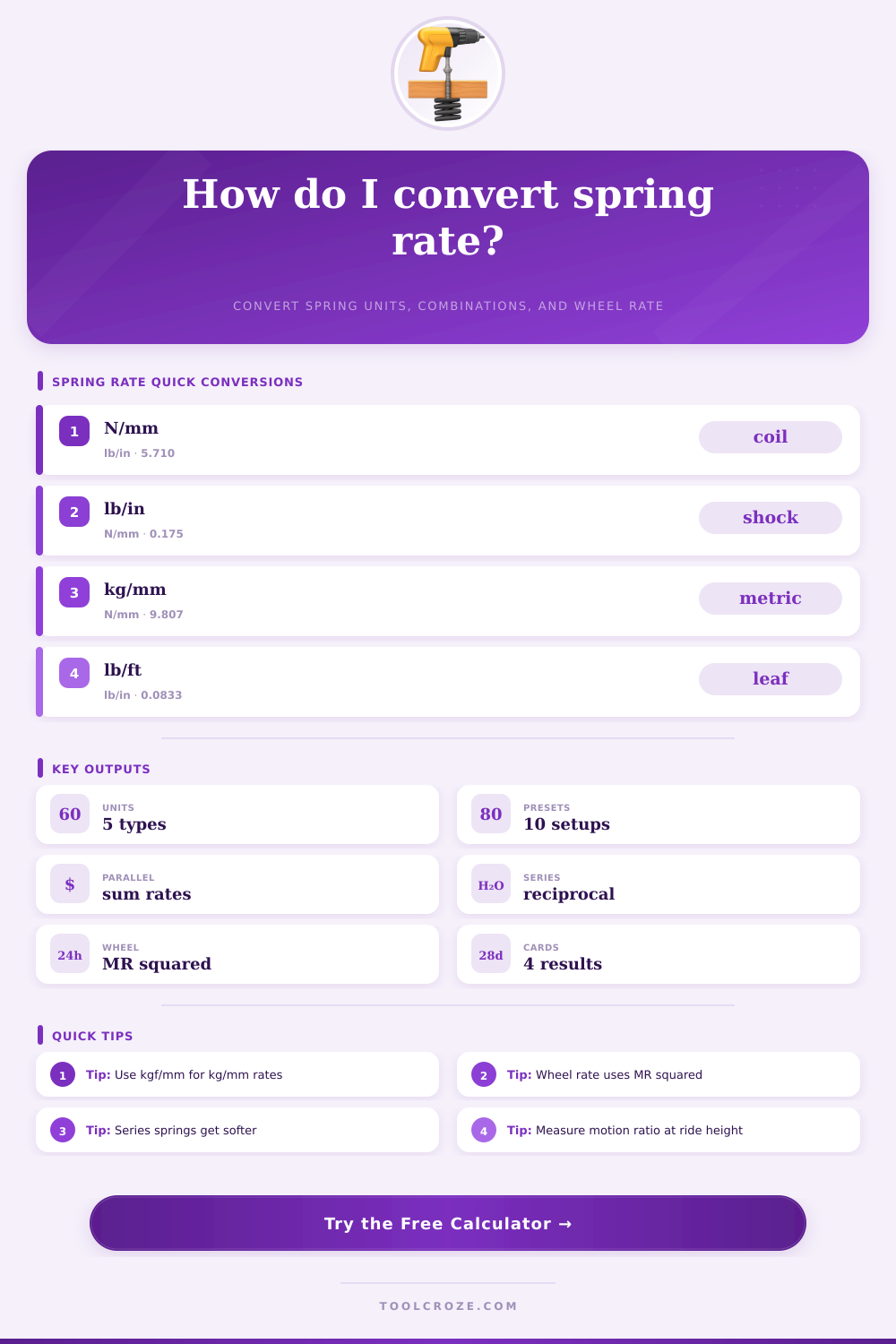
Convert spring stiffness between N/mm, lb/in, kg/mm, lb/ft, and N/m, then check series springs, parallel spring packs, motion ratio, wheel rate, and estimated deflection under load.
Load a common coilover, shock, leaf helper, die spring, or suspension setup, then adjust the rate and geometry for your application.
Calculation Breakdown
| Starting unit | Convert to N/mm | Convert to lb/in | Common use |
|---|---|---|---|
| N/mm | rate x 1 | rate x 5.710 | Metric coil springs, industrial springs, and test machines. |
| lb/in | rate x 0.1751 | rate x 1 | Coilover springs, shop test fixtures, and US catalogs. |
| kg/mm | rate x 9.8067 | rate x 56.00 | Often written as kg/mm, meaning kgf per mm. |
| lb/ft | rate x 0.01459 | rate / 12 | Leaf springs, long suspension members, and structural checks. |
| N/m | rate / 1000 | rate x 0.005710 | Engineering calculations and vibration work. |
| Arrangement | Formula | Effect | Shop note |
|---|---|---|---|
| Single spring | k total = k | Only unit conversion changes. | Use measured rate if the catalog tolerance matters. |
| Parallel springs | k total = k1 + k2 + ... | Total rate gets stiffer. | Springs share the same deflection and add their load capacity. |
| Identical series springs | k total = k / count | Total rate gets softer. | Two equal springs in series make half the rate. |
| Unequal series springs | 1 / k total = 1 / k1 + 1 / k2 | Softer spring dominates. | A tender spring collapses first if it has limited travel. |
| Parallel banks in series | 1 / k = 1 / bank A + 1 / bank B | Useful for stacked packs. | Build each bank by adding parallel springs first. |
| Motion ratio | Angle | Wheel-rate factor | Meaning |
|---|---|---|---|
| 1.00 | 0° | 1.000 x spring rate | Spring moves the same distance as the wheel. |
| 0.90 | 0° | 0.810 x spring rate | Common coilover inboard or angled linkage estimate. |
| 0.80 | 10° | 0.621 x spring rate | Both linkage ratio and angle reduce wheel rate. |
| 0.70 | 15° | 0.457 x spring rate | Large motion reduction makes the wheel much softer. |
| 1.20 | 0° | 1.440 x spring rate | Spring moves more than the wheel, so wheel rate rises. |
| Check | Good practice | Problem sign | Adjustment |
|---|---|---|---|
| Unit label | Confirm force and deflection units. | kg/mm used as mass instead of kgf. | Treat kg/mm catalog rates as kgf/mm. |
| Series stack travel | Each spring has enough working travel. | Tender spring reaches coil bind early. | Use a travel stop or calculate after bind separately. |
| Motion ratio | Measure near ride height or working height. | Large suspension travel changes the ratio. | Recheck at bump and droop if needed. |
| Angle correction | Use the angle from spring axis to motion line. | Result is too stiff for a leaned spring. | Apply cos²(angle) or correct the geometry. |
| Catalog tolerance | Use a 5% to 10% band for planning. | Measured spring differs from printed value. | Use the measured rate in this calculator. |
Spring rate is a measurement of the force necessary to compress a spring a specific distance. The spring rate for a vehicles suspension system is a critical component of how the suspension system will feel when the vehicle is in operation. While the spring rate are a numerical value, the true meaning of the spring rate is dependent upon a few different factors, such as the units in which the spring rate is measured, the springs mounting method, and whether the spring is working alone or in a spring system with other components of the suspension.
Because of these different factors that influence the spring rate, a conversion tool may be necessary to convert units between different catalogs of suspension components. Many people will experience difficulties when a person is trying to compare two different springs that use different measurement systems. For example, one catalog may publish the spring rate for a suspension spring in pounds per inch, whereas another catalog may list the spring rate in units of Newtons per millimeter or kilograms per millimeter.
Spring Rate Basics and How to Calculate It
Furthermore, it is possible to purchase a spring with a spring rate of 350 pounds per inch, but the way in which the spring is mounted on the suspension system will alter the way the spring feels when mounted. For instance, springs mounted in a way that creates a one to one relationship between spring movement and wheel movement will feel different than if the wheel movement is twice the movement of the spring movement. In order to account for these different spring rates and the geometry in which the suspension system is constructed, a calculator is useful in preventing human error with spring rate calculations.
Springs can be mounted in a variety of different arrangements on a suspension system. For instance, the springs can be mounted in a parallel arrangement to one another, or the springs can be mounted in a series arrangement to one another. In suspension systems, springs mounted in a parallel arrangement will allow each spring to experience the same movement as the other spring in the system, and the spring rates will be additive.
For instance, a helper spring that is mounted beside the main spring of a suspension system will allow for the vehicles corner to be stiffer with the same change in the height of the vehicle. In suspension systems, the springs can also be mounted in a series. For instance, a person can mount a softer spring on the vehicle on top of the main spring, and the suspension system will allow the soft spring to compress prior to the main spring of the suspension system begins to compress.
A calculator can allow a person to enter spring rates for each spring in the system, as well as the number of each type of spring in the suspension system, to calculate the total spring rate. The wheel rate for a system is the most important measurement for the handling of the vehicles suspension system. The wheel rate is calculated with the spring rate, the spring angle, and the motion ratio of the system.
Furthermore, the motion ratio has a significant impact upon the wheel rate; the motion ratio is squared in the equation for the wheel rate. For instance, a motion ratio of 0.8 will reduce the wheel rate to 64% of the spring rate. For these reasons, it is important to measure the motion ratio of the suspension system at it’s ride height, rather than referring to the drawing of the suspension system.
A calculator can automatically calculate the wheel rate based off the spring rate, angle, and motion ratio, which ensures that the wheel rate calculations are accurate. Another important calculation that can be performed is the calculation of the deflection under load of the suspension system. A person can multiply the corner weight of a vehicle by the wheel rate to calculate the deflection of the suspension system under that load.
This deflection calculation will allow a person to determine if the suspension system has enough travel to accommodate the load of the vehicle, if the suspension system will reach the coil bind limit of the suspension system, and if the dampers has enough stroke to absorb the movement of the suspension system. Furthermore, the deflection of the spring can be compared to the deflection of the wheel to determine how much movement of the suspension system is lost or gained through the linkage. It is important to understand that the actual spring rates of many vehicles will differ from the spring rates that are published on the catalog sheets for the suspension system components.
The catalogs sheets that manufacturers provide for their suspension system components provide a range of spring rates for which a given component will fall, known as the spring rate tolerances. Thus, when designing or purchasing suspension system components for a vehicle, it is common to use a tolerance band within which the spring will fall; using a five or ten percent window around the catalog spring rate will allow for the actual spring rate of the suspension component to be accounted for, as well as for potential changes in the motion ratio of the system. Furthermore, many suspension design calculators allow for the user to select the spring rate tolerance band for the component that is to be purchased.
Another detail that many people ignore when calculating spring rates is the spring angle. When a spring is mounted to a vehicle at an angle to the movement of the wheel, the spring will lose some of its effectiveness. This lost effectiveness must be accounted for in the calculation of the spring rate; when a spring is mounted on an angle of 15 degrees, for instance, the spring will lose more than six percent of its spring rate effectiveness.
Furthermore, the angle should be measured at the ride height of the vehicle, as measuring the angle will prevent a spring from being assumed to have its published spring rate for the component. Another factor to consider is the relationship between series, parallel springs, and the travel of the suspension system. For instance, a tender spring that is mounted in a series with a main spring of the suspension system may reach its coil bind limit prior to the main spring compressing to that same limit.
Furthermore, if this tender spring reaches its coil bind limit, the suspension system will from that point on act as a single stiff spring for the remainder of it’s travel. Similarly, if the springs are arranged in a parallel system, each spring will share the load equally, but each spring will experience the same deflection. Thus, if one spring in a parallel system reaches its coil bind limit, the total spring rate of the suspension system will change during the remainder of the systems travel.
Both of these scenarios can be calculated in advance with a suspension design calculator. One more consideration in the calculation of spring rates is the units in which the spring rate is published. Spring rates that are published in units of kg/mm usually refer to the spring rate in kilograms-force per mm of deflection, not the spring rate in units of mass.
Thus, if the spring rate were to be calculated using the spring rate in kg instead of kgf, the spring rate would be mathematicaly incorrect by a factor of nearly ten. Design calculators usually define the unit as the engineering unit for spring rate, so the spring rate will be accurate with the spring rate indicated by the catalog sheet for the spring component. Finally, it is important to understand that spring rate is not an isolated calculation.
The spring rate is not calculated in isolation from the geometry in which the suspension is constructed, the arrangement of the springs on the vehicle, or the travel limits of the suspension. For instance, changing the geometry of a suspension system will change the wheel rate, the spring rate will change with the change in the arrangement of the springs on a vehicle, and the suspension travel limits will change the behavior of the suspension system with respect to the springs. Thus, a calculator that allows for the spring rate to be calculated allows for a designer or purchaser of suspension components to focus upon the aspects of the system and suspension that influence the spring rate, rather than the calculation of the spring rate itself.
You should of checked the catalogs more carefully to avoid errors.