Spring Force Calculator
Calculate preload, working force, travel reserve, and solid-height clearance for compression springs or extension springs using spring rate, free length, installed length, travel, and spring count.
Choose a common shop spring setup. Each preset fills the mode, spring rate, free length, installed length, travel, solid height, and spring count fields.
Spring Force Results
Calculation Breakdown
| Material or duty | Typical use | Strength note | Calculator allowance |
|---|---|---|---|
| Music wire | Shop fixtures, light machines | High strength, dry indoor use | General baseline |
| 302 stainless | Outdoor, food, damp areas | Lower strength than music wire | Reduce working stress |
| Chrome silicon | High cycle, hot, shock duty | Good fatigue resistance | Best for repeated compression |
| Oil-tempered wire | Rugged mechanical service | Durable but less precise | Use measured rate when possible |
| Phosphor bronze | Electrical, nonmagnetic work | Modest spring force | Keep deflection conservative |
| Die spring | Press tools and guided pockets | Color-coded heavy compression | Respect catalog travel limits |
| Item | Compression spring | Extension spring | Workshop check |
|---|---|---|---|
| Preload deflection | Free length minus installed length | Installed length minus free length | Should be intentional and repeatable |
| Working force | Rate times total compression | Rate times total extension | Add initial tension if catalog lists it |
| Parallel springs | Forces add at same deflection | Forces add at same extension | Use matched rates and equal mounts |
| Series springs | Rates reduce and travel adds | Rates reduce and travel adds | This calculator assumes parallel, not series |
| Check | Good range | Problem sign | Adjustment |
|---|---|---|---|
| Compression reserve | 15% or more travel left | Working length near solid | Longer spring or lower travel |
| Solid height entry | Below installed and working length | Installed length already solid | Correct catalog data before sizing |
| Extension stretch | Within catalog max extension | Hooks open or coils gap too far | Use longer spring or lower rate |
| Guide condition | Rod, bore, or short free length | Spring bows sideways | Add guide or lower slenderness |
| Preset | Mode | Rate range | Common check |
|---|---|---|---|
| Die spring press return | Compression | 120 to 350 lb/in | Catalog max travel |
| Drill press quill return | Compression | 8 to 25 lb/in | Smooth return force |
| Fixture clamp compression | Compression | 40 to 180 lb/in | Repeatable preload |
| Screen door pull spring | Extension | 3 to 12 lb/in | Hook load and stretch |
| Pedal return extension | Extension | 5 to 20 lb/in | Comfort at full stroke |
Spring are components that provide force to many machines and fixtures. Many times, peoples notice the spring when it stop working. All types of springs return to there initial position, including return and die springs.
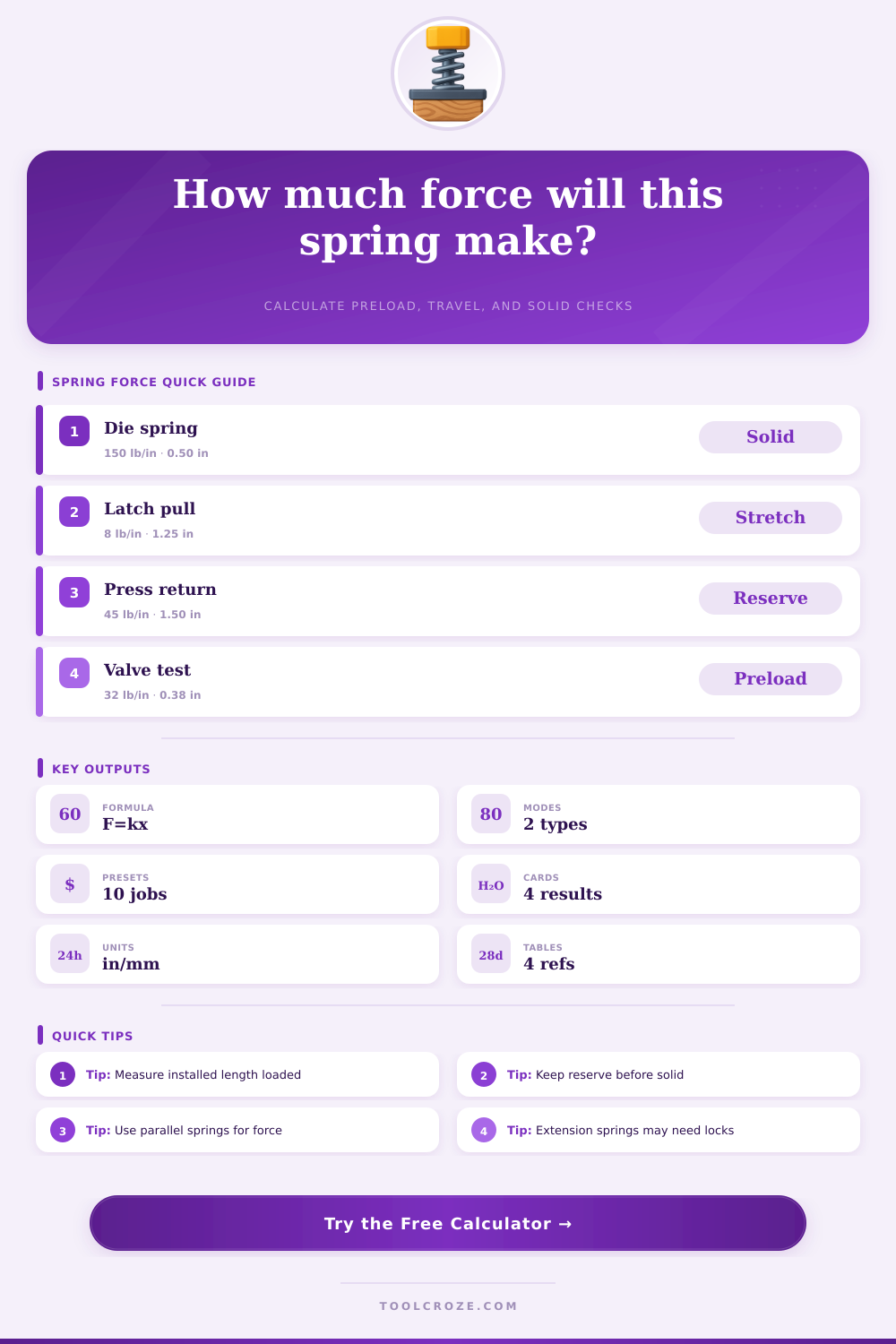
The force of a spring is equal to the product of the spring rate and spring deflection. Using a calculator to determine spring force allow people to avoid guesswork by inputting the variable that will tell them if the spring will reach the necessary force without bottoming out the spring. To use a spring correctly, there is three critical measurements to consider: free length, installed length, and working travel.
How Springs Work and How to Use Them Safely
Free length is the length of the spring when it is on the bench and not touch by any components. Installed length is the length of the spring once it is mount on its seats. Working travel is the movement of the spring once it begin to operate.
These three variable determine the preload or the force in the spring before it begin to move. If the installed length is close to the free length, the preload will be close to zero. This will make the spring feel loose until it begin to pick up a load.
Many fixture fail due to the designer not considering that there will not be much preload in the spring. The spring’s material will determine how much deflection the spring will experience. If the designer select music wire for their spring, it is a strong material but will rust if use outdoors.
Stainless steel is another material that hold up well in damp environments but have less strength than music wire so a heavier spring will be need for the same amount of force. Chrome silicon springs can take more heat and cyclical use so they are best for production presses. The spring calculator will change the recommendation based on the material used.
The catalog will show the travel that the spring can experience, which is the true limit of the spring. Using two or more parallel springs can add to the force required by the machine. Using two springs will double the force the spring can provide.
However, if the support for the spring are not made square with the spring or the two springs are of different length, the load sharing between the two springs will not be even. One spring will have to do most of the work and the other spring will not contribute much to the required force for the machine part. The spring calculator will have a guide factor to make up for uneven load sharing.
However, you will have to measure the force after mounting the spring to make sure the force is as required. For compression and extension springs, the movement of the spring once it leave the free length of the spring can have different effect. For compression springs, the length of the spring will decrease while it is in use, and the coil will eventually touch each other.
The spring calculator will warn the designer if the working length of the spring is close to the solid height as this can cause the spring to fail. For extension springs, the length of the spring will increase while it is in use. The limit for extension springs will be the hook on the spring rather than the length of the spring’s coils.
Overextending the spring can cause the hooks on the spring to open or the springs coil to move out of place. Travel reserve is the distance between the length of the spring’s working length and the limit of the spring. A fifteen percent travel reserve is the standard distance use in most shops.
A travel reserve of fifteen percent will allow for error in the spring’s length. If the travel reserve is less than fifteen percent, shortening the travel, using a longer spring, or using parallel spring can be used to fix this issue. The distance can be seen direct on the spring calculator to allow the designer to make a decision before ordering the spring.
Cycle duty refer to the number of cycle the spring will be used for. For springs that will be used occasionally, the cycle duty can be low. However, if the spring will see high production use or heavy shock load, the spring will fatigue quick.
To combat this, the spring calculator will use higher duty cycle that allow less travel for the spring to reduce fatigue damage to the spring coil. Mistake are common when using the catalog free length rather than measuring the installed length of the spring. One mistake is treating the solid height as the stop for the spring while in use.
However, treating the solid height as the stopping point for the spring while it is in operation will lead to spring failure at high speed. Another mistake when using extension springs is not accounting for the initial tension of the spring. The spring rate will not be applied to the extension spring while in initial tension so this must be account for in the spring calculation.
Springs store energy and can sudden release it if they are not properly secure in their components. Using positive stop and lockout procedure when using springs will protect the operator from the spring’s stored energy. When using springs, make sure to carefully measure the spring.
Ensure that there is a travel reserve and that the calculation of the force of the spring match the spring that is being installed in the machine.