Spray Gun Air Consumption Calculator
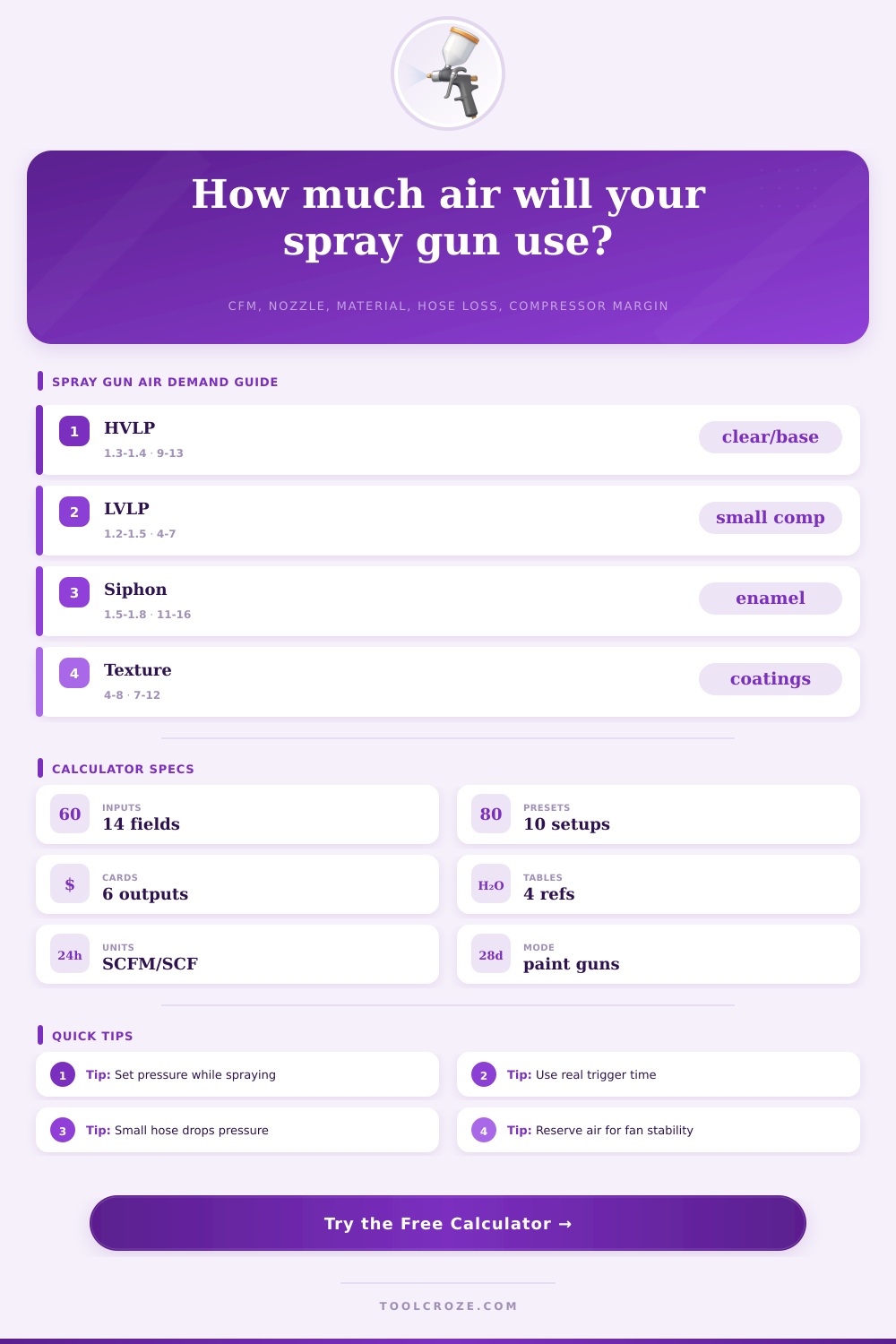
Estimate spray gun SCFM from gun type, nozzle size, material, fan pattern, overlap, travel speed, regulator pressure, hose restriction, compressor delivery, and paint-session duty cycle.
🎨 Spray Gun Presets
Load a real finishing setup, then adjust the pressure, hose, nozzle, pattern, coats, and compressor rating to match the tool data plate and your spray technique.
📊 Calculator Inputs
Calculation Breakdown
⚙ Spray Gun Spec Grid
🔫 Spray Gun Type Reference
| Spray Gun Type | Typical Nozzle | Typical Air Consumption | Pressure Planning Note |
|---|---|---|---|
| HVLP gravity feed finish gun | 1.2 to 1.4 mm | 9 to 13 SCFM | Needs steady volume even when inlet pressure is modest. |
| Compliant gravity feed gun | 1.2 to 1.5 mm | 8 to 11 SCFM | Often runs slightly higher inlet pressure than HVLP. |
| LVLP gravity feed gun | 1.2 to 1.5 mm | 4 to 7 SCFM | Useful where compressor output is limited, but pass speed may be slower. |
| Conventional siphon gun | 1.5 to 1.8 mm | 11 to 16 SCFM | Higher pressure and air volume are common for full fan atomization. |
| Pressure feed production gun | 1.0 to 1.8 mm | 12 to 18 SCFM | Continuous spraying pushes average demand close to triggered demand. |
| Mini touch-up gun | 0.8 to 1.2 mm | 3 to 6 SCFM | Short panels and spot repairs usually have low total SCF use. |
| Detail airbrush | 0.2 to 0.6 mm | 0.5 to 2 SCFM | Low air use, but pressure stability still affects line quality. |
| Texture hopper gun | 4 to 8 mm | 7 to 12 SCFM | Large nozzles and pulsing material flow make reserve useful. |
🧪 Spray Gun, Nozzle, And Material Comparison Grid
| Job Type | Gun And Nozzle | Material Match | Air Setup Range |
|---|---|---|---|
| Automotive basecoat | HVLP or compliant, 1.2 to 1.4 mm | Thin to medium basecoat | 8 to 13 SCFM, 20 to 35 psi inlet. |
| Urethane clear coat | HVLP or compliant, 1.3 to 1.4 mm | Clear with full fan wet edge | 9 to 14 SCFM, stable pressure is critical. |
| Primer surfacer | HVLP, 1.7 to 2.0 mm | High build primer | 11 to 15 SCFM; larger nozzle adds air demand. |
| Cabinet lacquer or sealer | LVLP, 1.2 to 1.4 mm | Thin wood finish | 4 to 7 SCFM with slower controlled passes. |
| Single-stage enamel | Siphon or gravity, 1.4 to 1.8 mm | Medium viscosity enamel | 10 to 16 SCFM depending on fan and pressure. |
| Waterborne trim coating | HVLP or LVLP, 1.5 to 1.8 mm | Waterborne acrylic | 6 to 13 SCFM; atomization may need extra reserve. |
| Texture or heavy coating | Hopper gun, 4 to 8 mm | Texture, aggregate, heavy latex | 7 to 12 SCFM with large pulses and wide variance. |
💨 Hose Pressure Loss Reference
| Air Line Setup | Planning Loss At 10 SCFM | Spray Pattern Effect | Calculator Use |
|---|---|---|---|
| 25 ft 1/4 in hose with standard couplers | About 6 to 10 psi | Fan narrows and atomization weakens on high-CFM guns. | Use only for mini, airbrush, or low-CFM touch-up work. |
| 25 ft 5/16 in hose | About 3 to 5 psi | Moderate loss on HVLP clear, better for LVLP work. | Works for portable setups if pressure is checked while spraying. |
| 25 ft 3/8 in hose, full-flow fittings | About 1.5 to 3 psi | More stable full fan and fewer pressure dips. | Good default for full-size finish guns. |
| 25 ft 1/2 in shop lead or manifold | Under 1.5 psi | Best pressure stability for production or pressure feed guns. | Use for long spray sessions and shared air branches. |
🕒 Project Trigger Time Reference
| Spray Project | Typical Area Per Coat | Common Duty Cycle | Air Planning Takeaway |
|---|---|---|---|
| Single automotive panel | 20 to 45 sq ft | 25% to 40% | Total air use is modest, but the gun still needs full triggered SCFM. |
| Cabinet door batch | 40 to 90 sq ft | 30% to 50% | LVLP may fit a smaller compressor if pass speed is controlled. |
| Primer on body shell sections | 80 to 160 sq ft | 35% to 60% | Large nozzle and high build material raise compressor demand. |
| Production railing or trim | 120 to 300 sq ft | 50% to 75% | Average SCFM matters more than tank storage during repeated spraying. |
| Texture ceiling or wall pass | 150 to 400 sq ft | 45% to 70% | Use a wide reserve because hopper flow changes air demand quickly. |
💡 Practical Tips
⚠ Safety Note
Calculating teh air consumption of a spray gun is another necessary step that a person must take in order to succesfuly complete a finishing project. Many people feels that purchasing a compressor for a spray gun is a simple purchase. However, the amount of air that a spray gun will consume depend on several different variable.
The variables include the size of the nozzle of the spray gun, the thickness of the material that is being spray, the restriction to the air that passes through the hose, and the amount of time that the trigger of the spray gun is pulled. If you dont account for the variables when purchasing a compressor, then there is a chance that the compressor will not supply enough air to the spray gun. A lack of air from the spray gun will make the finish of a project unevenly.
How to Calculate Spray Gun Air Use
In order to accurately calculate the air consumption of a spray gun, the air pressure of the regulator is not the same than the air pressure at the spray guns nozzle. When the trigger of the spray gun is pulled, the air from the compressor travels through the hose to the spray gun. As the air move through the hose, there is a drop in air pressure.
The longer the hose and the smaller the diameter of the hose, the more greater the drop in air pressure. Thus, a person may find that the spray gun has enough air to provide a proper spray when the trigger of the spray gun is not pulled. However, when the trigger is pulled and the air starts to travel from the compressor to the nozzle, the air pressure drops to a level that may not be suitable for the projects.
Another variable to consider is the capacity of the compressor. When a manufacturer manufactures the compressor, a number on the data plate of the compressor represents the capacity of the compressor. This number is the maximum amount of air that the compressor can provide.
However, the actual amount of air that a compressor can provide is less than this number due to components like moisture separator, regulators, and other couplers. In order to account for this loss of air, a person should purchase a reserve percentage of air for the compressor. If the reserve percentage is not accounted for, it is likely that the compressor will not be able to keep up with the demand of the spray gun during the spraying process.
Another factor that impact the air consumption of a spray gun is the duty cycle of the air compressor. The duty cycle is the percentage of the time that the trigger of the spray gun is pulled. Although a person may be spraying a certain material, they are also taking breaks and repositioning the spray gun.
The lower the percentage of the duty cycle, the less that the spray gun will be under an average load. However, the higher the percentage of the duty cycle, the more that the spray gun will be under an average load. Another variable of air consumption is the type of material that is being sprayed.
Thicker material require more air to atomize the material than thinner materials. Additionally, waterborne materials require more air than solvent-based materials. Therefore, the air consumption of a spray gun change with the material that is being sprayed, and that material factor must be taken into account when calculating the air consumption of the spray gun.
Another factor that impacts the amount of air that is delivered to the spray gun is the diameter of the hose that is used to direct the air. A 1/4 inch hose is relatively easy to carry. However, a 1/4 inch hose will cause a significant loss of air pressure at the inlet of the spray gun.
A 3/8 inch hose will reduce the loss of air pressure at the inlet of the spray gun. Thus, a person must decide if they would like to use a 1/4 inch hose or a 3/8 inch hose. Travel speed also has an impact upon the amount of air that is consumed by the spray gun.
The faster that the spray gun is moved to cover a certain area, the less amount of air will be required to spray that area. However, fast travel speeds require a certain technique from the individual using the spray gun in order to prevent create thin spots on the project. Additionally, the overlap that is used with the spray gun will have an impact upon the air consumption.
If an individual moves the spray gun slow and uses a heavy overlap to spray a certain area, that spray gun will consume more air than if it were to be moved rapidly to cover the same area. The total standard cubic feet of air is a measurement of the total amount of air that will be consume during the entire project. This total standard cubic feet is calculated by converting the triggered air of the spray gun and the time that the spray gun is sprayed into a total volume of air.
Knowing this measurement is helpful for individuals who are using a compressor with a limited tank of air. Additionally, knowing the total standard cubic feet is helpful for individuals that share the same compressor with other individuals. The goal of an individual who purchases a compressor is to ensure that the capacity of the compressor is set to the average air consumption of the spray gun.
By setting the two variables to be the same, the air pattern will remain the same and the quality of the spray gun will be high. You should of checked the capacity before you buy.