🔧 Spot Drill Depth Calculator
Set the cone depth, target diameter, and angle for spot drilling, countersinking, or clean drill starts without guesswork.
📌 Presets
📊 Calculator
📋 Material Guide
📈 Reference Tables
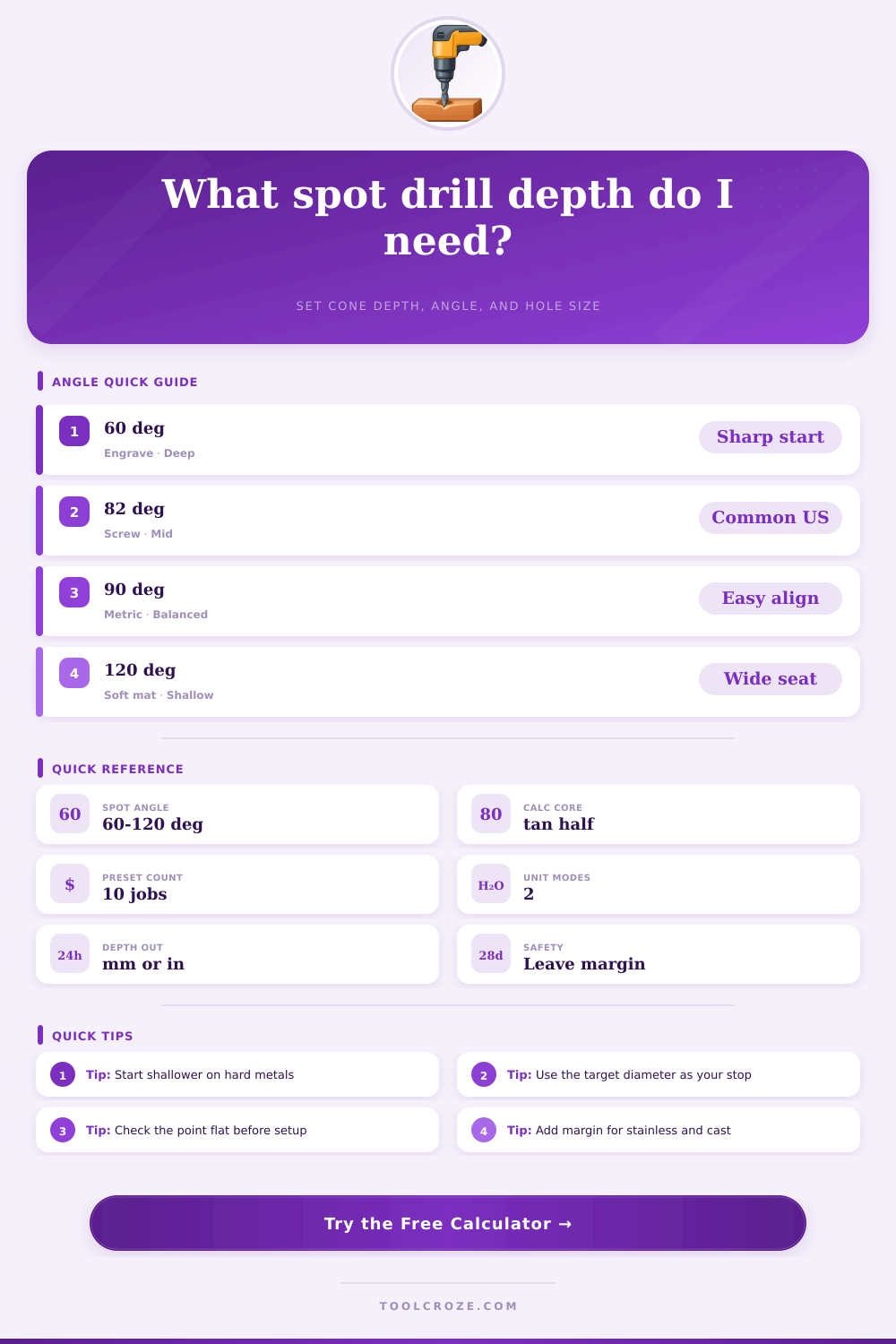
| Angle | Typical use | Depth factor | Comment |
|---|---|---|---|
| 60° | Sharp point | Deep | Fast visual center |
| 82° | US screw heads | Mid | Very common shop angle |
| 90° | General drilling | Balanced | Easy to set and measure |
| 120° | Wide soft seat | Shallow | Gentler cone entry |
| Job | Hole | Target | Use |
|---|---|---|---|
| M3 clearance | 3.4 mm | 4.0 mm | Light guide |
| M6 clearance | 6.6 mm | 7.8 mm | Machine screw |
| 1/4 in bolt | 0.266 in | 0.312 in | Standard fit |
| 3/8 in bolt | 0.390 in | 0.450 in | Shop layout |
💡 Tips
Use this spot drill depth calculator to set a clean cone, match the hole diameter, and keep the tool from wandering. It is quick to adjust for CNC, drill press, and hand setup.
Spot drill depth forms key part for work with tools. For 118-degree spot using carbide drills, the depth simply matches the drill width times 0.3. For example, hole of 0.250 inches requires 0.075 inches of spot drilling.
Good rule of thumb is made of to find the spot drill depth with the diameter of the main drill bit. So, for 10 mm-diameter drill, expect around 10 mm of depth. Metric users simply put the size with “mm” in the diameter field of the hole, for instance “12mm” for 12 mm-hole.
How to Find Spot Drill Depth
Remember, that all spot depths show in inches.
Different formulas help to count the Z-travel for sharp-point countersink or spot drill angle. One say Z = (D / 2) [1 / tan(α / 2)], other Z = (D / 2) cot(α / 2), where α are the countersink angle and D the diameter. Z show the depth, that the tool must go into the part surface.
Other way: Depth = Diameter / (2 * tan(Angle / 2)), where Diameter is that of the next drill and Angle the tip of the spot drill. For exactly get the true-diameter without measure by means of caliper, use degree-based calculator. For 118-degree drill, apply 31 tan(radius).
NC spot drills lack body clearance and are not made for go more than the spot angle depth. 90- and 120-degree spots most commonly create for 118- and 135-degree secondary drills. Some uses only deep-drilling with 142 degrees for carbide, because 140 degrees works for 135-degree split points and 120 degrees for 118-degree split points.
For 0.25-inch hole with 0.031-inch chamfer, the spot drill diameter becomes 0.312 inches. Occasionally you uses spot drill for diameter 0.01 until 0.015 inches more than the wanted hole-diameter. Typical spot drills have 0.005 until 0.010-inch flat on the tip, so that the depth needs adjust.