🔊 Speaker Wire Gauge Calculator
Find the correct AWG wire for your home theater, stereo, or surround sound system
| AWG | Dia. (mm) | Dia. (in) | Resistance (Ω/ft) | Resistance (Ω/m) | Max Current (A) | Typical Use |
|---|---|---|---|---|---|---|
| 10 AWG | 2.59 | 0.102 | 0.000999 | 0.00328 | 30 | Very high power, commercial PA |
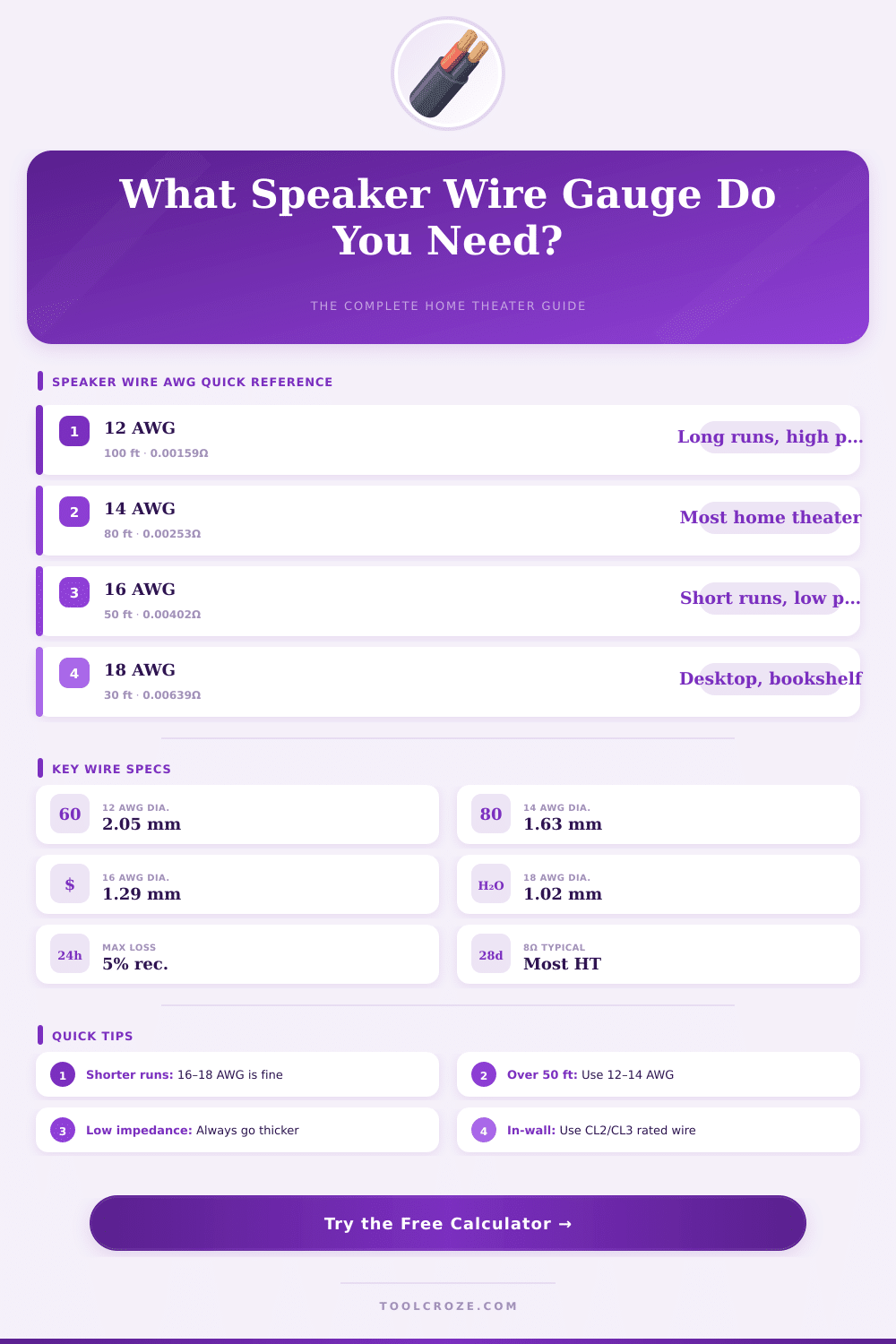
| 12 AWG | 2.05 | 0.0808 | 0.00159 | 0.00521 | 20 | Long runs, high power home theater |
| 14 AWG | 1.63 | 0.0641 | 0.00253 | 0.00830 | 15 | Standard home theater, most HT receivers |
| 16 AWG | 1.29 | 0.0508 | 0.00402 | 0.01319 | 13 | Short runs, budget systems, surrounds |
| 18 AWG | 1.02 | 0.0403 | 0.00639 | 0.02096 | 10 | Desktop, bookshelf, very short runs |
| 20 AWG | 0.812 | 0.0320 | 0.01015 | 0.03331 | 7.5 | Low power, small speakers only |
| 22 AWG | 0.644 | 0.0253 | 0.01614 | 0.05295 | 5 | Interconnects, not recommended for speakers |
| AWG | 4 Ω Speaker (ft) | 6 Ω Speaker (ft) | 8 Ω Speaker (ft) | 16 Ω Speaker (ft) | 4 Ω (m) | 8 Ω (m) |
|---|---|---|---|---|---|---|
| 10 AWG | 157 | 236 | 314 | 628 | 47.9 | 95.7 |
| 12 AWG | 99 | 148 | 198 | 396 | 30.2 | 60.4 |
| 14 AWG | 62 | 93 | 124 | 249 | 18.9 | 37.8 |
| 16 AWG | 39 | 59 | 78 | 157 | 11.9 | 23.8 |
| 18 AWG | 25 | 37 | 49 | 98 | 7.5 | 15.0 |
| 20 AWG | 15 | 23 | 31 | 62 | 4.7 | 9.4 |
| Installation | Required Rating | Min AWG (typical) | Notes |
|---|---|---|---|
| Open Air / Exposed | Standard / CL2 | 16 AWG | Any speaker wire OK for short open runs |
| In-Wall | CL2 or CL3 rated | 16 AWG | Required by NEC for in-wall installation |
| In-Ceiling | CL2 or CL3 rated | 16 AWG | Must be plenum (CMP) if in air handling space |
| In-Conduit | Standard OK | 16 AWG | Conduit acts as protection; simplifies future changes |
| Direct Burial | Direct Burial rated | 14 AWG | Use gel-filled or PE-jacketed rated cable only |
| Outdoor Exposed | UV-resistant / CL3 | 14 AWG | Conduit strongly recommended for UV protection |
| Commercial / PA | CL3 or 70V rated | 12 AWG | 70V systems change impedance math significantly |
| Layout | Channels | Typical Run (ft) | Rec. AWG | Total Wire Est. |
|---|---|---|---|---|
| 2.0 Stereo | 2 | 10–20 ft | 16–18 AWG | 20–40 ft |
| 2.1 Stereo + Sub | 2 + sub | 10–20 ft + 15 ft | 16 AWG (RCA for sub) | 35–55 ft |
| 5.1 Surround | 5 | 20–50 ft avg | 14–16 AWG | 100–250 ft |
| 7.1 Surround | 7 | 20–60 ft avg | 14–16 AWG | 140–420 ft |
| 5.1.2 Atmos | 7 total | 20–60 ft avg | 14–16 AWG | 140–420 ft |
| 7.1.4 Atmos | 11 total | 20–75 ft avg | 12–14 AWG | 220–825 ft |
| Outdoor Zone | 2–4 | 50–150 ft | 12–14 AWG | 100–600 ft |
For most home theater setups, speaker wire gauge simply shows how thick it is. The American Wire Gauge system, or AWG, serves for that measure. Here the part that commonly confuses folks: lower numbers actually mean thicker wires, while higher numbers mean slimmer wires.
When you manage to wrap your head around that idea, it does not seem that difficult.
How to Choose the Right Speaker Wire for Your Home Theater
For most home audio setups, wire of 16 gauge does the task very well. When your speakers stand less than 50 feet from the receivers, 16 gauge is an excellent choice. Even 18 gauge works for even shorter runs.
Around 10 feet, 18 gauge is fully fair, unless your speakers have very low impedance. For anything under 20 feet? Solid 16 gauge speaker wire handles it without problems.
When you have longer cables, things start getting tricky. For 14 gauge speaker wire with an 8 ohm speaker, avoid going past 80 feet or more. On the other hand, 12 gauge speaker wire handles runs up to around 120 feet with 8 ohm speakers.
If the impedance drops to 4 ohms, that same 12 gauge limits to about 60 feet. It falls even more down to 2 ohms, and then you have only 30 feet. The more long the signal travels through the wire, the more the resistance builds in it.
Also slimmer wire worsens that problem. So both the distance and the thickness of the wire afefcts the result here.
Why does the resistance matter so much? The energy from the amplifier controls the cone of the speaker to create sound. If resistance grows in the wire, the amplifier must push more strongly to beat it.
Lower gauges give less resistance, which makes it easier for the amplifier to move the speakers. Using too slim wire over long distances can make the sound week or even damage your gear.
In a typical home theater setup with 8 ohm speakers and cables between 15 and 25 feet, 16 to 18 AWG costs only pennies. If you need longer runs, speakers with low impedance or heavy power, then 12 to 14 AWG makes more sense. Choose thicker than needed?
It does not risk anything. There is no penalty for going to the safe side with the gauge.
Also the material quality matters, truly. Oxygen-free copper, OFC, beats copper-covered aluminium or CCA, always. OFC offers better flow overall.
So choose OFC and skip the CCA. Shielded 16 gauge speaker wire can beat unshielded 14 gauge, because the shielding keeps long cables against picking up false signals, like an antenna.
But here is the main point: thicker cables do not always make the sound better. For most home theater systems with under 250 watts and short distances, the difference between one gauge and another barely shows. Speaker wire ranks almost last among the factors that affect the sound quality, if you use normal lengths and proper gauges.
The signal that passes through them simply cannot hurt the sound in any real way. If you keep the resistance under five percent of the impedance of your speakers, grab a bit of 14 gaugeOFC speaker wire and you are set.