Sling Capacity Calculator
Estimate rated lift capacity from sling type, vertical WLL, hitch, legs, sling angle, D/d bend reduction, choker reduction, basket factor, and planning margin.
⚙Real Rigging Presets
📏Lift Inputs
🧱Sling Material / Spec Comparison
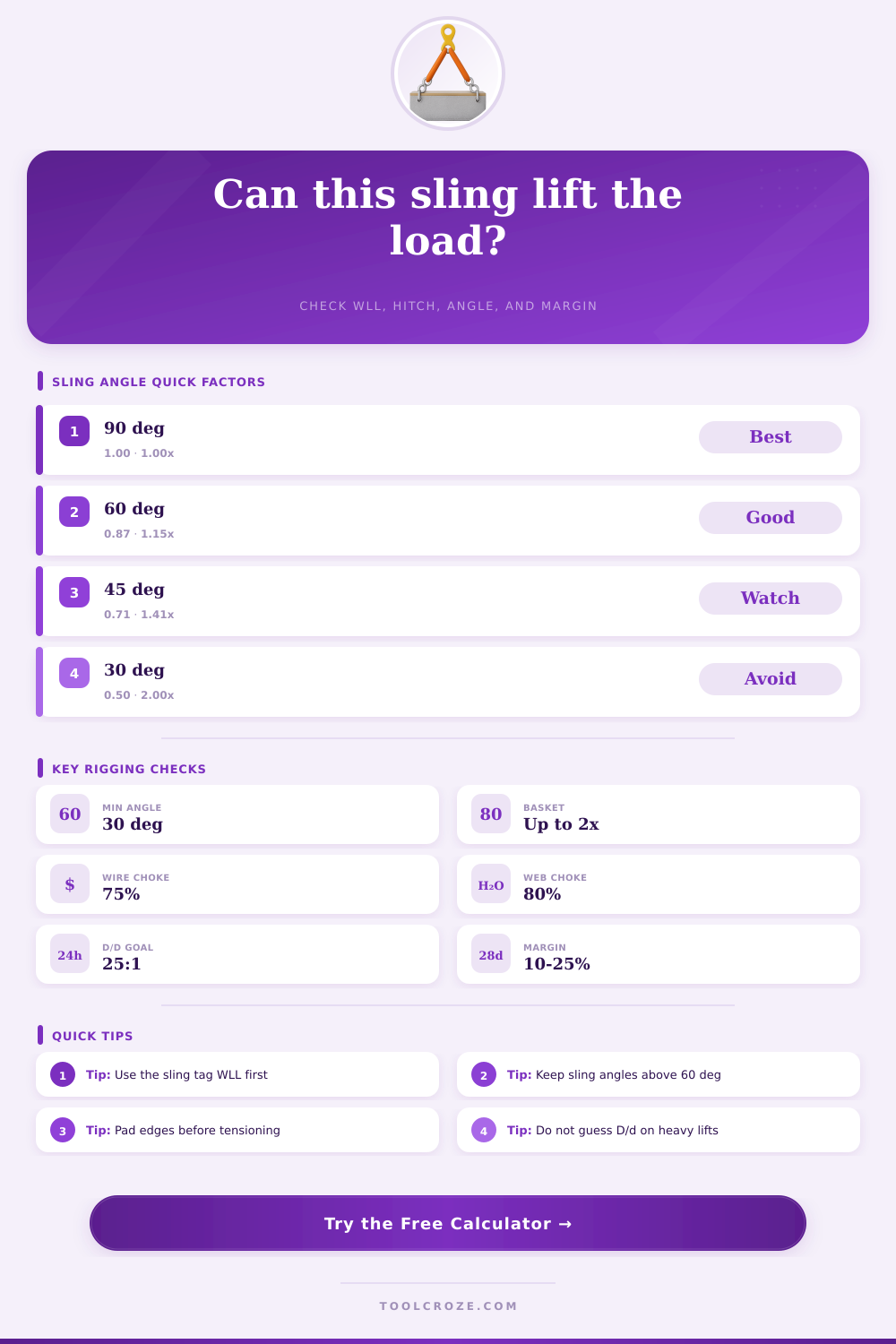
📊Sling Angle Reference
| Angle from horizontal | Capacity multiplier | Tension factor | Planning note |
|---|---|---|---|
| 90° | 1.000 | 1.00 times vertical share | Vertical pick, lowest sling tension |
| 75° | 0.966 | 1.04 times vertical share | Very good bridle angle |
| 60° | 0.866 | 1.15 times vertical share | Common target minimum for routine lifts |
| 45° | 0.707 | 1.41 times vertical share | Capacity drops quickly; verify hardware |
| 30° | 0.500 | 2.00 times vertical share | Generally avoid; needs qualified lift planning |
🔗Hitch and Reduction Reference
| Hitch / condition | Typical factor | Where it applies | Important limit |
|---|---|---|---|
| Vertical or straight bridle leg | 1.00 | Single leg, bridle legs, tagged vertical WLL | Angle factor still applies to bridles |
| Wire rope choker | 0.75 | Approximate choker capacity from vertical WLL | Use tag if choker WLL is marked |
| Chain, web, round sling choker | 0.80 | Planning estimate from vertical WLL | Choke angle can reduce this further |
| True basket hitch | 2.00 | Both eyes on hook, load supported evenly | Basket angle and D/d reduce capacity |
| Uneven basket contact | 0.90 to 1.73 | Offsets, unequal leg lengths, shifting contact | Do not assume full 2x without geometry |
📐D/d Bend Ratio Reference
| D/d ratio | Planning factor | Typical condition | Action |
|---|---|---|---|
| 25:1 or larger | 1.00 | Large pin, broad saddle, generous radius | Still verify manufacturer chart |
| 20:1 to 24:1 | 0.95 | Good bend radius with slight efficiency loss | Check sling construction limits |
| 10:1 to 19:1 | 0.85 | Common pin contact needing derating | Use correct shackle or spreader if needed |
| 5:1 to 9:1 | 0.75 | Tight bend or small hook bowl contact | High caution; inspect and derate |
| 2:1 to 4:1 | 0.65 | Severe bend on small contact surface | Usually needs a different rigging method |
🛡Choker Angle Reference
| Angle of choke | Additional factor | Effect | Planning note |
|---|---|---|---|
| 120° or more | 1.00 | Full selected choker factor | Preferred choker geometry |
| 90° to 119° | 0.87 | Moderate reduction | Recheck sling tag and bite |
| 60° to 89° | 0.74 | Major reduction | Often better with different hitching |
| 30° to 59° | 0.62 | Severe reduction | Qualified planning required |
| Under 30° | 0.50 | Do not use as routine | Choose another rigging method |
💡Rigging Calculation Tips
Rigging a load requires a person to consider many different variable that may affect the safety of the rigging operation. Rigging a load isnt simply a matter of selecting an appropriate sling for the load and perform the lift. For instance, a rigger must consider the weight of the load that will be hanging from the crane hook, but the tension in the sling also depends upon an angle of the sling.
The rigging hardware must be able to handle the forces created by the load geometry. A capacity calculator is one tool that will force the rigger to consider each of these variables instead of relying upon the information printed on the sling tag from the manufacturer. A rigger must first decide which type of hitch to use.
How to Use a Rigging Capacity Calculator
For instance, a vertical leg hitch or a bridle hitch will exhibit increased tension in each of the sling legs due to the angle of the bridle. A choker hitch inherently reduces the working load limit of the system, and the tighter the choker hitch, the more the choker hitch reduces the working load limit. A basket hitch may allow a sling to support twice the load, but that capacity is only maintained if the load rest evenly on each leg of the sling.
The capacity calculator allows a rigger to enter each of these hitch types to view how they might impact the safety of the lift. Another factor that affects the rigging operation is the angle of the sling. Sling angle is a factor that many riggers do not fully understand.
For instance, the angle of the sling can create increased tension in each leg of the sling. When the sling is sixty degrees from the horizontal, the increase in tension in each leg is relatively small. However, if the rigger reduces the angle of the sling by fifteen degrees, the increase in tension in each sling leg can be significant.
The increased angle between the sling and the horizontal can increase the inward pressure on the load, which can damage the load or shift its center of gravity. The capacity calculator will allow a rigger to view the tension created by the sling angle to decide whether the headroom required for the lift is worth the cost of increased tension on the sling and the load. Many rigging operations use different materials for the slings.
Each of these materials have different properties. For instance, chain slings can tolerate heat and point loading, but may be damaging to soft surfaces. Wire rope slings handle abrasion well and work well in basket hitches, but lose strength if bent around small diameters.
Synthetic webbing slings distribute the load over a large area, which is helpful for finished goods, but require edge protection and cannot stand high temperatures. Round slings are flexible and work well on objects with irregular shapes, but hide damage to internal components. Each type of sling will have a vertical working load limit printed on the sling.
The capacity calculator will ask for that figure as well as allow for the reduction of the load limit based off sling material. A rigger must also consider the D/d ratio for the slings. The D/d ratio is a factor that many riggers may not consider, but one that can kill a sling.
For instance, if the rigger bends the sling around a shackle or hook with a small diameter, the fibers of the sling that are on the inside of the bend will carry more of the load than the other fibers of the sling. These slings will have a permanent loss of capacity that will not be reflected on the sling tag. A reference table can show the reduced capacity for different D/d ratios.
This factor must be entered into the capacity calculator to ensure that the calculations is accurate. Choker angle and basket factor use the same logic as the D/d ratio. For instance, if the rigger creates the choker with a small angle, more derating will be placed upon the already-reduced working load limit of the choker hitch.
If the load is not even on a basket hitch, the two-times working load limit of the sling will not be maintained. These are small factors for a single lift, but can add up over time in multiple lifts. The capacity calculator will allow a rigger to enter these factors for calculation.
Load sharing is another factor that impacts the rigging operation. For instance, if the sling is not even, each of the legs of the sling will not carry the same amount of the total load of the object. One leg of a sling may be required to support more of the load than the other.
The percentage of the total load that each leg of a sling will support can be entered into the capacity calculator, which will calculate the tension that each of the slings will experience. The last factor that can be entered into the capacity calculator is the safety margin for the rigging operation. This margin is the last factor that a rigger may adjust after the calculations are made.
A ten percent safety margin may be used for most lifts. A twenty or twenty-five percent safety margin may be used for loads that are dynamic or for those that is below the load. While this safety margin will not change the physics of the setup, it will allow for some error or malfunction in the lifting operation.
In calculating each of these factors with the capacity calculator, a rigger can ensure that the sling that will be used for the load is the correct sling for that load. The capacity calculator allows a rigger to ensure that the angle of the sling will not create problems for the rigging operation. Furthermore, the rigger can use the calculator to ensure that the hardware will be able to survive the load.
While not a replacement for a qualified lift plan, calculating the numbers for a rigging operation will prevent the rigger from making the common errors with rigging. Each of the factors should be entered into the capacity calculator as honest as possible. The actual sling to be used, the angle of the sling, the contact diameter of the sling, and the load share for the sling should be entered as they will be for the rigging operation.
The result will indicate whether the plan that is to be used for the rigging operation makes sense or whether the plan should be changed. This habit will ensure that a rigger does not overload the slings with the load that must be moved. Actualy, a rigger should of checked the slings length before starting.
Youll find that the moddern equipment makes it easier too, but dont forget the basics.