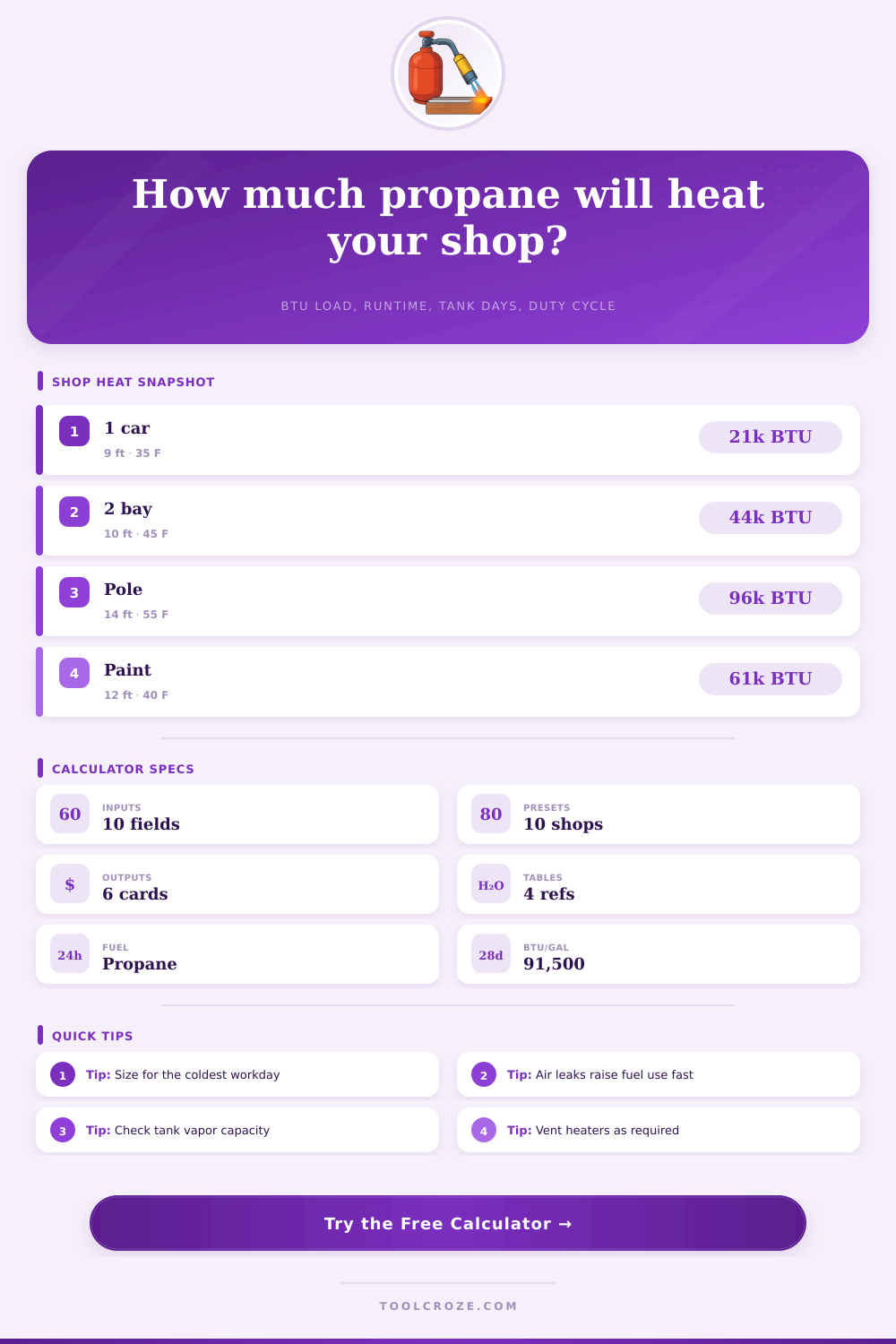
Shop Heating Propane Calculator
Estimate shop heat load, propane use, heater duty cycle, tank runtime, and cold-weather vapor capacity from square footage, ceiling height, insulation, temperatures, heater rating, runtime, and air changes.
🛠 Real Shop And Heater Presets
Choose a common garage, outbuilding, workshop, or bay profile, then adjust temperatures, heater size, efficiency, tank size, and air leakage to match your actual space.
📐 Shop, Weather, Heater, And Fuel Inputs
Calculation Breakdown
⚙ Current Shop Model Grid
📋 Heater, Space, And Fuel Comparison Grid
| Setup | Typical Input | Best Fit | Planning Check |
|---|---|---|---|
| Vented unit heater | 45k to 125k BTU/hr | Insulated garages and shops | Good steady heat; confirm flue and combustion air |
| Infrared tube heater | 40k to 150k BTU/hr | High ceilings and work bays | Warms surfaces; check clearance to combustibles |
| Blue flame wall heater | 10k to 30k BTU/hr | Small rooms and sheds | Often space-limited; follow ventilation rules |
| Portable forced-air heater | 35k to 170k BTU/hr | Temporary warm-up and open repair bays | High oxygen and moisture impact; ventilate carefully |
| Bulk propane tank | 100 to 1000 gal | Daily shop use and cold climates | Better vapor capacity than small cylinders |
💨 Insulation And Air Change Reference
| Shop Condition | Shell Factor | Typical ACH | Design Note |
|---|---|---|---|
| Excellent insulated shell | 0.55 BTU/hr per sq ft per °F | 0.20 to 0.45 | Insulated doors, sealed ceiling, few leaks |
| Good shop insulation | 0.75 BTU/hr per sq ft per °F | 0.40 to 0.75 | Common finished garage or woodshop baseline |
| Average mixed shell | 1.00 BTU/hr per sq ft per °F | 0.60 to 1.00 | Mixed wall insulation, slab edge, overhead doors |
| Lightly insulated shell | 1.35 BTU/hr per sq ft per °F | 0.90 to 1.60 | Older outbuildings and thin doors |
| Uninsulated metal shell | 1.80 BTU/hr per sq ft per °F | 1.30 to 2.50 | Use spot heat or major reserve for cold weather |
🔥 Propane Tank Runtime Reference
| Tank Size | Nominal Propane | Usable At 80% | Best Shop Use |
|---|---|---|---|
| 20 lb cylinder | 4.7 gal | 3.8 gal | Small portable heater or short warm-up |
| 40 lb cylinder | 9.4 gal | 7.6 gal | Small shop wall heater with light use |
| 100 lb cylinder | 23.6 gal | 18.9 gal | Moderate unit heater or weekend shop |
| 420 lb / 100 gal tank | 100 gal | 80 gal | Regular shop heating and colder weather |
| 500 gal bulk tank | 500 gal | 400 gal | Large shop, pole barn, or daily use |
🌡 Heater Output Sizing Reference
| Delivered Load | Example Heater Input | At 80% Efficiency | Space Type |
|---|---|---|---|
| 15k to 25k BTU/hr | 20k to 35k BTU/hr | 16k to 28k BTU/hr | Small shed, one-car garage, tool room |
| 30k to 50k BTU/hr | 45k to 65k BTU/hr | 36k to 52k BTU/hr | Two-car garage or insulated woodshop |
| 60k to 90k BTU/hr | 75k to 115k BTU/hr | 60k to 92k BTU/hr | Three-bay repair space or medium pole barn |
| 100k to 150k BTU/hr | 125k to 190k BTU/hr | 100k to 152k BTU/hr | High-bay service shop or drafty farm shop |
💡 Practical Propane Heat Tips
A propane shop heating calculator can helps you to determine how much propane your shop heater will consume in order to maintain a desired temperature in your workspace. Many shop owners has experienced issues with propane tank running out of propane or shop heaters not providing enough heat to there workspaces during colder weather. These issues typically occur because the amount of heat that the propane heater that is placed in the shop provides are not sufficient to compensate for the amount of heat that the shop loses to the outside environment.
The propane shop heating calculator allow shop owners to understand how these two values relate to one another, which can help in planning for propane consumption. A propane shop heating calculator calculate two types of heat loss that occur from a shop. The first type of heat loss is from the shop itself, such as the wall, the ceiling, and the doors of the shop.
How to Use a Propane Shop Heating Calculator
The second type of heat loss is from air leakage, which occur when warm air leaves the shop and cold air enters the shop. While these two forms of heat loss are different from one another, a propane shop heating calculator accounts for both forms of heat loss. In order to calculate the heat loss from the shop, you must enter the dimension of the shop into the calculator.
Specifically, you must enter the area of the floor of the shop as well as the height of the ceiling of the shop. Additionally, the insulation profile of the shop must also be entered into the calculator. The insulation profile determine the rate at which heat leaves the shop through it’s wall and ceilings.
Another value that must be entered into the calculator is the outdoor temperature of the area in which the shop is located. The outdoor temperature is important to account for because as the outdoor temperature decrease, the vapor pressure of the propane within the tanks decrease. This means that at outdoor temperatures that are very low, a propane tank may not be able to release enough propane from the tank to supply a propane heater with the amount of propane that is necesary to provide heat to the shop.
Furthermore, another value that must be entered into a propane shop heating calculator is the air change per hour within the shop. Air changes per hour is a value that represent the number of times that the air within the shop is replaced with outside air. For instance, a fabrication shop will typically have more air change per hour than a finished woodshop due to the fact that the former shop will experience more air movement in and out of the shop.
Additionally, you must also enter the tank size for the propane tank and the percentage of the propane tank that can be safely fill with propane into the propane shop heating calculator. Propane tanks are typically not filled to 100% of their capacity in order to allow for the propane to expand into it liquid form within the tank. Thus, the percentage of the propane tank that is filled with propane is referred to as the “usable fill percentage” of that tank.
By entering these different variable into a propane shop heating calculator, shop owners can gain an understanding of how each of these variable may impact propane consumption by the shop. By using a propane shop heating calculator, shop owners can gain an understanding of the relationship between the shops insulation level, the amount of air leakage from the shop, and the amount of propane that that shop will consume. By understanding this relationship between these three variable, shop owners can create a plan for their shop that account for the amount of propane that will be required to heat the shop to the temperature that are desired.
Thus, by using such a propane shop heating calculator, shop owners will be able to ensure that their propane tank will last as long as possible during the heating cycle of their shops, and that their propane heater will be able to maintain the temperatures that are required in those workspace.