Shelf Bracket Capacity Calculator
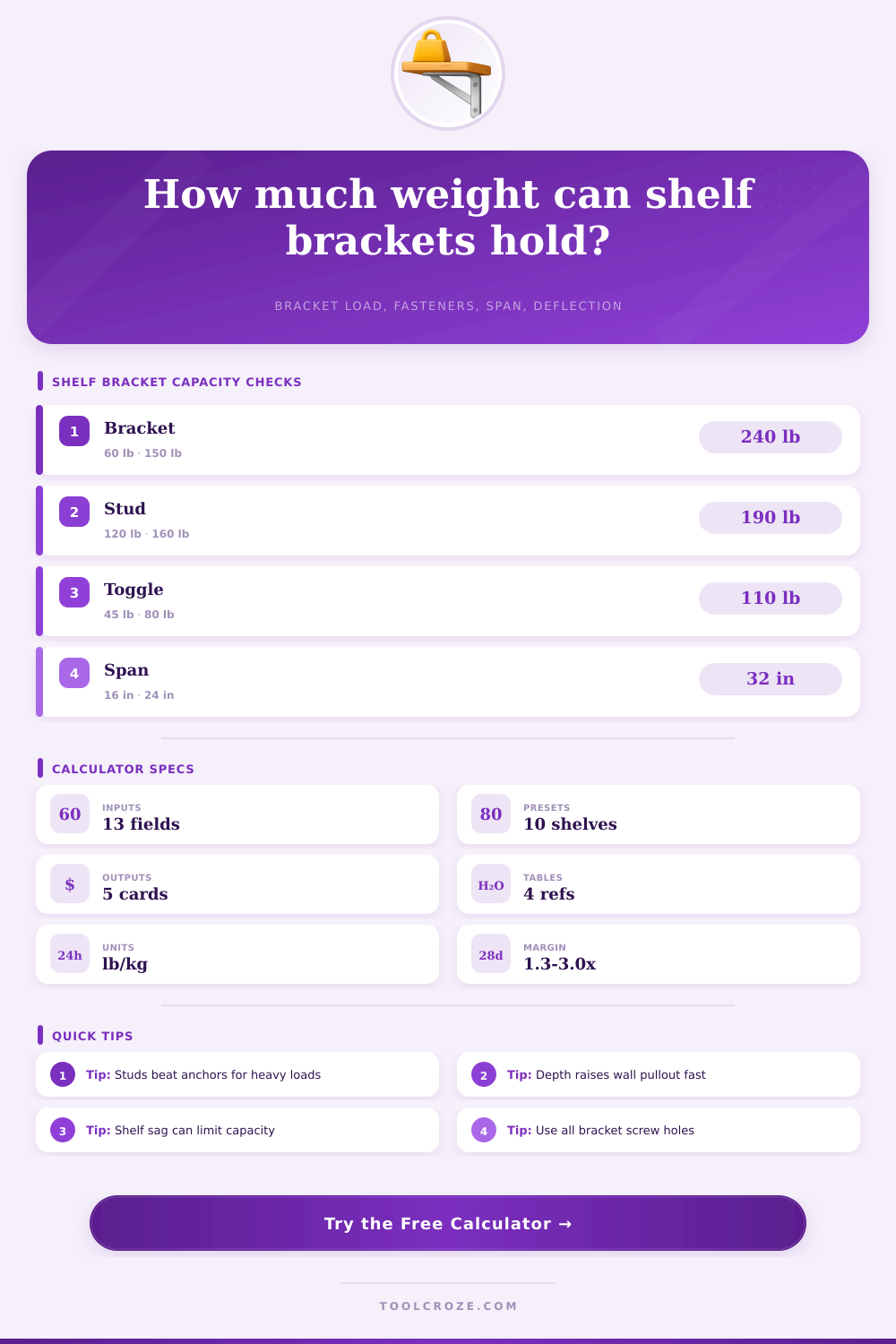
Estimate safe item load from bracket rating, wall fasteners, shelf span, shelf stiffness, depth leverage, and selected safety factor.
Choose a starting point, then adjust the shelf, bracket, wall, and load details to match the actual installation.
These reference values are conservative planning estimates for comparing shelf layouts. Use manufacturer ratings and local fastening guidance for final installation.
| Shelf material | Density | Elastic modulus | Typical use |
|---|---|---|---|
| Softwood / pine | 26 lb/ft³ | 1.2M psi | Light utility and trim shelves |
| Hardwood / oak | 44 lb/ft³ | 1.6M psi | Books, display, mantels |
| Cabinet plywood | 34 lb/ft³ | 1.3M psi | Pantry, shop, cabinet shelves |
| MDF panel | 48 lb/ft³ | 0.6M psi | Short painted shelves |
| Tempered glass | 157 lb/ft³ | 10.0M psi | Small display shelves |
| Steel plate | 490 lb/ft³ | 29.0M psi | Industrial ledges and trays |
| Bracket profile | Planning rating | Best depth range | Notes |
|---|---|---|---|
| Light L bracket | 60 lb each | 6-8 in | Small ledges and spice shelves |
| Stamped steel bracket | 95 lb each | 8-12 in | Common closet and pantry shelves |
| Heavy steel angle | 180 lb each | 10-16 in | Books and garage storage |
| Triangular gusset | 240 lb each | 12-20 in | Strongest open support style |
| Hidden floating rod | 75 lb each | 6-10 in | Moment limited by embedment |
| Folding bracket | 90 lb each | 10-16 in | Limit for dynamic front loading |
| Wall condition | Shear per fastener | Pullout per top fastener | Use case |
|---|---|---|---|
| Wood stud screws | 160 lb | 150 lb | Reliable heavy shelves |
| Solid blocking | 190 lb | 180 lb | Best for long shelves |
| Drywall expansion anchors | 45 lb | 35 lb | Light decorative loads |
| Toggle bolts | 80 lb | 70 lb | Medium hollow wall loads |
| Masonry screws | 120 lb | 120 lb | Brick or block walls |
| Concrete sleeve anchors | 170 lb | 160 lb | Concrete basement walls |
| Common shelf setup | Typical dimensions | Bracket spacing | Main limit to watch |
|---|---|---|---|
| Kitchen spice shelf | 24 x 6 x 0.75 in | 16-24 in | Anchor pullout if not in studs |
| Pantry shelf | 36 x 12 x 0.75 in | 16-24 in | Sag with MDF or particleboard |
| Book shelf | 48 x 10 x 1 in | 16-24 in | Wall moment and fastener pullout |
| Garage utility shelf | 60 x 16 x 0.75 in | 16-24 in | Bracket rating and wall backing |
| Closet shelf | 72 x 12 x 0.75 in | 16-32 in | Long-span deflection |
| Floating mantel | 54 x 8 x 2 in | 16-24 in | Rod embedment and front leverage |
A shelf bracket capacity calculator is a tool that can help determine an amount of weight that a shelf can hold. A shelf bracket capacity calculator use specific measurements of the shelf and the wall to calculate the amount of weight that can be placed on that shelf. A shelf bracket capacity calculator uses these specific measurements because the weight that is placed on a shelf will alter the way in which the wood and the wall distributes that weight, altering the capacity of that shelf.
In order to use a shelf bracket capacity calculator, an individual will need to providing information regarding the length, depth, thickness of the shelf, and the types of brackets that will be utilized on that shelf. Additionally, an individual will need to provide information regarding the condition of the wall on which the shelf will be place. Shelf depth is one of the most important factors in determining the amount of weight that a shelf can hold.
How to Use a Shelf Bracket Capacity Calculator
If the depth of the shelf are increased, the weight that is placed upon the shelf will create more pull on the wall brackets. For instance, a shelf bracket that can hold 180 pounds when the shelf has a depth of eight inch may not be able to hold that same weight if the shelf depth is increased to twelve or even sixteen inch. The calculator will ask for information regarding where the center of the load are relative to the total depth of the shelf.
For instance, a shelf that is filled with heavy can may fail more easy than a shelf that contains books. Fastener choice is another important factor in determining the weight of a shelf. Within the calculator, an individual can choose the type of wall condition upon which the shelf will be placed.
The calculator will adjust the calculation according to whether toggle bolts will be utilized in hollow drywall, or whether masonry screws will be placed into brick. For example, if the shelf is placed into studs in the wall, the strength of the fastener will be greater than if it were place into hollow drywall. Therefore, using fasteners within studs will allow the shelf to hold more weight.
Additionally, many individuals may not realize that any type of fastener will work for medium load; the top row of fasteners will often bear the majority of the load. The calculator can help individuals understand how much load will be placed upon each type of fastener. Shelf stiffness is another important factor in ensuring that the shelf will be able to hold the loads that are to be place upon it.
For instance, if the shelf is made of a type of material like half-inch MDF panel, it may bend under its own weight, or the weight of the items that are to be place upon it. The calculator will allow an individual to enter the type of material that will be used to make the shelf, and will calculate any sag that may result from that material, as well as any span-to-deflection ratio for that material. If the shelf material is likely to bend, the calculator will reduce the total amount of weight that can be placed upon the shelf.
Thus, ensuring that the stiffness of the shelf is considered will ensure that the shelf does not sag with time. The weight of the shelf material itself is another factor that an individual that wish to safely place items upon a shelf must consider. The calculator will automatically add the weight of the shelf material that the individual selected.
For instance, a shelf that is made of thick oak will be heavier than a shelf that is made of thin wood. Although the weight of the shelf material itself is a small factor when considering short shelves, that factor becomes more important when considering long shelves. Therefore, it is important for the individual to consider the weight of the shelf material, as that weight must be supported by the bracket supporting the shelf.
In addition to the factors discussed above, an individual can utilize a safety factor. For instance, the calculator may suggest that the shelf can hold a certain weight. The safety factor can be used to ensure that there is some margin of error for the shelf to fail; a value of 1.5 can be used if the shelf is a pantry shelf that will not change, but 2.5 or 3.0 can be used for a shelf in a garage or display case.
Using a higher safety factor will reduce the amount of weight that is calculated as can be safely placed upon the shelf. Thus, using a safety factor will provide the individual with a safety cushion for the shelf to not fail. The reference tables that is provided for each type of calculation will allow the individual to compare their plans for the shelf to common types of shelves.
These tables are not meant to replace the data provided by the manufacturer for the individual items; rather, they will provide an individual with an understanding of whether or not their plans is realistic. After the calculation of the capacity of the shelf, the calculator will provide an individual with an understanding of which factor is the tightest controlling element for that shelf; it could be the brackets that are to be utilized, the shear strength of the fasteners, the pullout strength of the fasteners from the wall, or the deflection strength of the shelf. Once an individual understands which of these elements is the controlling element, they can make changes to ensure that that element is no longer a problem for the shelf.