Shackle Length Calculator
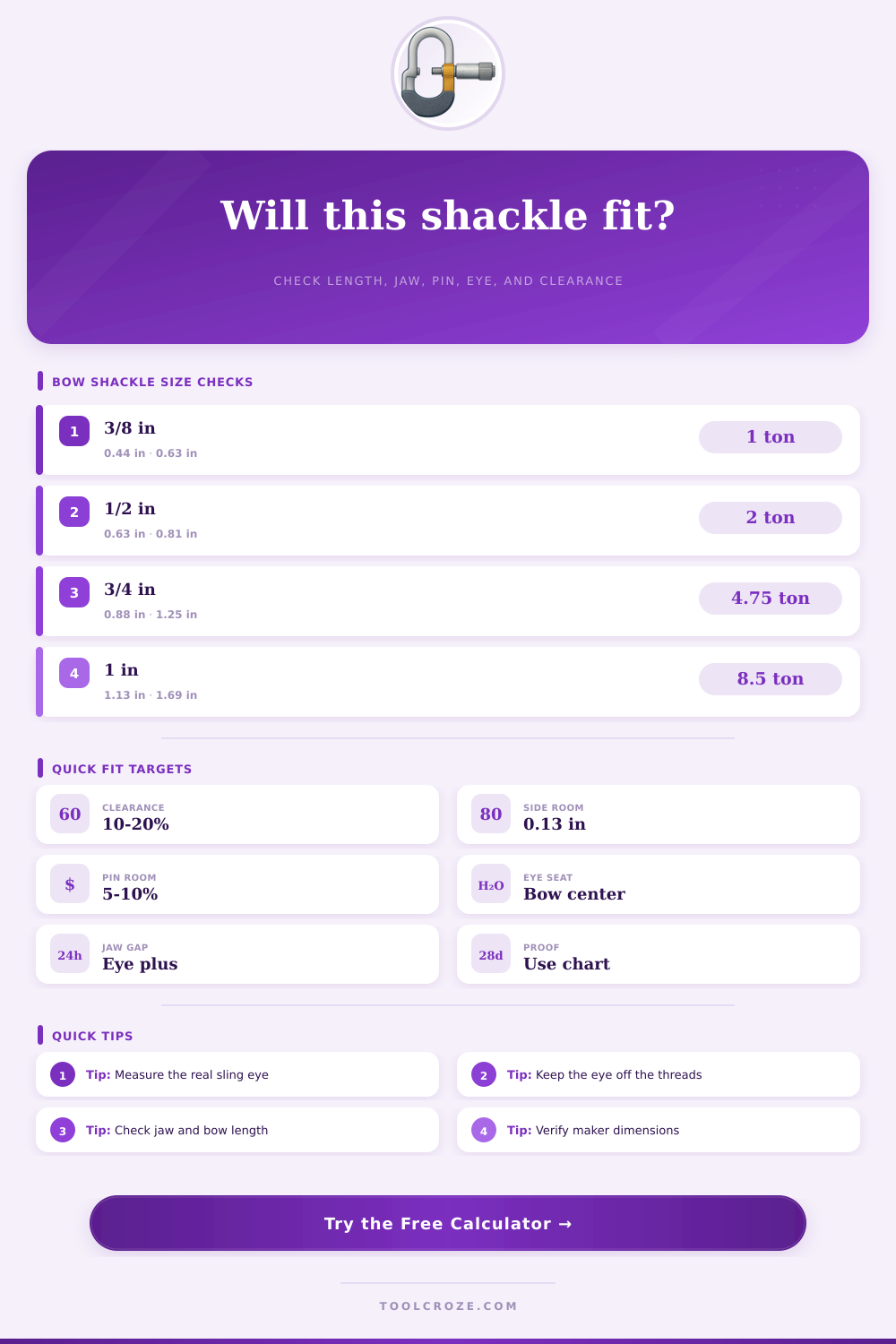
Check whether a bow shackle has enough inside length, jaw opening, pin clearance, inside width, and load path room for a measured sling eye or connecting link.
⚙Real Bow Shackle Size Presets
📏Shackle and Sling Eye Inputs
📊Current Shackle Dimension Summary
🔗Shackle Dimension / Spec Comparison Grid
| Nominal size | Typical pin dia. | Inside width / jaw | Inside length | Typical WLL |
|---|---|---|---|---|
| 1/4 in bow | 0.31 in | 0.47 in | 1.13 in | 0.5 ton |
| 5/16 in bow | 0.38 in | 0.53 in | 1.34 in | 0.75 ton |
| 3/8 in bow | 0.44 in | 0.63 in | 1.50 in | 1 ton |
| 1/2 in bow | 0.63 in | 0.81 in | 1.88 in | 2 ton |
| 5/8 in bow | 0.75 in | 1.06 in | 2.38 in | 3.25 ton |
| 3/4 in bow | 0.88 in | 1.25 in | 2.81 in | 4.75 ton |
| 7/8 in bow | 1.00 in | 1.44 in | 3.31 in | 6.5 ton |
| 1 in bow | 1.13 in | 1.69 in | 3.75 in | 8.5 ton |
| 1-1/4 in bow | 1.38 in | 2.03 in | 4.69 in | 12 ton |
| 1-1/2 in bow | 1.63 in | 2.38 in | 5.75 in | 17 ton |
📐Fit Clearance Reference
| Fit area | Calculator check | Common target | Why it matters |
|---|---|---|---|
| Inside bow length | Eye length + pin wrap + angle growth + clearance | Positive after factor | Prevents the eye from jamming into the crown or pin shoulder |
| Inside width | Eye width + side clearance on both cheeks | 0.06 to 0.13 in per side | Lets the eye seat without squeezing or folding |
| Jaw opening | Eye thickness + clearance + thread allowance | Clear, not forced | Keeps hardware from riding on threads or cheek edges |
| Pin bearing | Pin diameter compared with eye bend radius | Use maker limits | Small pins can reduce sling efficiency or damage soft eyes |
🧵Sling Eye Measurement Reference
| Sling or fitting | Measure length | Measure width | Watch point |
|---|---|---|---|
| Flat synthetic web eye | Usable eye opening under light tension | Folded web stack width | Avoid eye bunching in a narrow bow |
| Round sling eye | Loaded loop length at the contact point | Compressed sleeve or jacket width | Large jacket thickness often controls jaw clearance |
| Wire rope thimble eye | Thimble outside length | Thimble outside width | Hard thimbles need room to seat without side bearing |
| Master link or chain link | Link inside length plus bearing contact | Outside link width at shackle bow | Keep the link aligned with the shackle centerline |
📘Load Path Geometry Reference
| Geometry condition | Angle input | Added length model | Planning note |
|---|---|---|---|
| Straight seated eye | 0 to 5° | Small or no angle growth | Best fit because the eye seats naturally in the bow |
| Light skew or bridle lean | 10 to 20° | Eye width times sine of angle | Usually acceptable if side clearance remains positive |
| Noticeable offset | 25 to 40° | More length and cheek clearance consumed | Consider a larger bow, master link, or different connection |
| Severe angular fit | 45 to 60° | High clearance demand | Do not treat fit clearance as approval for side loading |
💡Shackle Fit Tips
A shackle length calculator are a tool that will allow a person to determine if a sling eye will fit inside of a bow shackle. When a person places a sling eye into a bow shackle, the sling eye should be able to completly seat into the bow shackle, and should not becomes jammed against the crown of the shackle or against the threads of the shackle. If the sling eye do not have enough space within the shackle, the sling eye can become bound to the shackle or wear prematurely.
Such a shackle length calculator is useful in that it can take the dimensions of the sling eye and the shackle to inform the person of whether or not those two component will work together. In order to calculate the length of the shackle that will provide for the sling eye, several measurements of the sling eye and the shackle must first be obtained. The person must enter the pin diameter of the shackle into the shackle length calculator, as the sling eye must wrap around the pin; the width of the sling eye and its jaw opening must be provided, as these measurements provide information regarding the space that the sling eye will have on each side; the inside length of the bow shackle must be provided; and the person must measure the length, width, and thickness of the sling eye while the sling eye is under light tension.
Check If a Sling Eye Fits a Bow Shackle
Finally, the load path angle between the two object must be provided. In addition to the measurements of the sling eye and the shackle, the shackle length calculator also includes a factor that provides for the possibility of the sling eye picking up dirt, the sling eye having an uneven jacket, or the shackle having a small shoulder or thread runout. Each of these factor can reduce the length of the sling eye that is available for the shackle to open.
The shackle length calculator incorporates a clearance factor and a cheek allowance to account for these factors. The shackle length calculator will provide the minimum length for the inside of the shackle, the amount of clearance that remains for the sling eye, and an assessment of whether or not the sling eye will fit into the shackle. A mistake can be made with the shackle length calculator if the sling eye is consider to be a fixed shape.
More specifically, if the sling eye is a soft sling eye, it will naturaly spread when it is placed into the bow shackle. This spreading will increase the width and length of the sling eye. Such a length can be accounted for in the shackle length calculator by adjusting the pin wrap allowance.
The shackle length calculator does not take into account the type of sling eye that is being used; a narrow synthetic sling eye will behave differently than a wide round sling. If the differences between sling eyes are not consider, the sling eye may not be able to fully seat into the shackle. The shackle length calculator does not indicate whether or not the working load limit of the shackle will be met; there is no provision within the shackle length calculator for checking whether the pin of the shackle has thread damage; and there is no way for the shackle length calculator to determine whether the shackle will be subject to side loading.
Each of these variables must still be inspected, measured, and accounted for in the planning of the lift. The only variable that the shackle length calculator removes from the equation is the variable of the dimensions of the sling eye and shackle. The shackle length calculator provides reference tables for the common size of bow shackles.
While these tables provide a starting point for the dimensions of the sling eye, it is always better to enter the custom measurement of the shackle if the person has the shackle itself. For example, a 3/4 inch shackle will have a larger inside length and jaw opening than a 1/2 inch shackle, which may provide more benefit to a thick sling eye. The load path angle that exists between the sling eye and the shackle will impact the length of the sling eye that is required.
When the person introduces the load path angle, the sling eye will begin to be pulled in another direction than the sling eye is expected to travel. When such an angle is included in the calculations of the shackle length calculator, the length of the sling eye is modeled with the sine of the load path angle times the width of the sling eye. While the shackle length calculator does not approve of side loading, the shackle length calculator will provide a warning if the load path angle is entered.
The value of using a shackle length calculator is that it forces the person to measure the sling eye while it is under loaded tension. When the person measures the sling eye while under load, the shackle length calculator will help to avoid surprises with the fit of the sling eye when it is under load. When using the shackle length calculator, the conversation between the person who is lifting the object and the crew will be more concrete; rather than having a conversation of whether or not the sling eye will fit, the calculation will provide information as to how much room the sling eye will have for clearance within the shackle.
Thus, while the shackle length calculator will still not eliminate the need for inspecting the hardware, checking the working load limits, or planning the lift, the shackle length calculator will provide the person with an answer as to whether or not the sling eye will seat into the bow shackle.