⚙️ Servo Motor Torque Calculator
Size servo motors for motion control — calculate peak torque, RMS torque, and inertia ratio
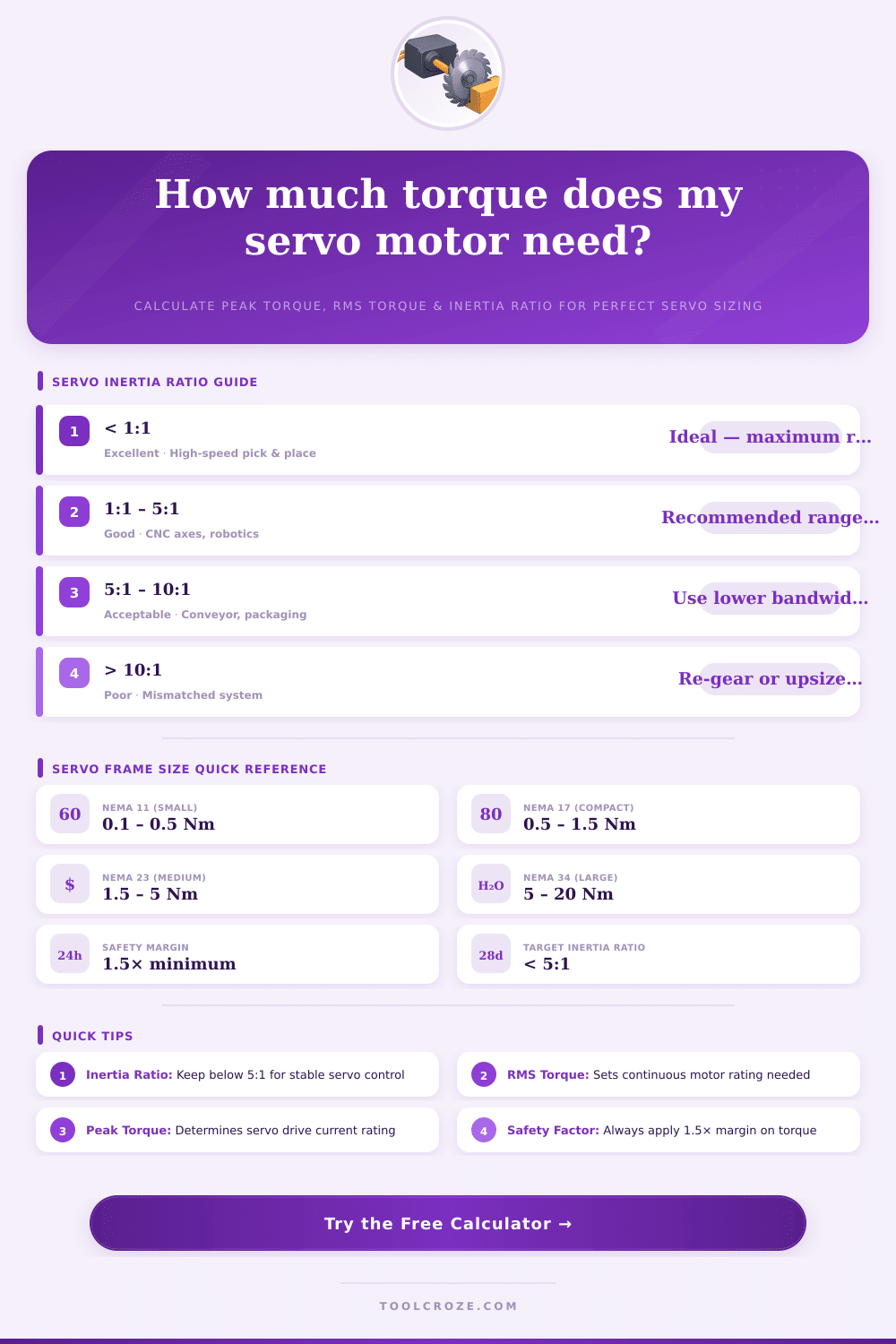
| Inertia Ratio | Control Quality | Recommendation |
|---|---|---|
| < 1:1 | Excellent | Ideal — maximum responsiveness, highest bandwidth |
| 1:1 – 5:1 | Good | Recommended for most servo applications |
| 5:1 – 10:1 | Acceptable | Use lower bandwidth; tune carefully |
| 10:1 – 20:1 | Marginal | Consider adding gearbox or upsize motor |
| > 20:1 | Poor | Re-design required — system will be uncontrollable |
| Duty Cycle | Peak Torque | Required Continuous Torque | Drive Current Impact |
|---|---|---|---|
| 100% | 1.0× rated | 1.0× rated | Full continuous current |
| 75% | 1.0× rated | 0.87× rated | Moderate — allows some derating |
| 50% | 1.0× rated | 0.71× rated | Moderate — good thermal margin |
| 25% | 1.0× rated | 0.50× rated | Low — significant derating possible |
| 10% | 1.0× rated | 0.32× rated | Very low — intermittent duty servo |
Nm
kg·cm²
Nm
kg·cm²
Nm
kg·cm²
Nm
kg·cm²
| Zone | Torque Level | Duration | Description |
|---|---|---|---|
| Continuous Zone | 0 – 100% rated | Unlimited | Safe for indefinite operation; thermal limit governs |
| Intermittent Zone | 100 – 200% rated | < 30 s | Short-term bursts; drive current limits apply |
| Peak Zone | 200 – 300% rated | < 1 s | Acceleration spikes only; requires immediate fallback |
servo motor genuinely matter, and torque ranks between the main spots for understanding them well. The advantage of a servo motor lies in its system of feedback that does not depend on a particular trait of the engine itself. Usually, the maximum torque comes already at low RPM which is useful greatly for many projects.
torque is found by means of force times distance. Like this, if a servo motor is rated at 2,5 kg·cm, that means that it makes fixed force based on the radius. For instance, that value matches around 13 N on a 1 cm long pole or 130 N on a 10 cm radius.
What Is Torque in Servo Motors
One can also flip the equation of torque. So, distance matches torque divided by force, or force matches torque divided by distance. Because torque stays the same for a given engine, growing one value requiers lowering of the other.
Choosing a servo motor for use in machine work, the rated torque commonly serves as the basic kind. The rated torque shows the biggest steady torque that one gets at the pointed speed, that allows the engine to work without overheating. Servo motor units have actually two rules: steady work and brief burst.
When the surrounding heat is a lot below the maker limits, the rating for steady torque can indeed rise.
In the world of RC builds, a standard small servo motor with high torque delivers around 0,2 Nm. Trying to find a model with 5 Nm in the same small body simply does not happen. Because crawlers require more torque than speed, but for racers 25 kg torque already works well.
Around 35 kg could be too much, although too much does knot always hurt.
Need bigger torque? A gearbox for a servo motor offers one way to reach it. Adding a gear head gives a trade between speed and torque.
Other choices are to use a belt, chain or planetary stage based on stiffness and space demand. Changing the setup of the load to lengthen the arm of lift also helps. Even tying two or more servo motor units to turn together on one pole is possible.
To figure torque, one can follow the listed currents and applied forces. In DC engines, that use the bulk of servo motor units, the link between torque and current is direct. Multiplying the current by the constant of the engine gives the made torque.
That constant usually appears in the data sheet of servo motor units. Spinning inertia also affects. It shows the resistance of the engine against changes in its speed and one measures it in kg·m².
The needed torque to create turning boost depends on the spinning object, whether it is a solid roll, thin stick or other shape.
Engines for torque, sometimes called direct drive or frameless engines, work much like matching servo motor units with permanent magnets. They are built for high torque at low speeds. For instance, one servo motor model reaches 10 kg·cm at 6 V and 8,5 kg·cm at4,8 V.