Segmented Turning Calculator
Calculate segmented ring miter angle, outside and inside segment lengths, board stock length, kerf loss, blank width allowance, waste, species weight, and ring layout for bowls, vases, urns, and feature rings.
📌 Turning presets
Load a real segmented turning setup, then adjust diameter, wall thickness, ring count, saw kerf, blank width, species, and waste allowance.
⚙ Ring and stock inputs
Calculation breakdown
🧱 Segment and species grid
Compare common turning woods by density, stability, and typical segmented turning behavior.
📊 Reference tables
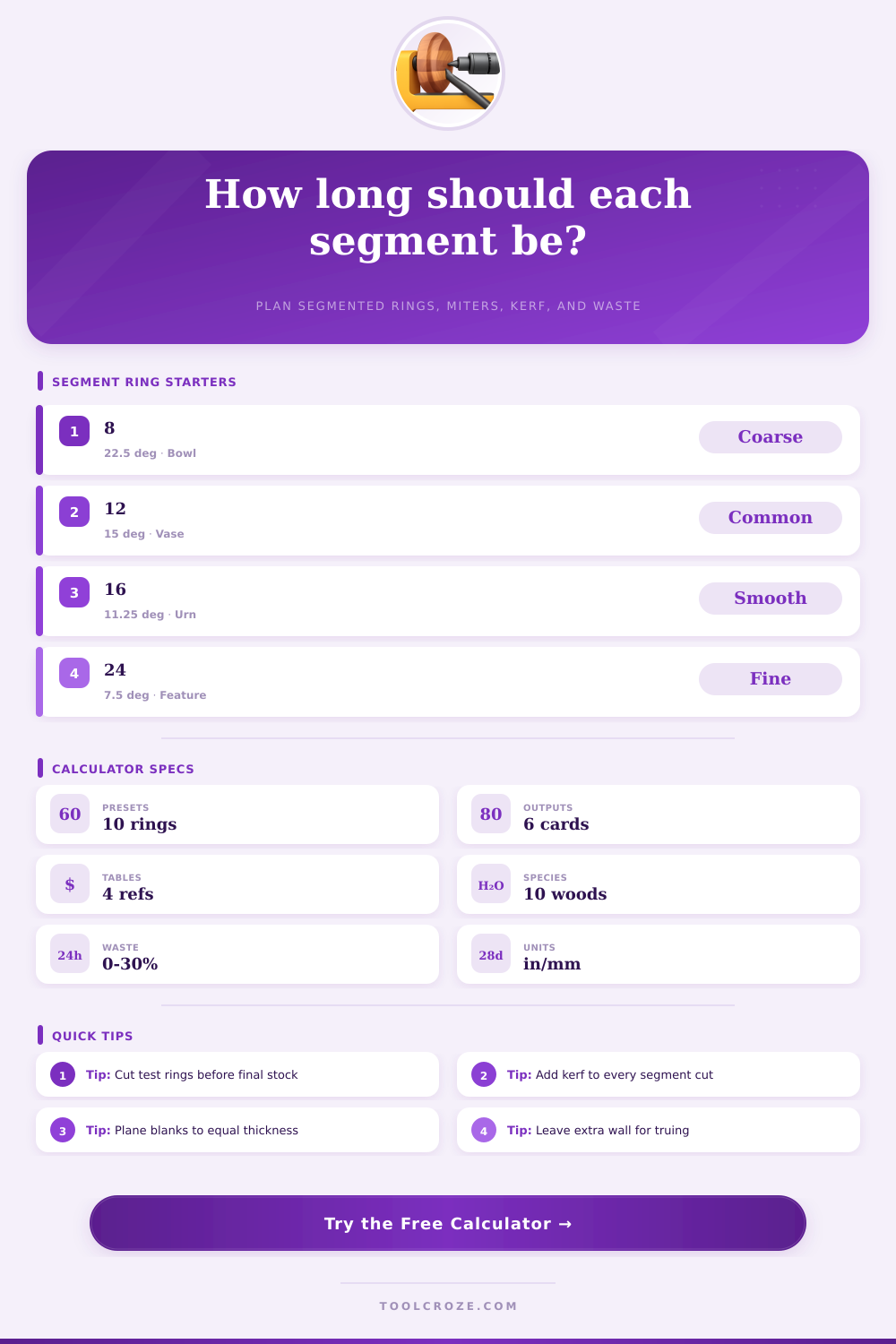
| Segments per ring | Miter per end | Outside flat | Best use |
|---|---|---|---|
| 6 | 30 deg | Large flats | Bold open forms and practice rings |
| 8 | 22.5 deg | Visible flats | Small bowls, lids, and thick wall forms |
| 12 | 15 deg | Moderate flats | Common bowl and vase ring count |
| 16 | 11.25 deg | Smoother ring | Vases, urns, canisters, and larger bowls |
| 24 | 7.5 deg | Fine ring | Feature rings and decorative laminations |
| 32 | 5.625 deg | Very fine ring | Thin accent bands and high detail work |
| Species | Density lb/ft³ | Turning feel | Segmented ring note |
|---|---|---|---|
| Black walnut | 38 | Medium | Clean feature rings and forgiving glue-ups |
| Hard maple | 44 | Hard | Sharp contrast, needs clean miters |
| Cherry | 35 | Medium | Good bowl stock, darkens with age |
| White oak | 47 | Hard | Strong ring stock, open grain sanding time |
| Padauk | 45 | Hard | Bright accents, use dust control |
| Western red cedar | 23 | Soft | Light weight, compresses under clamps |
| Kerf or waste item | Typical value | Calculator effect | Shop note |
|---|---|---|---|
| Thin kerf blade | 0.094 in / 2.4 mm | Less stock length lost | Verify blade plate and tooth set |
| Full kerf blade | 0.125 in / 3.2 mm | Common default loss | Good for stable stop block cuts |
| Test ring allowance | 5% to 10% | Adds extra stock length | Useful when angles are newly tuned |
| Figure or defects | 12% to 20% | Adds sorting margin | Helpful with knots, checks, and sapwood |
| Reclaimed stock | 20% to 30% | Large reserve | Allows for metal checks and tearout |
| Project type | Typical diameter | Segments | Blank width strategy |
|---|---|---|---|
| Small bowl | 6 to 9 in | 8 to 12 | Wall plus 1/8 to 1/4 in truing margin |
| Salad bowl | 10 to 14 in | 12 to 16 | Use wider radial stock for fair curves |
| Tall vase | 5 to 9 in | 16 to 24 | Keep ring heights consistent for stacking |
| Lidded box | 3 to 6 in | 10 to 16 | Leave extra diameter for lid fitting |
| Accent band | Any | 24 to 32 | Small pieces need exact stop block setup |
💡 Practical tips
Segmented turning is a craft that involves join many small piece of wood to create larger wood shape. This craft require much patience as segmented turning requires careful planning to ensure that the pieces of wood fit together correct. The diameter of the ring that will be created determine the scale of the entire project.
The more larger the diameter of the ring, the longer the segment of wood that will be required for the project, as well as the wider the blank of wood that will be needed. The blank of wood must be wide enough to allow for truing the inside and outside of the ring. The thickness of the wall of the ring will also affect the blank of wood.
How to Make a Segmented Wood Ring
The wall thickness of the ring will determine how much of the blank of wood will be used in the project. Thus, the blank of wood should be wider than the desired thickness of the wall of the ring. In addition to the thickness of the wood that will be used for the project, you should allow more of the blank of wood for possible error in the alignment of the wood pieces.
The segmented turning calculator make it easy to compute the ring diameter and the wall thickness of the ring. The segment count for the project will also affect the type of wood that will be used. Using a low segment count will create flat surface in the wood pieces that will be completed.
A high segment count will create a smoother curve in the wood. The segment count will determine the miter angle. The artisan has to calculate the miter angle according to the number of segments that will be used in the project.
The artisan can override the miter angle manual. The kerf loss and the waste allowance of the wood will be factor that are considered before the artisan begins to cut the wood. The kerf loss is the amount of wood that will be lost due to the width of the saw blade.
This loss of wood becomes significant when it is multiplied by the number of segment of wood that will be cut. The waste allowance is the amount of wood that will be allowed for test cut of the segmented wood, as well as for defect in the wood. This amount of wood will be included in the amount of wood that is calculated with the segmented turning calculator.
The type of species of wood will also have an impact upon the segmented turning process. Using denser species of wood will allow the miter line to be cut more cleanly. Additionally, denser species of wood will be more resistant to the compressive force of the clamps that will be used in the project.
Using softer species of wood will allow for more deformation of the wood under pressure from the clamps. Thus, softer species of wood will require the artisans to use gentle pressure with the clamps. The density of the wood will also impact the weight of the wood that is created and the ease with which the artisan is able to handle the wood with a lathe.
The height of the ring and the number of rings that will be created will impact the total height of the wood that will be created. The segmented turning calculator will calculate this total height. Each ring should have the same height to allow the glue joint to remain flat.
If the joints are flat, there will be less need to TRUE the wood when assembling the wood stack. Many error will happen in the segmented turning process due to the mistakes that are made in the miter angle measurement of the wood segments. Each incorrect miter angle will lead to a gap in the wood segments, and that gap will become more increasingly larger as the artisan creates more segment or ring.
To avoid such an error, many artisan will create a test ring prior to creating the segment of the wood that will be used in the project. The test ring will allow the artisans to examine the wood joint to make sure that the miter angle is correct. While the segmented turning calculator will display the accurate measurement of the miter angle for the segments of the wood, the test ring will provide the artisan with a physical test of the miter angle.
By using the measurement that have been calculated, the artisans will be able to create their work more efficiently. With the length of each segment of wood that is to be created, as well as the miter angle for each segment, the artisan can use a stop block to create all of the segment of the same length. Using a stop block will significantly reduce the amount of time that the artisan will spend measuring each segment of wood.
Thus, by using the segmented turning calculator and using a stop block, the artisan will be able to produce the segments of wood that is required for the segmented turning project. Finally, by using each of these calculation for the segmented turning project, that artisan will make it a repeatable process.