
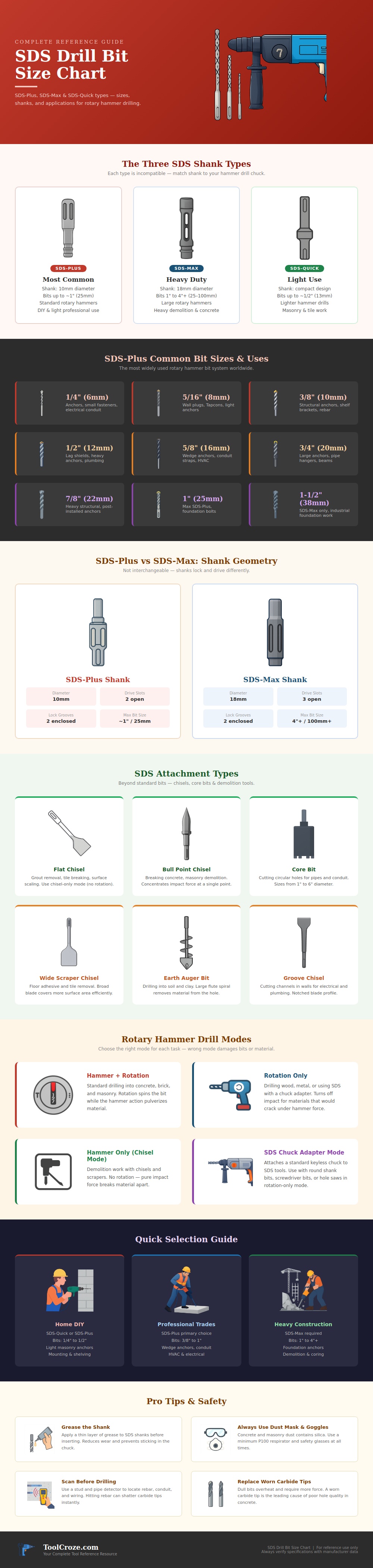
SDS drill bits come in different sizes depending on the type of SDS system you use SDS-Plus is the most common type, with diameters from 4 mm to 30 mm, or from 5/32″ to 1-1/4″. The shortest SDS-Plus masonry drill bits are about 110 mm in length, and the longest reach 1500 mm. SDS stands for special direct system and refers to the strong hammer action of the drill bit.
SDS Plus bits use 10mm shanks and work for light to medium tasks. They have two open grooves and two closed grovves, which ensures a firm grip in SDS Plus hammer drills. Typical sizes are 4mm, 12mm and 20mm.
SDS Drill Bit Sizes and Uses
You choose SDS Plus because it is good for lighter drilling than heavy hammer drills.
SDS Max is entirely different. It has 18mm shanks and is for heavy work. The sizes of SDS Max masonry bits tend to be bigger.
For concrete they range from 3/8″ to 2″ in diameter and from 13″ to 36″ in length. The fluting on SDS Max concrete bits helps to remove dust, so boring goes more quickly. The smallest SDS Max bit is around 1/2″ in diameter, and core bits can reach 6 inches.
All SDS Max shanks are the same regardless of the diameter of the drill head. So any smaller bit with an SDS Max shank will work in the tool, if it does not pass the maximum. The rating on the drill itself, like 1″, 1-1/8″ or 1-9/16″; points to the biggest diameter that it can handle.
SDS Plus bits for thin walls and core boring reach only around 4 inches. 3-inch core bits for SDS Plus work well in blocks and concrete floors. SDS bits have four slots on the side, so they do not fit in usual 3-jaw chucks.
The SDS shank is for 4-jaw SDS chucks.
Hammer drills work best in old concrete up to 3/16 inch. In 3/16″ in old concrete, 1/4″ in new concrete and 5/16″ in cement blocks SDS bits are better. It depends on the rotation speed and the impact strength.
When boring in a wall with SDS carbide bits, you must support the weight of the hammer drill. Without good support the bit itself will carry part of the weight, which can breakit in the hole.
