
Ever have those moments where your scissors will no longer cut; they’ll tear at paper? Push on the paper and it crumples because blade gets stuck in the material? That’s not because the scissors is poorly made but more likely because you’re holding them at wrong angle.
Sharpening isn’t about taking some rock and making it smooth enough to rub on metal. That’s not always right. It’s about the right angle. Adjust it to fit what you need to slice. Don’t make blade dull in seconds or break it off by forcing it into something it can’t cut with ease.
Why Angle Matters for Sharpening
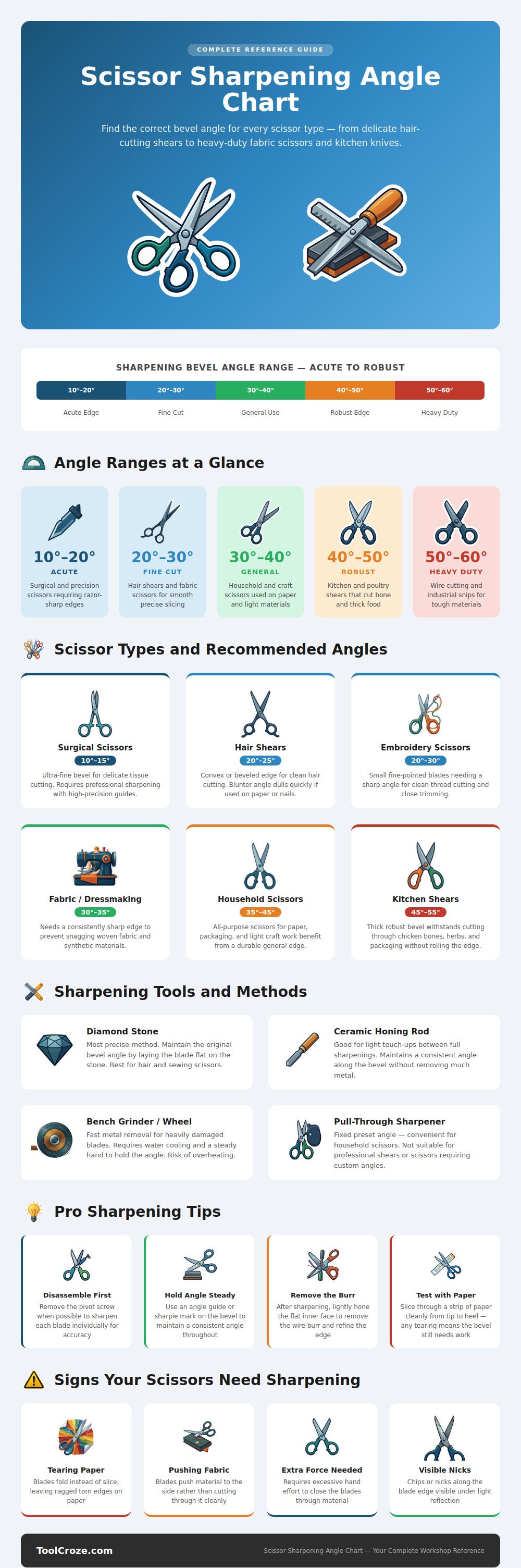
Now what’s all this got to do with sharpening? It means we don’t guess, but use something like the chart above so we know how sharp our blade needs to be based off the job. For example, surgical instruments and delicate hair shears requires an acute edge. Acute meaning it cuts cleanly and doesn’t tear out your skin. Since they are cutting soft materials, you want an instrument that works in a lower angle range and can withstand being razor thin and more fragile than others.
But those same scissors would of get destroyed if you tried opening cardboard box with them. The metal isn’t thick enough to take that kind of abuse. That’s why kitchen shears and heavy duty fabric scissors is in a lot wider angle. They know they will encounter thick weave, wire, bone, and more. They also want the edge to have some thickness (bevel) on it to protect it against chipping or rolling over.
So again a balance of durability vs. It requires finesse. You cannot have one and not the other.
So what’s my advice? What sharpening system do I use and why? That part really comes down to matching your method to the tool’s specific needs. If you’re working with an expensive tool, such as some embroidery scissors or barber shears, where each degree is important, you’ll want a system that puts you in complete control, i.e. Use a diamond stone, which lets you duplicate manufacturer’s original angle exactly. For other tools, where you simply need to maintain things until your next full-blown sharpening session, a Ceramic rod are a good choice, since it will buff out any micro-imperfections while not taking off too much metal.
Avoid pull-through sharpeners, however. While convenient for home tools, they imposes a set angle, which can destroy a more precise blade meant for a specific purpose. Sure, you may have a sharper edge but it’s the wrong one for the job, making the exercise pointless.
Keep your angle consistent while grinding, most folks loses their angle midway into the grind and end up with an uneven facet that won’t close evenly. Color your bevel with a marker so you know what’s getting eaten by the stone or use a guide if available. Speed isn’t as important as being consistent every time.
When you’ve got both sides ground out evenly don’t walk off just yet. You’ll notice a little wire burr running down edge, this is displaced metal that needs to go. Knock it off lightly by honing the inside flat part of the blade. A subtle move, but skipping it makes for a dull edge despite having the correct angle.
When one sheet cleanly separates all the way down the paper from heel to tip, you’re finished. You do not need to tear or tug; you just use a quiet gliding motion through paper. Is the paper buckling? Then your blade wasn’t quite right, either too blunt or still not consistent enough. Was it too sharp? Then maybe your angle was too sharp for the type of work at hand.
That can take time to get the right balance. But then you’ll never fight with dull scissors ever again. You’ll also know how to adjust to find the right angle/application match every time. It’s about the geometry and it’s doing what the geometry enables it to do. And now you have the roadmap to replicate.
