Saw Blade Kerf Calculator
Estimate how much material the blade removes, how much usable board remains, and how your layout changes for rip cuts, crosscuts, miters, sheet goods, and narrow resaw work.
1Real blade and cut presets
Choose a common shop setup, then fine-tune the actual measured kerf from your saw cut.
2Kerf and board inputs
Kerf loss results
3Blade and material comparison grid
4Common blade kerf widths
| Blade or saw type | Typical kerf | Best use | Layout note |
|---|---|---|---|
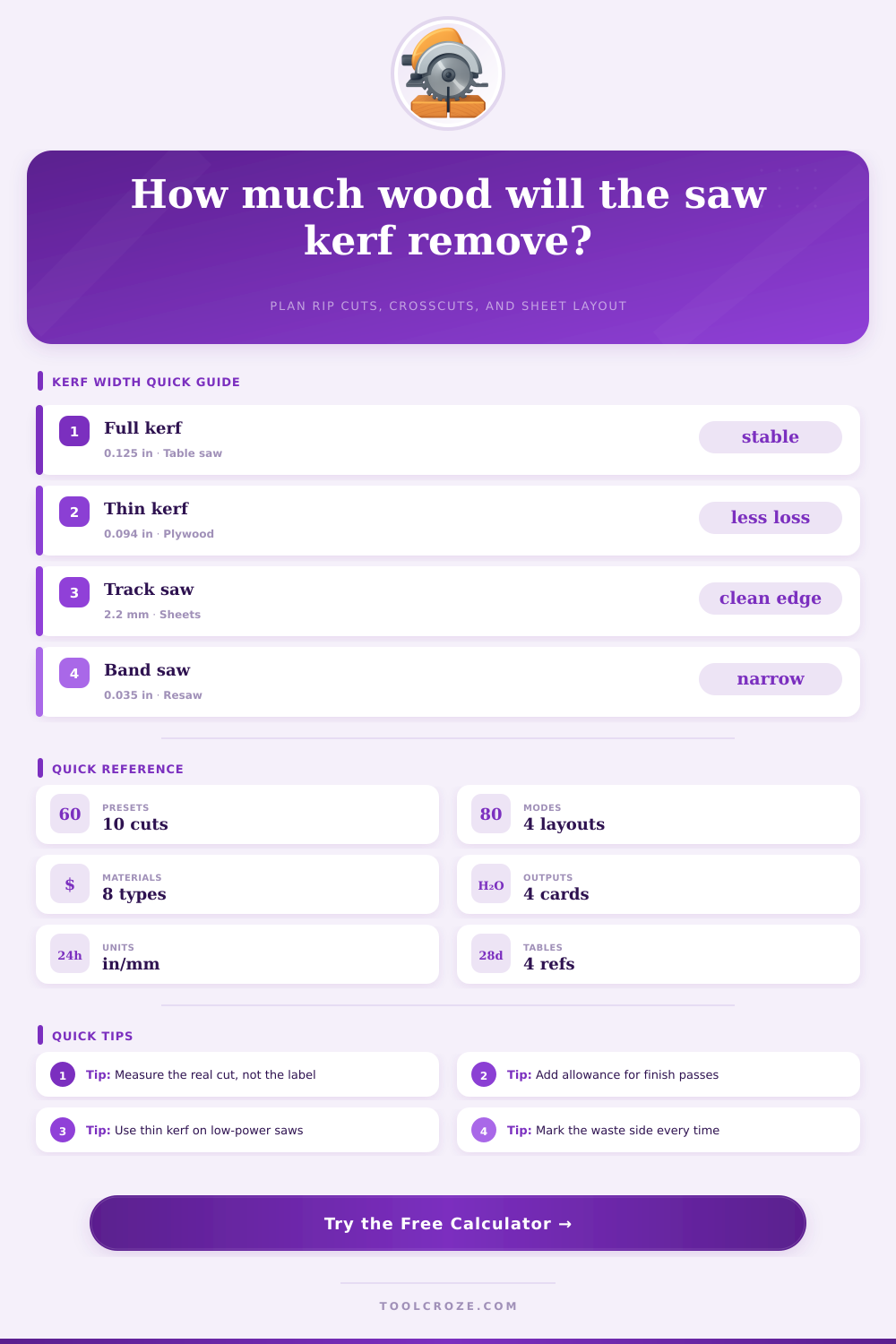
| 10 in full kerf table saw blade | 0.118 to 0.126 in | Hardwood, thick rips, stable cuts | Plan around 1/8 in per cut unless measured. |
| 10 in thin kerf table saw blade | 0.087 to 0.098 in | Plywood, small saws, lower waste | Use a stiffener or splitter matched to the blade. |
| 7-1/4 in circular saw framing blade | 0.060 to 0.075 in | Construction lumber and sheathing | Kerf varies widely by blade plate and tooth set. |
| Track saw fine sheet blade | 1.8 to 2.4 mm | Cabinet plywood and panels | Match the kerf to the splinter strip location. |
| Band saw resaw blade | 0.025 to 0.045 in | Bookmatching and veneers | Add cleanup allowance for drift and saw marks. |
5Material allowance reference
| Material | Starting allowance | Why it matters | Practical check |
|---|---|---|---|
| Softwood framing lumber | 0.015 in / 0.4 mm | Rough edges and bowed stock change the line. | Mark the keeper side before cutting. |
| Hardwood board | 0.010 in / 0.25 mm | Jointing, sanding, and burn removal need margin. | Cut a test strip before batch ripping. |
| Plywood or OSB sheet | 0.020 in / 0.5 mm | Face veneer and flakes can chip at the exit edge. | Support both sides of the cut. |
| MDF panel | 0.012 in / 0.3 mm | Dusty edges are consistent but fragile. | Use extraction and avoid forcing feed. |
| Melamine or laminate | 0.030 in / 0.75 mm | Surface chips often need a second cleanup pass. | Score first or use a zero-clearance insert. |
| Aluminum or acrylic | 0.015 in / 0.4 mm | Deburring or scraping can change final size. | Clamp firmly and use the correct blade type. |
6Cut mode layout reference
| Mode | Cut path length used | Dimension reduced by kerf | Common mistake |
|---|---|---|---|
| Rip cut | Board length | Board width or strip layout | Forgetting every strip boundary consumes a kerf. |
| Crosscut | Board width | Board length or part stack | Measuring all pieces from the same end without kerf offsets. |
| 45 degree miter | About 1.414 times board width | Board length and visible finished length | Ignoring the wider diagonal saw path. |
| Mixed sheet layout | Average of length and width | Area plan instead of a single edge | Counting rips but not later crosscuts. |
7Blade and material pairing table
| Blade setup | Material match | Kerf planning value | Setup note |
|---|---|---|---|
| 24T ripping blade | Softwood and hardwood rips | Use actual blade plate plus tooth set | Good feed control matters more than tooth count alone. |
| 40T combination blade | General table saw work | 0.098 to 0.126 in | A versatile default for mixed shop layouts. |
| 60T to 80T fine crosscut blade | Trim, plywood, laminate faces | Usually thin to medium kerf | Use a backer board when exit chipout matters. |
| Triple-chip grind blade | Laminate, MDF, aluminum, acrylic | Measure after a test cut | Let the blade clear chips instead of pushing hard. |
| 3 TPI band saw resaw blade | Thick hardwood resawing | 0.025 to 0.045 in | Allowance should include saw marks and planing. |
8Shop tips and safety
A saw blade leave a slot behind every time a saw blade make a cut. The saw blade makes the slot that is called the kerf. The kerf is the width of the material that the saw blade remove.
The width of the kerf is important because it determine how much wood the saw blade will remove. If a person dont account for the width of the kerf, the person may end up with wooden pieces that are shorter than they should of be. The difference in width between a full kerf saw blade and a thin-kerf saw blade is small.
What is a saw kerf and why it matters
However, the width of the kerf will multiply if the saw blade makes several cuts. The saw blade that is being use, the material that is being cut, and the way the teeth are set on the saw blade can determine the width of the kerf. For instance, a 10-inch table saw blade can remove an eighth of an inch of wood when sawing hardwood.
However, a thin-kerf blade can only remove three-thirty-seconds of an inch of wood. Furthermore, a track saw blade or a band saw blade will have a different width for the kerf because these saw blades are made for perform different tasks in the woodshop. The width of the kerf can also change due to the runout on the saw blade, the feed pressure that the person places on the saw blade, or the condition of the teeth on the saw blade.
Due to the fact that the actual width of the kerf can change, it is important to measure the kerf of the saw blade that will be used instead of rely on the information provided on the saw blade box. In order to measure the kerf for the saw blade, a person must make a test rip on a piece of scrap wood. Once the person has measured the actual kerf, the person can determine the amount of extra material that must be left for the saw blade cleanup.
It is important to understand that the kerf is not the same than the allowance. The kerf is the amount of wood that the saw blade removes. However, the allowance is the amount of extra wood that is kept for sanding the wood or removing marks from the wood.
To determine the total amount of material that the saw blade will remove, the user must add the kerf and the allowance together. The direction in which the saw blade makes its cut will change the way in which the kerf remove the wood. If the wood is being ripped into strips, each rip will remove a kerf width of wood.
If the wood is being crosscut, the crosscut will remove a kerf width of wood from the length of the piece of wood. Finally, if the wood is being mitered, the miter cut will remove more wood than a straight saw cut. Because each type of cut will remove a different amount of wood, the total amount of wood that the saw blade will remove may be more than the person expect.
The type of material that is being cut will also affect the kerf and allowance of the saw blade. For instance, plywood and melamine will require a larger allowance because these type of materials will chip at the edges of the saw blade cut. Hardwood will require a smaller allowance but still will require an allowance if the hardwood will be jointed after it is sawn.
Softwood will also require an allowance for the same reason that plywood and melamine will require an allowance for saw blades, because softwood will splinter when sawn. This calculator will handle the math for you. All you have to do is enter the kerf of your saw blade, the number of cuts that you will make, the size of your board, and the material that you are sawing.
The calculator will tell you how much of your board will turn to sawdust and how large the final size of each piece will be. Because of the way in which the kerf of a saw blade works, many people do not realize how much wood is actualy remove from the board. For instance, if a person makes six cuts with a full-kerf saw blade and allowance, the person may remove more than three-quarters of an inch of wood.
If too much wood is removed from the board, there will not be enough pieces of wood to fulfill the need of the person cutting the wood. Therefore, thin-kerf saw blades or smaller allowances will allow the person to have more piece of wood within the required dimensions of the project. A reserve factor can also be used when laying out the wood.
A 10 percent reserve factor is often used to account for bowed wood or measuring error. If the wood will be rough-sawn, a higher percentage reserve factor should be used. If the wood will be planed or jointed prior to sawing, a lower percentage reserve factor should be used.
Additionally, when laying out the wood, the user must mark the waste side of the cut line before the saw blade is use. By marking the waste side of the cut line, the saw user will not measure from the wrong edge of the wood. Furthermore, by marking the waste side of the cut line, the user will not accidental include the kerf width of the saw blade in their measurement.
This saw blade kerf calculator is a planning tool for saw users. All that the calculator will do is show the user if their wood is long enough based on the saw blade that will be used, the number of saw cuts that will be made, and the type of material that will be sawn. Based on these variable, the saw blade kerf calculator will tell the user if the remaining stock of wood is enough for the project or if another board must be purchase.
By knowing the kerf width of the saw blade that will be used, the saw user will not run out of the material that they need for their project.