
If you’ve ever strolled down the aisle of colorful abrasives wondering if you’re buying brown paper with a faint promise or actual sandpaper, you’re not alone. The numbers on the packaging seem arbitrary and advice online often contradicts itself. A helpful Internet voice offers advice that is different than another voice, so now you don’t know what to think.
Then you go about smoothing your table for two hours, only to find scratchy lines that you couldn’t see by the harsh glare of the shop light but became glaringly apparent after you laid down the stain. Panic sets in, right? Why? Because you got the wrong idea about what grit does. And it’s easy to assume: Finer is Better. Nope. Finer means Gentle.
How to Choose the Right Sandpaper
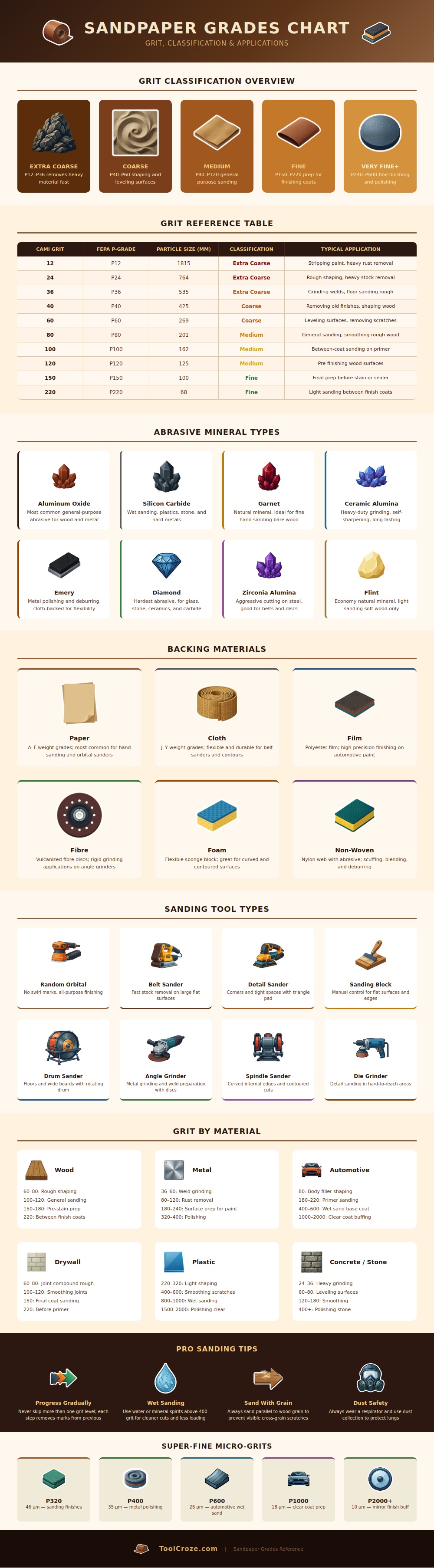
This chart breaks it down showing that your cutting power are dictated by particle size. Those big holes in a P12 sheet mean it can tear across old paint and rust with little effort. But you can’t take the same sheet and prep surface to be varnished. It’ll gouge so deeply you’ll have trenches full of dust forever.
When going from coarse to fine, it’s not only about getting smoother, it’s also about eliminating the scratch marks left behind by coarser paper. Going up a level skips the removal process and a fine grit isn’t going to erase coarse scratches. So pros demand slow progression. How fine it is alone isn’t enough.
You also need to know which abrasive minerals you’re working with. A workhorse general-purpose woodworking grit are aluminum oxide. It breaks along fracture lines that expose new sharp edges as you work. The result: It’s very effective at self-sharpening while sanding. More brittle (but sharper/harder), silicon carbide work well for wet sanding to cool and lubricate. This is used when removing automotive paint or polishing metal. Because it doesn’t clog the grain’s pores quite so much, garnet appears to be softer to the naked hand on raw wood. But really it’s picking the mineral based off what you’re cutting, rather than only the roughness of surface you want.
The type of backing material also dictates what kind of pressure you should of use with no harm done to either the workpiece or paper. For instance, cloth backings hold up to the pressure of a belt sander without tearing. Paper backings flex well and is ideal for orbital sanders that need to follow gentle curves. Use a thin A-weight paper on heavy duty belt machine and it will be ripped in seconds and probably tear the drum too. Film backings are dimensionally stable and waterproof, so they don’t stretch under moisture, critical for clear coating vehicles where uniformity is a must.
Match your tool to its grit range. Coarse grit on a belt sander takes off fast but it leaves a mess of gouges that will take hours by hand to smooth over. Medium and fine grit is the strength of the random orbital sander; its irregular motion eliminates swirl marks. Detail sanders does well in corners. Simple blocks also work well because they let you hold tighter than a power tool ever will. Never try to force a machine to get into corners where your hands would of did a better job controlling the pressure.
No one thinks about safety till it’s too late. Fine-finishes produce tiny dust particles. These particles is so small they go right through your lungs and deep into your lung tissue, past the protection of a regular dust mask. A good respirator isn’t optional equipment; it’s survival gear.
Always work with the wood’s grain when sanding. This will prevent ugly scratches in cross grain and ruin the look before you’ve applied any finish. Wet sanding at or above 400 grit cleans the paper clear of debris for a better cut. It also washes away swarf immediately for a smoother cut. Shape rough to start, shine smooth to finish, and don’t be in a hurry anywhere in between. Patience throughout the process determine if your work looks professional or amateur.
